US targets production, transfer of Iranian drones to Russia in new sanctions

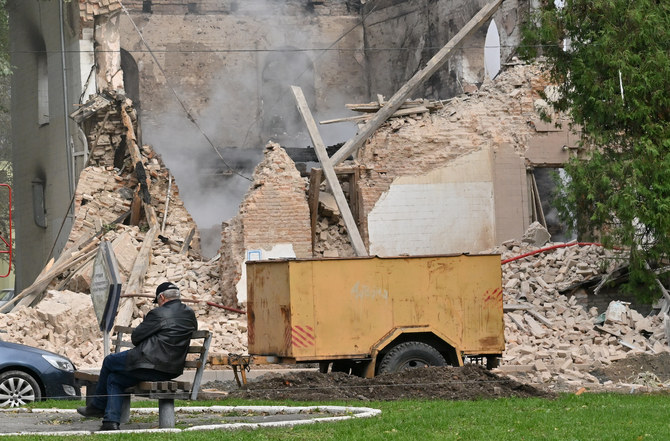
A local resident sits outside a building destroyed by Russian, Iranian-made, drones after an airstrike on Bila Tserkva, southwest of Kyiv. (File/AFP)
Short Url
Updated 15 November 2022
Follow

US targets production, transfer of Iranian drones to Russia in new sanctions

  • US Treasury Department in a statement said it imposed sanctions on the Shahed Aviation Industries Research Center
  • Treasury accused the center of being responsible for the design and production of Shahed-series drones being used by Russian forces in Ukraine

WASHINGTON: The United States on Tuesday imposed sanctions on companies it accused of being involved in the production of or transfer to Russia of Iranian drones that have been used in attacks on civilian infrastructure in Ukraine.
The US Treasury Department in a statement said it imposed sanctions on the Shahed Aviation Industries Research Center, accusing it of being responsible for the design and production of Shahed-series drones being used by Russian forces in Ukraine, as well as other companies.
Russia has managed to procure drones from Iran that have been used to attack cities and power infrastructure in Ukraine. Iranian military entities and industries are already under heavy US sanctions over Tehran’s nuclear development program
“As we have demonstrated repeatedly, the United States is determined to sanction people and companies, no matter where they are located, that support Russia’s unjustified invasion of Ukraine,” Treasury Secretary Janet Yellen said in the statement.
“Today’s action exposes and holds accountable companies and individuals that have enabled Russia’s use of Iranian-built UAVs to brutalize Ukrainian civilians,” she said, using the acronym for unmanned aerial vehicle.
Private military company Wagner group, Iran’s Islamic Revolutionary Guard Corps Aerospace Force, and Qods Aviation Industries — already under US sanctions — were also designated by the State Department in Tuesday’s move, the Treasury said.


Saudi, Arab and muslim ministers voice deep concern over worsening humanitarian crisis in Gaza

Updated 18 sec ago
Follow

Saudi, Arab and muslim ministers voice deep concern over worsening humanitarian crisis in Gaza

DUBAI: The foreign ministers of Saudi Arabia, Jordan, the United Arab Emirates, Indonesia, Pakistan, Turkiye, Qatar and Egypt expressed deep concern over the rapidly deteriorating humanitarian situation in the Gaza Strip on Friday.

A statement published by the Saudi Ministry of Foreign Affairs on X cited severe weather conditions and restrictions on humanitarian access as key factors exacerbating civilian suffering.

It said flooded camps, collapsed structures, damaged tents and exposure to cold temperatures had significantly increased risks to civilian lives, particularly among children, women, the elderly and those with medical vulnerabilities.

The ministers warned that the combination of malnutrition, poor shelter and lack of clean water has heightened the risk of disease outbreaks, placing additional strain on Gaza’s fragile health system.

The statement commended the efforts of UN agencies, particularly UNRWA, as well as international humanitarian organizations, for continuing to provide assistance under extremely challenging conditions.

The ministers stressed that humanitarian organizations must be allowed to operate in Gaza and the occupied West Bank in a sustained, predictable and unrestricted manner, describing any obstruction of their work as unacceptable.

The statement highlighted support for UN Security Council Resolution 2803 and US President Donald Trump’s “Comprehensive Plan,” as well as the ministers’ intention to contribute to efforts aimed at sustaining the ceasefire, ending the war in Gaza, and enabling early recovery and reconstruction.

The ministers also called on the international community to fulfill its legal and moral responsibilities, urging Israel, as the occupying power, to immediately lift restrictions on the entry and distribution of essential supplies, including shelter materials, medical aid, fuel, clean water and sanitation support.

They also demanded the immediate, full, and unhindered delivery of humanitarian assistance into Gaza through the UN and its agencies, the rehabilitation of critical infrastructure and hospitals, and the opening of the Rafah Crossing in both directions, in line with Trump’s plan.