

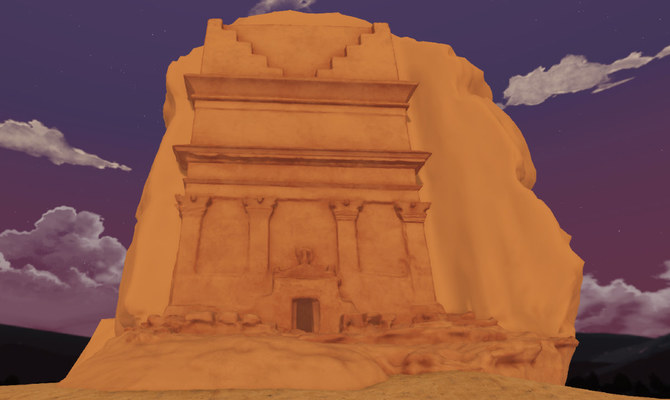
AlUla enters virtual world with Hegra’s Tomb of Lihyan

Short Url
Updated 14 November 2022
Follow

AlUla enters virtual world with Hegra’s Tomb of Lihyan

  • Move marks first metaverse debut of a UNESCO World Heritage Site

DUBAI: The Royal Commission for AlUla (RCU) has made its foray into the metaverse with an immersive 3D model of Hegra’s Tomb of Lihyan, son of Kuza, marking the first time a UNESCO World Heritage Site has been recreated for the metaverse.

The landmark will be available to online visitors on Decentraland, a virtual world platform that allows users to buy and visit virtual plots of land.

Visitors will be able to take a 360-degree tour of the 72-feet tall tomb, set among a realistic recreation of AlUla’s desert landscape. They will also be able to step through the tomb’s doorway, recreated in realistic dimensions, which is impossible in the real world.

The immersive experience will allow visitors to explore the site and activate information points to learn more about the history and story of the tomb.

Hegra in the metaverse will play host to several virtual events including a version of the AlUla Moments season, which includes various tours and activities aimed at showcasing the natural beauty of the region.

“RCU’s entry into the metaverse is a groundbreaking development in innovation and virtual reality tourism that connects the whole world with the wonders of AlUla,” said Amr Al-Madani, CEO of RCU.

“As the custodians of a unique culture, fascinating heritage and ancient traditions, the adoption of the latest technologies represents the next exciting step for RCU’s commitment to empower AlUla’s regeneration — moving from the physical to the digital realm and accessible to everyone, everywhere,” he added.

The move is part of KSA’s Vision 2030 National Transformation Program, which aims to empower technological development and innovation.

Frog, a global creative consultancy, was appointed to develop and facilitate Hegra’s debut in the metaverse and support the RCU’s innovation strategy across the Kingdom.


Trending: BBC report suggests sexual abuse and torture in UAE-run Yemeni prisons

Updated 02 February 2026
Follow

Trending: BBC report suggests sexual abuse and torture in UAE-run Yemeni prisons

  • The investigation was produced by British-Yemeni BBC journalist Nawal Al-Maghafi

LONDON: A recent BBC video report diving into what it says was UAE-run prison in Yemen has drawn widespread attention online and raised fresh questions about the role of the emirates in the war-torn country.

The report, published earlier this month and recently subtitled in Arabic and shared on social media, alleged that the prison — located inside a former UAE military base — was used to detain and torture detainees during interrogations, including using sexual abuse as a method.

The investigation was produced by British-Yemeni BBC journalist Nawal Al-Maghafi, who toured the site, looking into cells and what appear to be interrogation rooms.

Al-Maghafi said the Yemeni government invited the BBC team to document the facilities for the first time.

A former detainee, speaking anonymously, described severe abuse by UAE soldiers: “When we were interrogated, it was the worst. They even sexually abused us and say they will bring in the doctor. The ‘so-called’ doctor was an Emirati soldier. He beat us and ordered the soldiers to beat us too. I tried to kill myself multiple times to make it end.”

Yemeni information minister, Moammar al Eryani also appears in the report, clarifying that his government was unable to verify what occurred within sites that were under Emirati control.

“We weren’t able to access locations that were under UAE control until now,” he said, adding that “When we liberated it (Southern Yemen), we discovered these prisons, even though we were told by many victims that these prisons exist, but we didn't believe it was true.”

The BBC says it approached the UAE government for comment, however Abu Dhabi did not respond to its inquiries.

Allegations of secret detention sites in southern Yemen are not new. The BBC report echoes earlier reporting by the Associated Press (AP), which cited hundreds of men detained during counterterrorism operations that disappeared into a network of secret prisons where abuse was routine and torture severe.

In a 2017 investigation, the AP documented at least 18 alleged clandestine detention sites — inside military bases, ports, an airport, private villas and even a nightclub — either run by the UAE or Yemeni forces trained and backed by Abu Dhabi.

The report cited accounts from former detainees, relatives, civil rights lawyers and Yemeni military officials.

Following the investigation, Yemen’s then-interior minister called on the UAE to shut down the facilities or hand them over, and said that detainees were freed in the weeks following the allegations.

The renewed attention comes amid online speculation about strains between Saudi Arabia and the UAE over Yemen.