Uganda confirms Ebola case in country’s east as outbreak expands

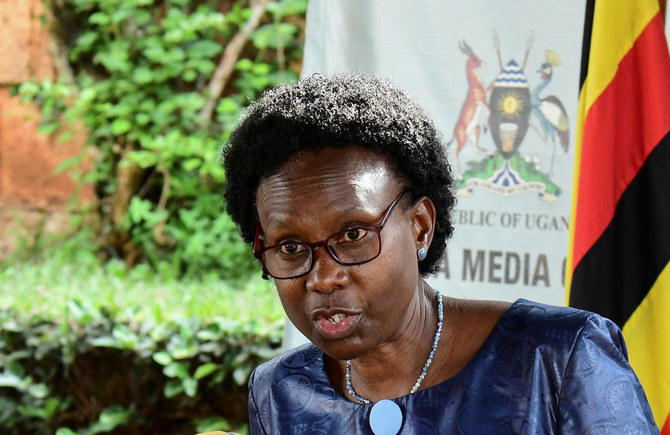
Uganda Minister of Health speaks during a news conference on the rising Ebola cases in Kampala. (REUTERS)
Short Url
Updated 14 November 2022
Follow

Uganda confirms Ebola case in country’s east as outbreak expands

  • Uganda records a total of 135 confirmed cases and 53 deaths

KAMPALA: An Ebola case has been confirmed in Jinja in eastern Uganda, the country’s health minister said on Sunday, the first time the outbreak has spread to a new region of the country from central Uganda where cases have been confined so far.
Authorities have been struggling to contain the highly infectious and deadly haemorrhagic fever since the epidemic was declared on Sept. 20.
Uganda has so far recorded a total of 135 confirmed cases and 53 deaths, according to the health ministry.
In a tweet, health minister Jane Ruth Aceng said the case in Jinja was of a 45-year-old man who died on Thursday. A sample that turned positive for Ebola had been obtained from the body by health workers at a private clinic where he had sought treatment.
“Contact tracing and epidemiological investigations have been activated,” Aceng said.
The virus circulating in Uganda is the Sudan strain of Ebola, for which there is no proven vaccine, unlike the more common Zaire strain that spread during recent outbreaks in neighboring Democratic Republic of Congo.
Ebola generally kills about half of the people it infects.


Ukraine accuses Hungary, Slovakia of ‘blackmail’ over threats to cut electricity

Updated 3 sec ago
Follow

Ukraine accuses Hungary, Slovakia of ‘blackmail’ over threats to cut electricity

KYIV: Ukraine’s Foreign Ministry condemned what it described as “ultimatums and blackmail” by the governments of Hungary and Slovakia on Saturday, after they threatened to stop electricity supplies to ​Ukraine unless Kyiv restarts flows of Russian oil.
Shipments of Russian oil to Hungary and Slovakia have been cut off since January 27, when Kyiv says a Russian drone strike hit pipeline equipment in Western Ukraine. Slovakia and Hungary say Ukraine is to blame for the prolonged outage.
Slovakia’s Prime Minister Robert Fico said on Saturday that he would cut off emergency electricity supplies to Ukraine within two days unless Kyiv resumes Russian oil transit to Slovakia over Ukraine’s ‌territory. Hungary’s Viktor ‌Orban made a similar threat days earlier.
The issue ​has ‌become ⁠one of ​the ⁠angriest disputes yet between Ukraine and two neighbors that are members of the EU and NATO but whose leaders have bucked the largely pro-Ukrainian consensus in Europe to cultivate warm ties with Moscow.
Slovakia and Hungary are the only two EU countries that still rely on significant amounts of Russian oil shipped via the Soviet-era Druzhba pipeline over Ukraine.
“Ukraine rejects and condemns the ultimatums and blackmail by the ⁠governments of Hungary and the Slovak Republic regarding energy supplies ‌between our countries,” the Ukrainian Foreign Ministry said ‌in a statement. “Ultimatums should be sent to the Kremlin, ​and certainly not to Kyiv.”

HUNGARY, ‌SLOVAKIA ARE KEY FOR UKRAINE’S ELECTRICITY IMPORTS
Between them, Hungary and Slovakia ‌have been providing around half of European emergency electricity exports to Ukraine, which Kyiv increasingly relies on as Russian attacks have damaged its grid.
“If oil supplies to Slovakia are not resumed on Monday, I will ask SEPS, the state-owned joint-stock company, to stop emergency electricity ‌supplies to Ukraine,” Fico said in a post on X.
Kyiv said that such actions were “provocative, irresponsible, and threaten the energy ⁠security of ⁠the entire region.”
Throughout the war that began with the full-scale Russian invasion whose fourth anniversary falls on Tuesday, Ukraine has allowed its territory to be used for Russian energy exports to Europe, which have been sharply curtailed but not halted.
Ukraine has proposed alternative transit routes to ship oil to Europe while emergency pipeline repair works are under way.
In a letter seen by Reuters, the Ukrainian mission to the EU proposed shipments through Ukraine’s oil transportation system or a maritime route, potentially including the Odesa-Brody pipeline linking Ukraine’s main Black Sea port to the EU.
Since October last year, Russia has intensified its drone and ​missile attacks on the Ukrainian ​energy system, knocking out electricity and heat and plunging millions of Ukrainians into long blackouts during bitterly cold winter temperatures.