

No decision yet on appointment of new Pakistan army chief — defense minister

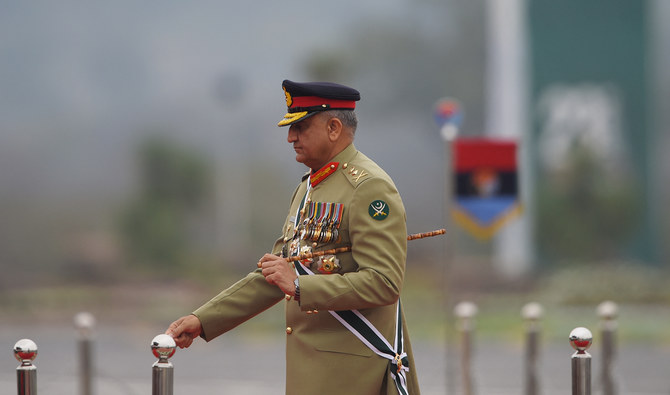
In this picture, taken on March 23, 2019, Pakistan Army Chief General Qamar Javed Bajwa arrives to attend the Pakistan Day parade in Islamabad. (Photo courtesy: AFP/File)
Short Url
Updated 14 November 2022
Follow

No decision yet on appointment of new Pakistan army chief — defense minister

  • General Bajwa due to retire on Nov. 29 amid speculation he might seek an extension, army denies this
  • New army chief’s selection has courted controversy after PM meetings with Nawaz Sharif in London

ISLAMABAD: Defense Minister Khawaja Asif on Monday said no decision had as yet been made on the appointment of a new army chief, arguably the most important office in the country after the prime ministers.

General Qamar Javed Bajwa has been the Pakistan army chief since November 2016 and is due to retire on November 29, following the final day of his second three-year term.

But the selection of the new army chief has been marred by controversy in recent months, with widespread speculation that Bajwa might take a second extension, though the military has repeatedly said the army chief would retire on time.

The debate was ignited again this past week with PM Sharif’s arrival in London for what local media reported were discussions with three time former premier Nawaz Sharif, founder of the ruling Pakistan Muslim League-Nawaz, on the new appointment.

Nawaz, who lives in self-exile in London, faces a slew of corruption cases back home. Opposition leaders have criticized the government and said Nawaz, who does not hold any public office and is wanted by the law, should not be part of discussions to pick the army chief.

“No decision yet,” Asif told reporters when asked if the new army chief had been selected.

When asked if PM Sharif had consulted on the selection with his self-exiled elder brother Nawaz Sharif in London, Asif said:

“This is the prime minister’s discretion, whatever he decides.”

But the widely publicized meetings between PM Sharif and Nawaz in London have added to the controversy surrounding the new army chief’s selection, with members of the opposition criticizing the premier for discussing the army chief’s appointment with an “absconder.”

Nawaz was removed from office in July 2017 by the Supreme Court for not declaring income from a company in United Arab Emirates.

The court also orders the National Accountability Bureau (NAB) to open a criminal trial into revelations in the Panama Paper revelations that showed the involvement of Sharif’s family in offshore companies, including two used to buy luxury homes in London.

In April, 2018, the Supreme Court further ruled Sharif was banned from political office for life and in July of that year, a NAB court convicted Sharif of corruption and sentenced him to 10 years in prison.

In November 2019, the three-time former PM left Pakistan on medical bail and has since not returned. He says the cases against him are politically motivated and claims innocence.

The appointment of the new army chief has also been in the spotlight as ex-premier Imran Khan, ousted in a parliamentary vote of no-confidence this April, insists the unelected government of PM Sharif, cobbled together through a parliamentary vote after his removal, does not have the right to appoint a new chief. He says the crucial selection should be made by the elected government after new polls are held.

Since his ouster, Khan has also criticized the army, and its chief, for not blocking his ouster and allowing his rivals led by now PM Sharif, who he considers corrupt, to come to power. The military says it remained apolitical in the transition.

Following Khan’s ouster, anti-military Twitter trends and posts calling on Bajwa to resign have become common in a country where the military was long feared and for decades ruled either through coups or as the invisible guiding hand in politics.

The criticism of the military had become so widespread in recent weeks, particularly after the mysterious killing of a pro-Khan Pakistani journalist in Kenya, that the head of Pakistan’s powerful spy agency, the Inter-Services Intelligence (ISI), made a rare public appearance last month to question Khan’s motives behind anti-army remarks and portraying Bajwa as a “traitor” among his followers.

This was the first time in Pakistan’s history that the head of the ISI has addressed a media briefing.

Khan’s party is currently leading a protest march on Islamabad to force Sharif into announcing early elections in the country. The government says polls will be held on time late next year.


Pakistani migrant’s death in UAE shatters economic future of families back home

Updated 11 sec ago
Follow

Pakistani migrant’s death in UAE shatters economic future of families back home

  • Pakistani driver killed by falling debris during missile interception in Abu Dhabi amid escalating Middle East conflict
  • Death leaves more than a dozen dependents in Pakistan without income after eight years of overseas work

ISLAMABAD: For days, Nazar Ali told his daughter-in-law a gentle lie: authorities in the United Arab Emirates (UAE) had confiscated all mobile phones and her husband, Mureeb Zaman, would call home as soon as he got it back.

In reality, Zaman, a 40-year-old Pakistani driver who had spent eight years working in the UAE to lift his family out of poverty, had already been killed by missile fragments during an aerial interception over Abu Dhabi amid an escalating conflict in the Middle East.

The conflict began on Feb. 28 after the United States and Israel launched strikes on Iran following weeks of escalating tensions between Tehran and its regional adversaries. The attacks triggered retaliatory drone and missile strikes by Iran targeting commercial and US-linked interests across the Gulf region, prompting air defense systems in several countries to intercept projectiles in the skies above major cities.

As interceptors met incoming missiles over the Emirati capital that night, falling debris struck Zaman, ending years of work he hoped would secure a better future for his five children in one of Pakistan’s most volatile regions.

“I found out the same day because nowadays it is the age of the Internet,” Ali, Zaman’s father, told Arab News during a condolence gathering at his residence last week.

“I myself was in the market at that time when I received the news [of his death], but I did not tell the family.”

Zaman had been supporting three households in his hometown in Pakistan’s northwestern Bannu district, including the family of his late younger brother. The region, located in the province of Khyber Pakhtunkhwa near the Afghan border, has witnessed a surge in militancy and counterinsurgency operations in recent years.

The 40-year-old was one of millions of Pakistani migrant workers in Gulf countries whose remittances are a vital source of foreign exchange for Pakistan’s fragile economy.

He is also among the first reported Pakistani casualties of the recent escalation. Two Pakistani nationals have been killed so far in aerial interceptions in the UAE, while another Pakistani died last week in a similar incident in Iranian waters off Pakistan’s southwestern Balochistan province, according to authorities.

Zaman’s life abroad was measured in long-distance phone calls and carefully saved earnings, while his wife, four daughters and one son lived in a single room at their family home in Bannu.

“He used to say that ‘When I come on Eid, God willing, I will build a room for you’,” Ali, his grieving father, said.

For Zaman, working in the UAE represented an escape from the insecurity and economic hardship that have long plagued his hometown, where militant attacks targeting security forces and civilians have periodically disrupted daily life.

Family members said he had hoped to return home for the upcoming Eid Al-Fitr holiday, encouraged by military operations against militant groups in Khyber Pakhtunkhwa that had raised hopes of greater stability in the region.

Adnan Gul, Zaman’s nephew, remembered his uncle as a warm and optimistic man who often spoke about building a better future for his family.

“His wish was to have a good home, a settled family, and a good, peaceful life,” Gul said.

Recalling Zaman as a cheerful man who loved food and rarely lost his temper, Gul added: “With younger people he behaved like one of them, and with elders he behaved like an elder.”

“He had many wishes, but unfortunately all those wishes remained unfulfilled.”

Now, Zaman’s death has left his extended family facing an uncertain future.

Relatives fear the loss of his income could disrupt the education of his children, who attend school while also memorizing the Holy Qur’an.

“He used to say these things and tell me ‘Not to tire yourself too much because you have already done a lot of hard work’,” Ali, his father, said, his voice trailing off.

“But such a day came that Allah Almighty once again left us [helpless], and we don’t know what will happen next.”

Buried in his hometown, Zaman is remembered through the photographs he shared with family members on WhatsApp and the Eid gifts he had already purchased before his death.

“When a person leaves this world, only memories remain,” Gul said.