

Afghan supreme leader orders full enforcement of Islamic law

People ride a motorbike past a banner placed by Taliban authorities asking women to wear a hijab, in Kandahar on June 16, 2022. (AFP/File)
Short Url
Updated 14 November 2022
Follow

Afghan supreme leader orders full enforcement of Islamic law

  • Public executions, stonings and floggings, and the amputation of limbs for thieves to be enforced
  • Women have seen hard-won rights evaporate in 15 months, increasingly squeezed out of public life

KABUL: Afghanistan’s supreme leader has ordered judges to fully enforce aspects of Islamic law that include public executions, stonings and floggings, and the amputation of limbs for thieves, the Taliban’s chief spokesman said.


Taliban spokesman Zabihullah Mujahid speaks during a press conference in Kabul on November 5, 2022. (Photo courtesy: AFP)

Zabihullah Mujahid tweeted late Sunday that the “obligatory” command by Hibatullah Akhundzada came after the secretive leader met with a group of judges.

Akhundzada, who has not been filmed or photographed in public since the Taliban returned to power in August last year, rules by decree from Kandahar, the movement’s birthplace and spiritual heartland.
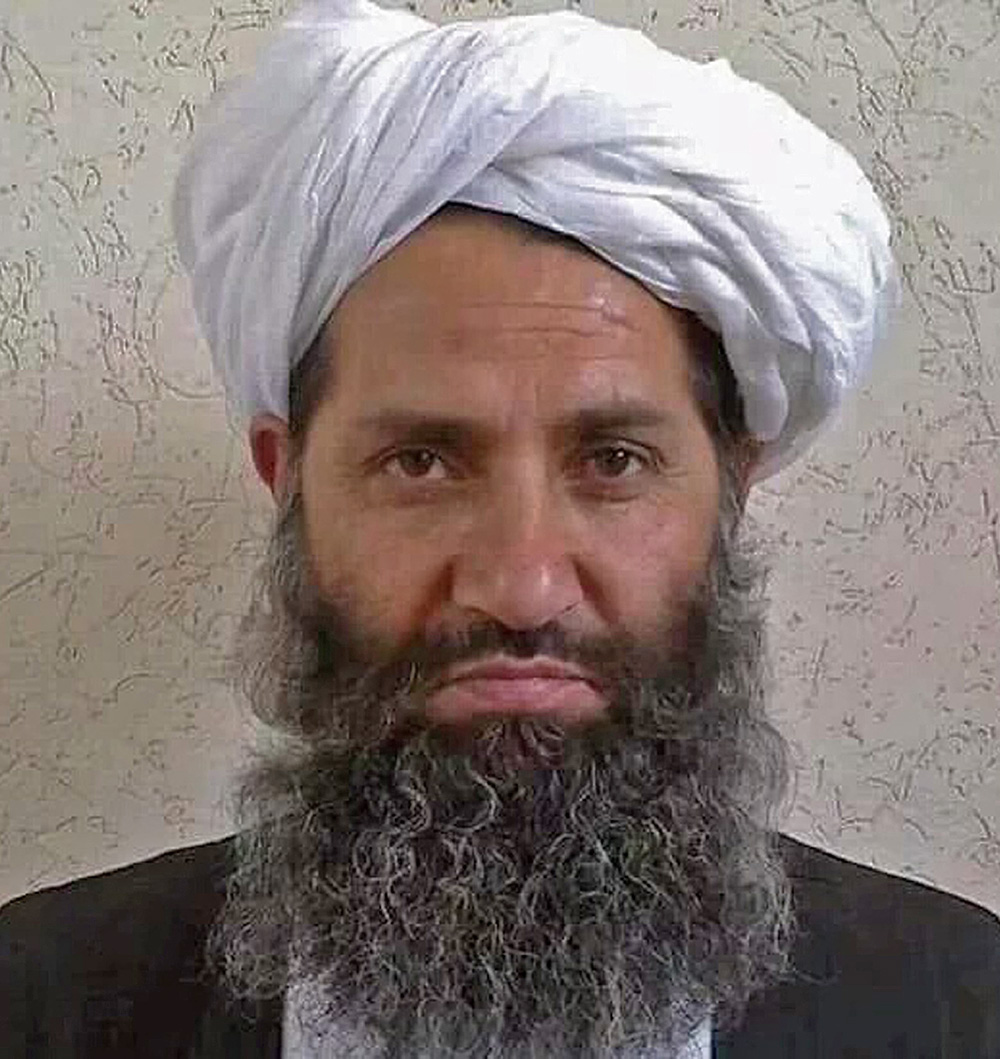


This undated handout photograph released by the Afghan Taliban on May 25, 2016 shows, Mullah Haibatullah Akhundzada posing for a photograph at an undisclosed location. (AFP/File)

The Taliban promised a softer version of the harsh rule that characterised their first stint in power, from 1996-2001, but have gradually clamped down on rights and freedoms.

“Carefully examine the files of thieves, kidnappers and seditionists,” Mujahid quoted Akhundzada as saying.

“Those files in which all the sharia (Islamic law) conditions of hudud and qisas have been fulfilled, you are obliged to implement.

“This is the ruling of sharia, and my command, which is obligatory.”

Mujahid was not available Monday to expand on his tweet.

Hudud refers to offenses which, under Islamic law, certain types of punishment are mandated, while qisas translates as “retaliation in kind” — effectively an eye for an eye.

Hudud crimes include adultery — and falsely accusing someone of it — drinking alcohol, theft, kidnapping and highway robbery, apostasy and rebellion.

Qisas covers murder and deliberate injury, among other things, but also allows for the families of victims to accept compensation in lieu of punishment.

Islamic scholars say crimes leading to hudud punishment require a very high degree of proof, including — in the case of adultery — confession, or being witnessed by four adult male Muslims.

Social media has been awash for over a year — and even recently — with videos and pictures of Taliban fighters meting out summary floggings to people accused of various offenses.

The Taliban have also several times displayed in public the bodies of kidnappers they said were killed in shootouts.

There have also been reports of adulterers being flogged in rural areas after Friday prayers, but independent verification is difficult to obtain.

Rahima Popalzai, a legal and political analyst, said the edict could be an attempt by the Taliban to harden a reputation they may feel has softened since they returned to power.

“If they really start to implement hudud and qisas, they will be aiming to create the fear society has gradually lost,” she told AFP.

She added the Taliban also wanted to burnish their Islamic credentials.

“As a theocratic setup, the Taliban want to strengthen their religious identity among Muslim countries.”

Women in particular have seen hard-won rights evaporate in the past 15 months, and they are increasingly being squeezed out of public life.

Most female government workers have lost their jobs — or are being paid a pittance to stay at home — while women are also barred from traveling without a male relative and must cover up with a burqa or hijab when out of the home.

In the past week, the Taliban also banned women from entering parks, funfairs, gyms and public baths.

During their first rule, the Taliban regularly carried out punishments in public — including floggings and executions at the national stadium.


Bangladesh mourns Khaleda Zia, its first woman prime minister

Updated 30 December 2025
Follow

Bangladesh mourns Khaleda Zia, its first woman prime minister

  • Ousted ex-premier Sheikh Hasina, who imprisoned Zia in 2018, offers condolences on her death
  • Zia’s rivalry with Hasina, both multiple-term PMs, shaped Bangladeshi politics for a generation

DHAKA: Bangladesh declared three days of state mourning on Tuesday for Khaleda Zia, its first female prime minister and one of the key figures on the county’s political scene over the past four decades.

Zia entered public life as Bangladesh’s first lady when her husband, Ziaur Rahman, a 1971 Liberation War hero, became president in 1977.

Four years later, when her husband was assassinated, she took over the helm of his Bangladesh Nationalist Party and, following the 1982 military coup led by Hussain Muhammad Ershad, was at the forefront of the pro-democracy movement.

Arrested several times during protests against Ershad’s rule, she first rose to power following the victory of the BNP in the 1991 general election, becoming the second woman prime minister of a predominantly Muslim nation, after Pakistan’s Benazir Bhutto.

Zia also served as a prime minister of a short-lived government of 1996 and came to power again for a full five-year term in 2001.

She passed away at the age of 80 on Tuesday morning at a hospital in Dhaka after a long illness.

She was a “symbol of the democratic movement” and with her death “the nation has lost a great guardian,” Bangladesh’s interim leader Muhammad Yunus said in a condolence statement, as the government announced the mourning period.

“Khaleda Zia was the three-time prime minister of Bangladesh and the country’s first female prime minister. ... Her role against President Ershad, an army chief who assumed the presidency through a coup, also made her a significant figure in the country’s politics,” Prof. Amena Mohsin, a political scientist, told Arab News.

“She was a housewife when she came into politics. At that time, she just lost her husband, but it’s not that she began politics under the shadow of her husband, president Ziaur Rahman. She outgrew her husband and built her own position.”

For a generation, Bangladeshi politics was shaped by Zia’s rivalry with Sheikh Hasina, who has served as prime minister for four terms.

Both carried the legacy of the Liberation War — Zia through her husband, and Hasina through her father, Sheikh Mujibur Rahman, widely known as the “Father of the Nation,” who served as the country’s first president until his assassination in 1975.

During Hasina’s rule, Zia was convicted in corruption cases and imprisoned in 2018. From 2020, she was placed under house arrest and freed only last year, after a mass student-led uprising, known as the July Revolution, ousted Hasina, who fled to India.

In November, Hasina was sentenced to death in absentia for her deadly crackdown on student protesters and remains in self-exile.

Unlike Hasina, Zia never left Bangladesh.

“She never left the country and countrymen, and she said that Bangladesh was her only address. Ultimately, it proved true,” Mohsin said.

“Many people admire Khaleda Zia for her uncompromising stance in politics. It’s true that she was uncompromising.”

On the social media of Hasina’s Awami League party, the ousted leader also offered condolences to Zia’s family, saying that her death has caused an “irreparable loss to the current politics of Bangladesh” and the BNP leadership.

The party’s chairmanship was assumed by Zia’s eldest son, Tarique Rahman, who returned to Dhaka just last week after more than 17 years in exile.

He had been living in London since 2008, when he faced multiple convictions, including an alleged plot to assassinate Hasina. Bangladeshi courts acquitted him only recently, following Hasina’s removal from office, making his return legally possible.

He is currently a leading contender for prime minister in February’s general elections.

“We knew it for many years that Tarique Rahman would assume his current position at some point,” Mohsin said.

“He should uphold the spirit of the July Revolution of 2024, including the right to freedom of expression, a free and fair environment for democratic practices, and more.”