Trudeau agrees unlimited flights between India and Canada as ties deepen with Indo-Pacific region

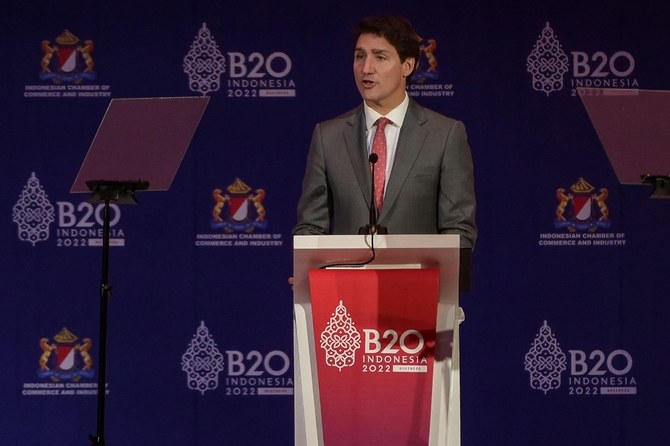
Canadian Prime Minister Justin Trudeau speaking at the B20 conference (AFP)
Short Url
Updated 14 November 2022
Follow

Trudeau agrees unlimited flights between India and Canada as ties deepen with Indo-Pacific region

RIYADH: Canada and India have signed a deal to allow unlimited flights between the two countries as the North American nation steadily deepens its economic and trade relations in the Indo-Pacific region, Canadian Prime Minister Justin Trudeau has announced. 

During his keynote address, at the B20 conference in Bali, Indonesia, on Nov. 14, Trudeau said that Canada is seeking to strengthen its engagement in the region through major investments.

“For example, we are establishing a new Canadian trade gateway in South East Asia that will help Canadian businesses expand into new markets, linking them to business networks in this dynamic region,” Trudeau said.

He added: “Canada and the Indo-Pacific region also share strong ties between our people, and we will make these ties even stronger.” 

Trudeau noted that Indonesia’s rapid growth presents enormous opportunities for investments and businesses. 

He continued: “Last week we announced our Indo-Pacific strategy. We are deepening our existing friendships in the region, seeking new allies and promoting stability. Business leaders are key to individual and collective success.” 

He also blamed Russia for the unprecedented food and energy crisis globally, post the war in Ukraine.

“Russia’s brutal war in Ukraine resulted in a food and energy crisis. It is disrupting supply chains and raising the cost of living. Challenges posed by Russia’s war in Ukraine are real, and only through collaboration between businesses, governments and civil society, we can create real lasting solutions,” Trudeau said. 

According to Trudeau, technology, “if used right,” will help build a better future for everyone. He further pointed out that all the technological developments which are happening in the world should be people-centered. 

“Whenever we talk about industry 4.0 and the prosperity it can unlock, we have to remember to always put people at the center of everything we do. Technology needs to make people’s lives comfortable,” he added. 

Trudeau went on and pointed out that new technologies can make the global economy and international trade more accessible for people everywhere. 

“Emerging technologies are radically transforming business and business models, and are unleashing new market opportunities. We also have to make sure that smaller economies and businesses can fully access global market economies,” he added. 

Talking about the renewable energy transition in Canada, the prime minister said that the nation’s electricity grid is already over 80 percent clean and is on its way to achieving 100 percent.




Trucks and vehicles crossing Saudi Arabia’s ports up 24% in 2025, reaching 4.7m

Updated 7 sec ago
Follow

Trucks and vehicles crossing Saudi Arabia’s ports up 24% in 2025, reaching 4.7m

RIYADH: The number of trucks and vehicles entering and exiting through Saudi customs ports jumped to 4.7 million in 2025, recording annual growth of 24 percent compared with 2024, according to the Zakat, Tax and Customs Authority in statements to Al Eqtisadiah. 

Specialists in the logistics services sector attributed the increase to transformation in the field, starting with raising the efficiency of ports, speeding up procedures, and adopting unified platforms to facilitate processes for importers and exporters. 

The authority reported that the total number of trucks and vehicles that crossed Saudi customs ports over the past three years exceeded 11.8 million trucks and vehicles, with an annual average of 4 million, of which 6.3 million were incoming vehicles and 5.5 million were outgoing. 

Five ports recorded the largest share of truck and vehicle traffic: Al Batha, Al Haditha, King Fahd Causeway, Al Khafji, and Salwa, which are all considered key arteries for interregional and regional trade movement. 

The authority indicated that customs ports completed procedures last year for 2.6 million trucks and vehicles arriving in Saudi Arabia, in addition to 2.1 million trucks and vehicles departing, reflecting the efficiency of procedures and the speed of completing customs operations. 

On the operational side, land, sea, and air ports completed procedures for 2.5 million containers and cleared 7 million customs declarations, alongside the authority’s expansion in developing procedures and programs that support the flow of goods. 

Chief among these was the launch of the updated version of the Saudi Authorized Economic Operator Program, with the participation of 14 government entities. 

The program contributed to increasing the number of registered establishments from 560 establishments in 2024 to 753 by the end of 2025, a growth rate of 34.5 percent, enhancing the reliability of supply chains and raising the efficiency of logistics operations in line with global best practices. 

Smart platforms and ports behind the growth 

Supply chain and operations management consultant Khaled Al-Zahrani explained that these positive indicators do not only reflect growth in traffic volume, but also expansion in the application of digital solutions and the linking of entities through unified platforms, which helped reduce operating costs for importers and exporters. 

Logistics specialist Nashmi Al-Harbi said that the efficiency of customs ports indicates the development of digital and operational infrastructure through faster procedures and building trust with trading partners, which reduces customs clearance time and enhances supply chain flexibility. 

In turn, Sami Al-Otaibi, a specialist in logistics services and customs clearance, explained that infrastructure projects and smart ports have begun to yield tangible results on the ground.