

Cricket great Imran, PM Sharif praise 'brave' Pakistan after T20 World Cup heartbreak

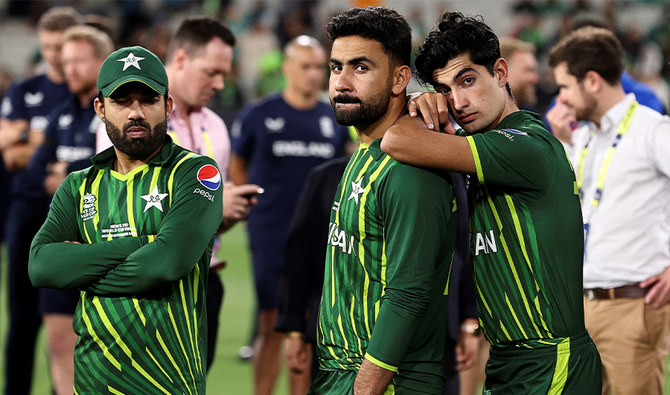
Pakistan's Muhammad Rizwan (L) and Naseem Shah (R) look on after the ICC men's Twenty20 World Cup 2022 Final between Pakistan and England at Melbourne Cricket Ground (MCG) in Melbourne on November 13, 2022. (AFP)
Short Url
Updated 14 November 2022
Follow

Cricket great Imran, PM Sharif praise 'brave' Pakistan after T20 World Cup heartbreak

  • Pakistan made a lion-hearted effort to defend below-par total of 137-8 at the Melbourne Cricket Ground
  • Were dealt a body blow when pace spearhead Shaheen Afridi injured himself while taking a catch

ISLAMABAD: Prime Minister Shehbaz Sharif and cricket great Imran Khan led tributes to Pakistan's valiant fight in Sunday's Twenty20 World Cup final against England saying the country was proud of the team led by Babar Azam. 

Pakistan made a lion-hearted effort to defend a below-par total of 137-8 at the Melbourne Cricket Ground (MCG) but were dealt a body blow when pace spearhead Shaheen Afridi injured himself while taking a catch and eventually hobbled off the field without completing his quota of four overs. 

Jos Buttler's England prevailed by five wickets at the MCG to claim their second T20 World Cup title but Pakistan's never-say-die attitude drew praise from fans that included the country's top politicians. 

"Team Pakistan fought back hard & brave. Great bowling performance..." tweeted Prime Minister Sharif. 

"We are proud of our boys in green for making it to the final match of this mega tournament." 

Pakistan, at the same MCG 30 years ago, had beaten England in the final of the 50-overs world Cup under Khan's inspiring leadership. 

The cricketer-turned-politician was happy at least Babar's team showed the same fighting spirit. 

"I know the country has suffered a heartbreak, because we had hoped we'd win the World Cup," Khan said in a video shared by Dawn newspaper. 

"Win and loss are part and parcel of the game. I used to tell my team to fight till the last ball, try your best...They fought really hard till the end." 

Former all-rounder Khan said Afridi's injury had a major bearing on the outcome of the final. 

"No one can do anything about that and unfortunately it happened at a time when the match was at a very important stage and Shaheen could have made a difference." 

Another former captain, Waqar Younis, said Pakistan could be proud of their display in Australia. 

"Chin-up boys! You guys made us all very Proud. Better Luck next time," he tweeted. 


Rating firm S&P says it won’t rush Iran war downgrades, sees risks for countries like Pakistan

Updated 12 March 2026
Follow

Rating firm S&P says it won’t rush Iran war downgrades, sees risks for countries like Pakistan

  • Agency says it is monitoring indebted energy importers as higher oil prices strain finances
  • Gulf economies seen better placed to weather shock, though Bahrain flagged as vulnerable

LONDON: S&P Global ‌said it would not make any knee-jerk sovereign rating cuts following the outbreak of war in the ​Middle East, but warned on Thursday that soaring oil and gas prices were putting a number of already cash-strapped countries at risk.

The firm’s top analysts said in a webinar that the conflict, which has involved US and Israeli strikes ‌against Iran and Iranian ‌strikes against Israel, ​US ‌bases ⁠and Gulf ​states, ⁠was now moving from a low- to moderate-risk scenario.

Most Gulf countries had enough fiscal buffers, however, to weather the crisis for a while, with more lowly rated Bahrain the only clear exception.

Qatar’s banking sector could ⁠also struggle if there were significant ‌deposit outflows in ‌reaction to the conflict, although there ​was no evidence ‌of such strains at the moment, they ‌said.

“We don’t want to jump the gun and just say things are bad,” S&P’s head global sovereign analyst, Roberto Sifon-Arevalo, said.

The longer the crisis ‌was prolonged, though, “the more difficult it is going to be,” he ⁠added.

Sifon-Arevalo ⁠said Asia was the second-most exposed region, due to many of its countries being significant Gulf oil and gas importers.

India, Thailand and Indonesia have relatively lower reserves of oil, while the region also had already heavily indebted countries such as Pakistan, Bangladesh and Sri Lanka whose finances would be further hurt by rising energy prices.

“We ​are closely monitoring ​these (countries) to see how the credit stories evolve,” Sifon-Arevalo said.