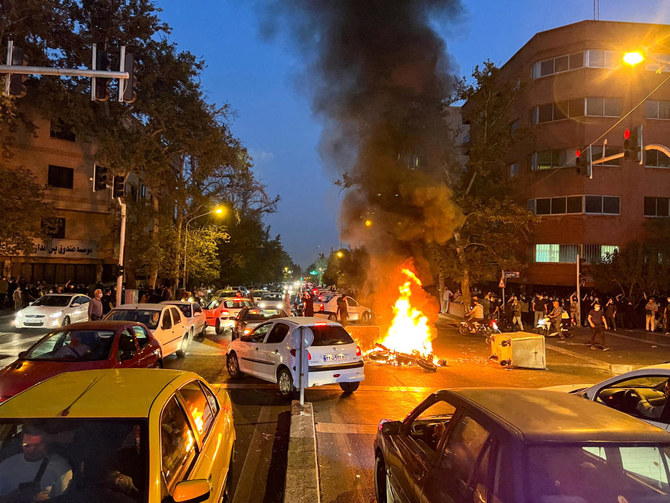
GENEVA: The UN Human Rights Council announced on Monday it would hold an urgent session this month on Iran, where a brutal crackdown on mass protests has left hundreds dead.
The United Nations’ highest rights body said a special session on “the deteriorating human rights situation” in Iran would be held on November 24.
The decision comes after the German and Icelandic ambassadors to the UN in Geneva submitted a request for such a meeting late on Friday.
The support of 16 of the Human Rights Council’s 47 members — more than a third — is required to convene a special session outside the three regular ones held each year.
So far, 44 countries, including 17 Council members, have backed the call, the body said.
The request follows eight weeks of protests in Iran, sparked by the death of 22-year-old Mahsa Amini, after she was arrested for an alleged breach of the country’s strict dress rules for women based on Islamic sharia law.
At least 326 people have been killed in the crackdown on the protests, according to the Oslo-based group Iran Human Rights (IHR), as the demonstrations have grown into a broad movement against the theocracy that has ruled Iran since the 1979 fall of the shah.
Thousands of peaceful protesters have also been arrested, according to UN rights experts, including many women, children, lawyers, activists and journalists.

UN rights council to hold urgent session on Iran
https://arab.news/crvjf
UN rights council to hold urgent session on Iran
- Decision comes after the German and Icelandic ambassadors to the UN in Geneva submitted a request for such a meeting late on Friday
- So far, 44 countries, including 17 Council members, have backed the call
EU warns Israel suspending Gaza NGOs would block ‘life-saving aid’
BRUSSELS: The EU warned Wednesday that Israel's threat to suspend several aid groups in Gaza from January would block "life-saving" assistance from reaching the population.
"The EU has been clear: the NGO registration law cannot be implemented in its current form," EU humanitarian chief Hadja Lahbib posted on X, after Israel said several groups would be barred for failing to provide details of their Palestinian employees.
"IHL (international humanitarian law) leaves no room for doubt: aid must reach those in need," Lahbib wrote.
NGOs had until December 31 to register under the new framework, which Israel says aims to prevent "hostile actors or supporters of terrorism" operating in the Palestinian territories, rather than impede aid.
Israeli authorities announced Tuesday that organisations which "refused to submit a list of their Palestinian employees in order to rule out any links to terrorism" had received notice that their licences would be revoked as of January 1, with an obligation to cease all activities by March 1.
Israel has not disclosed the number of groups facing a ban, but it has specifically called out Doctors Without Borders (MSF) for failing to meet the rules. It accused the medical charity of employing two individuals with links to Palestinian armed groups.
The Israeli government told AFP earlier this month that 14 NGO requests had been rejected as of November 25.
Several NGOs said the new rules will have a major impact on aid distribution in Gaza, with humanitarian organisations saying the amount of aid entering Gaza remains inadequate.
While an accord for a ceasefire that started on October 10 stipulated the entry of 600 trucks per day, only 100 to 300 are carrying humanitarian aid, according to NGOs and the United Nations.
COGAT, the Israeli defence ministry body responsible for Palestinian civilian affairs, said last week that on average 4,200 aid trucks enter Gaza weekly, which corresponds to around 600 daily.