NUSA DUA, Indonesia: President Joe Biden objected directly to China’s “coercive and increasingly aggressive actions” toward Taiwan during the first in-person meeting of his presidency with Xi Jinping, as the two superpower leaders aimed on Monday to “manage” their differences in the competition for global influence.
The nearly three-hour meeting was the highlight of Biden’s weeklong, round-the-world trip to the Middle East and Asia, and came at a critical juncture for the two countries amid increasing economic and security tensions. Speaking at a news conference afterward, Biden said that when it comes to China, the US would “compete vigorously, but I’m not looking for conflict.”
He added: “I absolutely believe there need not be a new Cold War” between America and the rising Asian power.
Biden reiterated US support for its longstanding “One China” policy, which recognizes the government in Beijing — while allowing for informal American relations and defense ties with Taipei, and “strategic ambiguity” over whether the US would respond militarily if the island were attacked. He also said that despite China’s recent saber rattling, he does not believe “there’s any imminent attempt on the part of China to invade Taiwan.”
Xi, according to the Chinese government’s account of the meeting, “stressed that the Taiwan question is at the very core of China’s core interests, the bedrock of the political foundation of China-US relations, and the first red line that must not be crossed in China-US relations.”
Biden said he and Xi also discussed Russia’s aggression against Ukraine and “reaffirmed our shared belief” that the use or even the threat of nuclear weapons is “totally unacceptable.” That was a reference to Moscow’s thinly veiled threats to use atomic weapons as its nearly nine-month invasion of Ukraine has faltered.
Chinese officials have largely refrained from public criticism of Russia’s war, although Beijing has avoided direct support of the Russians, such as supplying arms.
While there were no watershed breakthroughs, the Biden-Xi meeting brought each side long-sought, if modest, gains. In addition to the shared condemnation of Russian nuclear threats, Biden appeared to secure from Xi the resumption of lower-level cooperation from China on a range of shared global challenges. Meanwhile, Xi, who has aimed to establish China as a geopolitical peer of the US, got symbolic home turf for the meeting as well as Biden’s forceful One China policy commitment.
The White House said Biden and Xi agreed to “empower key senior officials” to work on areas of potential cooperation, including tackling climate change and maintaining global financial, health and food stability. Beijing had cut off such contacts with the US in protest of House Speaker Nancy Pelosi’s trip to Taiwan in August.
China and the US are the world’s worst climate polluters, and their one-on-one climate contacts are seen as vital to staving off some of the most dire scenarios of climate change. Biden’s first stop on his long overseas trip was in Egypt for a major climate conference.
The two leaders agreed to have US Secretary of State Antony Blinken travel to Beijing to continue discussions.
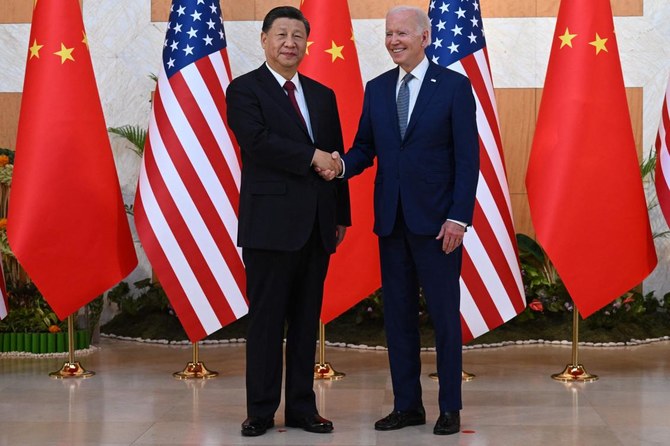
Xi and Biden warmly greeted each other with a handshake at a luxury resort hotel in Indonesia, where they are attending the Group of 20 summit of large economies.
“As the leaders of our two nations, we share responsibility, in my view, to show that China and the United States can manage our differences, prevent competition from becoming anything ever near conflict, and to find ways to work together on urgent global issues that require our mutual cooperation,” Biden said to open the meeting.
Xi called on Biden to “chart the right course” and “elevate the relationship” between China and the US He said he wanted a “candid and in-depth exchange of views.”
Both men entered the highly anticipated meeting with bolstered political standing at home. Democrats triumphantly held onto control of the US Senate, with a chance to boost their ranks by one in a runoff election in Georgia next month, while Xi was awarded a third five-year term in October by the Communist Party’s national congress, a break with tradition.
But relations between the two powers have grown more strained under successive American administrations, with economic, trade, human rights and security differences at the fore.
As president, Biden has repeatedly taken China to task for human rights abuses against the Uyghur people and other ethnic minorities, crackdowns on democracy activists in Hong Kong, coercive trade practices, military provocations against self-ruled Taiwan and differences over Russia and Ukraine.
The White House said Biden specifically mentioned US concerns about China’s actions in Xinjiang, Tibet, and Hong Kong, and the plight of Americans it considers “wrongfully detained” or subject to exit bans in China.
Taiwan has emerged as one of the most contentious issues. Multiple times in his presidency, Biden has said the US would defend the island — which China has eyed for eventual unification — in case of a Beijing-led invasion. But administration officials have stressed each time that the US China policy has not changed.
Pelosi’s trip prompted China, officially the People’s Republic of China, to retaliate with military drills and the firing of ballistic missiles into nearby waters.
The White House said Biden “raised US objections to the PRC’s coercive and increasingly aggressive actions toward Taiwan, which undermine peace and stability across the Taiwan Strait and in the broader region, and jeopardize global prosperity.”
In the meeting, Biden said China’s economic practices “harm American workers and families, and workers and families around the world,” the White House said.
The meeting came just weeks after the Biden administration blocked exports of advanced computer chips to China — a national security move that bolsters US competition against Beijing.
Xi’s government said he condemned such moves, saying, “Starting a trade war or a technology war, building walls and barriers, and pushing for decoupling and severing supply chains run counter to the principles of market economy and undermine international trade rules.”
Although the two men have held five phone or video calls during Biden’s presidency, White House officials said those encounters were no substitute for an in-person meeting. They said sitting down with Xi was all the more important after the Chinese leader strengthened his grip on power with a third term and because lower-level Chinese officials have been unable or unwilling to speak for their leader.
White House officials and their Chinese counterparts spent weeks negotiating details of the meeting, which was held at Xi’s hotel with translators providing simultaneous interpretation through headsets. Each leader was flanked by nine N-95 mask-wearing aides, and in the case of Xi, at least one official newly elevated in the recent Congress to its top leadership.
US officials were eager to see how Xi approached the meeting after consolidating his position as the unquestioned leader of the state — whether that made him more or less likely to seek out areas of cooperation.
Biden said Xi was as he’s always been.
“I didn’t find him more confrontational or more conciliatory,” Biden said. “I found him the way he’s always been, direct and straightforward.”


![]()

Biden, Xi clash on Taiwan but try to ‘manage’ differences
Short Url
https://arab.news/bbs47
Biden, Xi clash on Taiwan but try to ‘manage’ differences
- Both leaders stress the need to manage differences and avoid conflict


Latest updates





© 2026 SAUDI RESEARCH & PUBLISHING COMPANY, All Rights Reserved And subject to Terms of Use Agreement.