

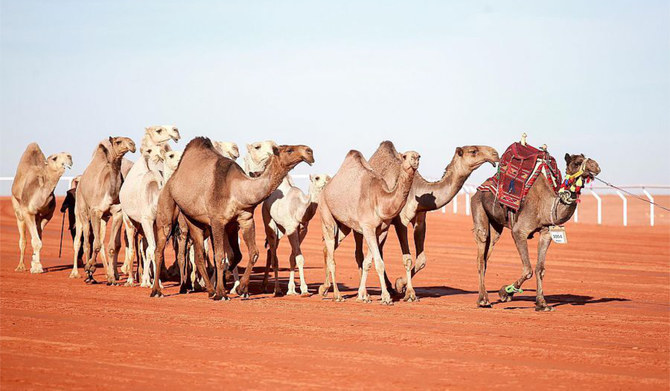
Camel race named after Princess Nourah bint Abdulrahman

It was decided by the chairman of the Camel Club board of directors that the women's race would be named after Princess Nourah bint Abdulrahman. (SPA)
Short Url
Updated 14 November 2022
Follow

Camel race named after Princess Nourah bint Abdulrahman

  • The women’s race was approved for the first time for the festival’s sixth edition, during which 38 women participated, 10 of whom were qualified, and five participants ended up winning

RIYADH: The chairman of the board of directors of the Camel Club, Fahd bin Falah bin Hathleen, approved naming the women’s race at the seventh King Abdulaziz Camel Festival after Princess Nourah bint Abdulrahman, sister of the founder of Saudi Arabia, King Abdulaziz.

The Princess Nourah bint Abdulrahman women’s race will be handled as a royal race, and the first-place winner is not entitled to delegate another to receive the award. The winner will also have the honor of receiving their award from King Salman at the closing ceremony.

The women’s race was approved for the first time for the festival’s sixth edition, during which 38 women participated, 10 of whom were qualified, and five participants ended up winning.

The contest involved Al-Mughateer camels, a famous Arabian breed. Bedouin tribes divide Al-Mughateer camels into colors ranging from white shades to yellow and red, and each color has a name.

Haya Al-Askar ranked first, followed by Rasma Al-Dosari in second, Malath bint Aoun in third, Lamia Al-Rashidi in fourth and Dalal bint Abdullah Al-Otaibi in fifth place.

This race promoted strong competition and Saudi women’s participation in traditional dress. The participation of women at the festival is the beginning of broader plans by the club to expand the presence of women in all manner of camel-related events.

Princess Nourah bint Abdulrahman was born in Riyadh in 1875 and died in 1950. She was the daughter of Abdulrahman bin Faisal, and the eldest sister of King Abdulaziz.

She was known for the positive role she played in her brother’s life, who in turn had a lot of affection and appreciation for her. King Abdulaziz used to confide in her and consult her on many matters; the two had a strong bond since childhood.



Red Sea Global unveils scientific model for regenerative tourism worldwide

Updated 45 min 58 sec ago
Follow

Red Sea Global unveils scientific model for regenerative tourism worldwide

  • The report details the model’s rollout at “The Red Sea” and “AMAALA” destinations, backed by studies covering 8 marine habitats

TABUK: Red Sea Global (RSG) has unveiled a science-based model aimed at achieving a 30 percent net positive conservation benefit across its tourism destinations by 2040. 

The framework is now available for global adoption, according to a statement released by RSG.

Owned by Saudi Arabia’s Public Investment Fund (PIF), Red Sea Global is the multi-project developer behind ambitious regenerative tourism destinations like “The Red Sea” and “AMAALA.” 

As a cornerstone of the Kingdom’s Vision 2030, the company aims to diversify the national economy while setting new global benchmarks for sustainable, nature-positive development.

CEO John Pagano stated that openly sharing this detailed approach will help elevate the global tourism sector and secure a healthier environment for future generations.
 

Map showing the boundaries of the Red Sea Zone. (Graphic from the RSG report)

The cornerstone of this initiative is the proprietary SIIG Model, a four-step framework:
• Survey: Establish biodiversity baselines and monitor long-term changes.
• Identify: Assess risks to priority habitats and species.
• Intervene: Execute evidence-based actions, such as regulating fishing and enhancing natural habitats.
• Gain: Measure and verify biodiversity improvements.

The report details the model’s rollout at “The Red Sea” and “AMAALA” destinations, backed by extensive 2022–2023 environmental baseline studies covering eight marine habitats and priority species groups during 2022 and 2023. 

A major intervention is the 5,015-square-kilometer Fishery Management Area in Al-Wajh Lagoon. The plan reserves 38 percent of the area for priority conservation—protecting 62 percent of local coral reefs—while allocating 61 percent for sustainable fishing.

According to scientific modeling, eliminating fishing in high-protection zones could increase reef fish populations by 113 percent, sharks and rays by 72 percent, and marine mammals by 24 percent. These measures are expected to boost coral resilience, support ecosystem recovery, and protect vulnerable species like sea turtles and seabirds.
Ihab Kindi, RSG’s Red Sea Destination Executive Director, called the data-driven model a practical roadmap for large-scale marine recovery. The complete methodology is available in the new report, “The SIIG Model: A Roadmap Toward Achieving Measurable Conservation Gains.”