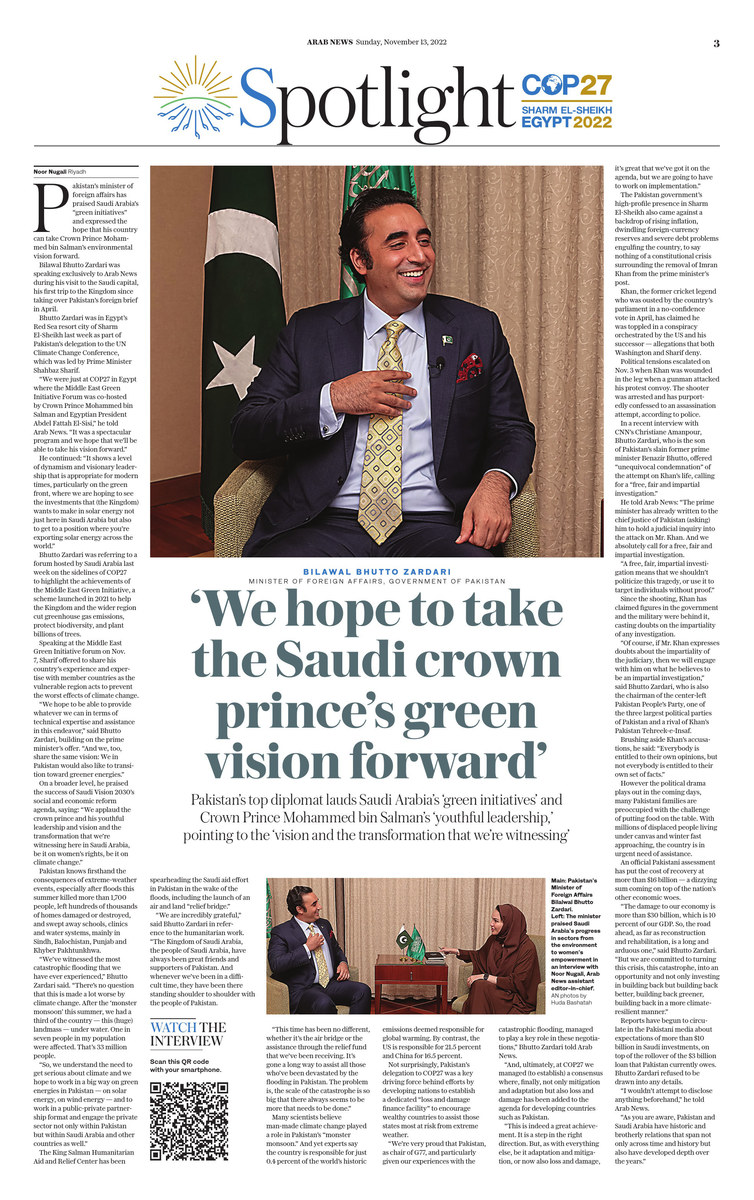
RIYADH: Pakistan’s minister of foreign affairs has praised Saudi Arabia’s “green initiatives” and expressed the hope that his country can take Crown Prince Mohammed bin Salman’s environmental vision forward.
Bilawal Bhutto Zardari was speaking exclusively to Arab News during a two-day visit to the Saudi capital, his first trip to the Kingdom since taking over Pakistan’s foreign brief in April.
Bhutto Zardari was in Egypt’s Red Sea resort city of Sharm El-Sheikh last week as part of Pakistan’s delegation to the United Nations Climate Change Conference, which was led by Prime Minister Shahbaz Sharif.
“We were just at COP27 in Egypt where the Middle East Green Initiative Forum was co-hosted by Crown Prince Mohammed bin Salman and Egyptian President Abdel-Fattah El-Sisi,” he told Arab News. “It was a spectacular program and we hope that we’ll be able to take his vision forward.”
He continued: “It shows a level of dynamism and visionary leadership that is appropriate for modern times, particularly on the green front, where we are hoping to see the investments that (the Kingdom) wants to make in solar energy not just here in Saudi Arabia but also to get to a position where you’re exporting solar energy across the world.”
Bhutto Zardari was referring to a forum hosted by Saudi Arabia last week on the sidelines of COP27 to highlight the achievements of the Middle East Green Initiative, a scheme launched in 2021 to help the Kingdom and the wider region cut greenhouse gas emissions, protect biodiversity, and plant billions of trees.

Pakistan’s minister of foreign affairs Bilawal Bhutto Zardari speaking with Arab News Assistant Editor-in-Chief Noor Nugali. (AN Photo/Huda Bashatah)
Speaking at the Middle East Green Initiative forum on Nov. 7, the Pakistani prime minister offered to share his country’s experience and expertise with member countries as the vulnerable region acts to prevent the worst effects of climate change.
“We hope to be able to provide whatever we can in terms of technical expertise and assistance in this endeavor,” said Bhutto Zardari, building on Sharif’s offer. “And we, too, share the same vision: We in Pakistan would also like to transition toward greener energies.”
On a broader level, he praised the success of Saudi Vision 2030’s social and economic reform agenda, saying: “We applaud the crown prince and his youthful leadership and vision and the transformation that we’re witnessing here in Saudi Arabia, be it on women’s rights, be it on climate change.”
Pakistan knows firsthand the consequences of extreme-weather events, especially after floods this summer killed more than 1,700 people, left hundreds of thousands of homes damaged or destroyed, and swept away schools, clinics and water systems, mainly in Sindh, Balochistan, Punjab and Khyber Pakhtunkhwa.
“We’ve witnessed the most catastrophic flooding that we have ever experienced,” Bhutto Zardari said. “There’s no question that this is made a lot worse by climate change. After the ‘monster monsoon’ this summer, we had a third of the country — this (huge) landmass — under water. One in seven people in my population were affected. That’s 33 million people.
“So, we understand the need to get serious about climate and we hope to work in a big way on green energies in Pakistan — on solar energy, on wind energy — and to work in a public-private partnership format and engage the private sector not only within Pakistan but within Saudi Arabia and other countries as well.”
The King Salman Humanitarian Aid and Relief Center has been spearheading the Saudi aid effort in Pakistan in the wake of the floods, including the launch of an air and land “relief bridge.”
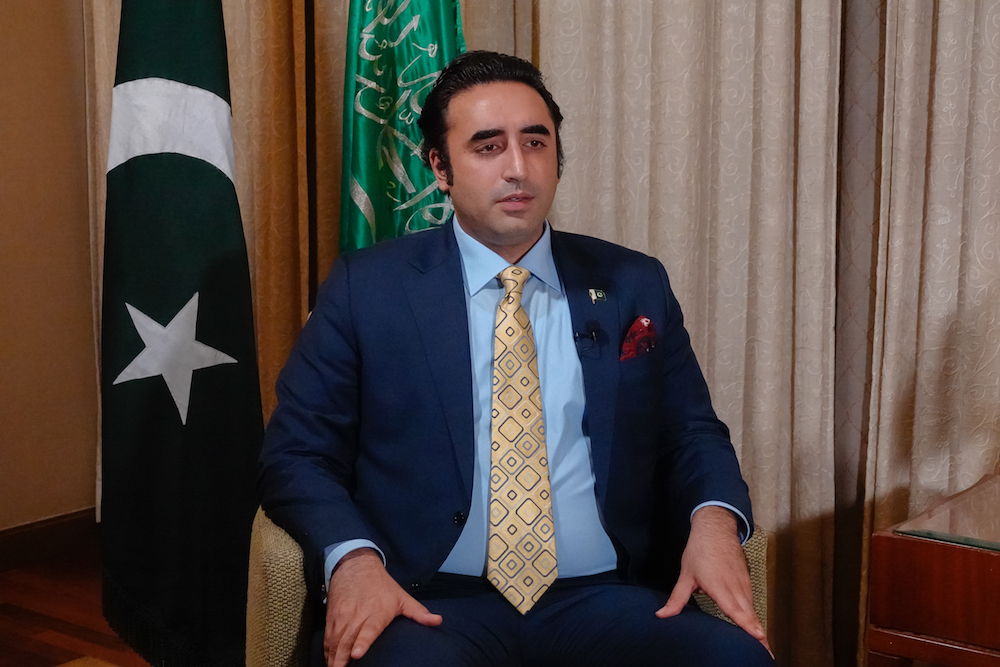
Bhutto Zardari was impressed with Saudi Arabia’s “green initiatives” and expressed the hope that Pakistan could take Crown Prince Mohammed bin Salman’s environmental vision forward. (AN Photo/Huda Bashatah)
“We are incredibly grateful,” said Bhutto Zardari in reference to the humanitarian work. “The Kingdom of Saudi Arabia, the people of Saudi Arabia, have always been great friends and supporters of Pakistan. And whenever we’ve been in a difficult time, they have been there standing shoulder to shoulder with the people of Pakistan.
“This time has been no different, whether it’s the air bridge or the assistance through the relief fund that we’ve been receiving. It’s gone a long way to assist all those who’ve been devastated by the flooding in Pakistan. The problem is, the scale of the catastrophe is so big that there always seems to be more that needs to be done.”
Many scientists believe man-made climate change played a role in Pakistan’s “monster monsoon.” And yet experts say the country is responsible for just 0.4 percent of the world’s historic emissions deemed responsible for global warming. By contrast, the US is responsible for 21.5 percent and China for 16.5 percent.
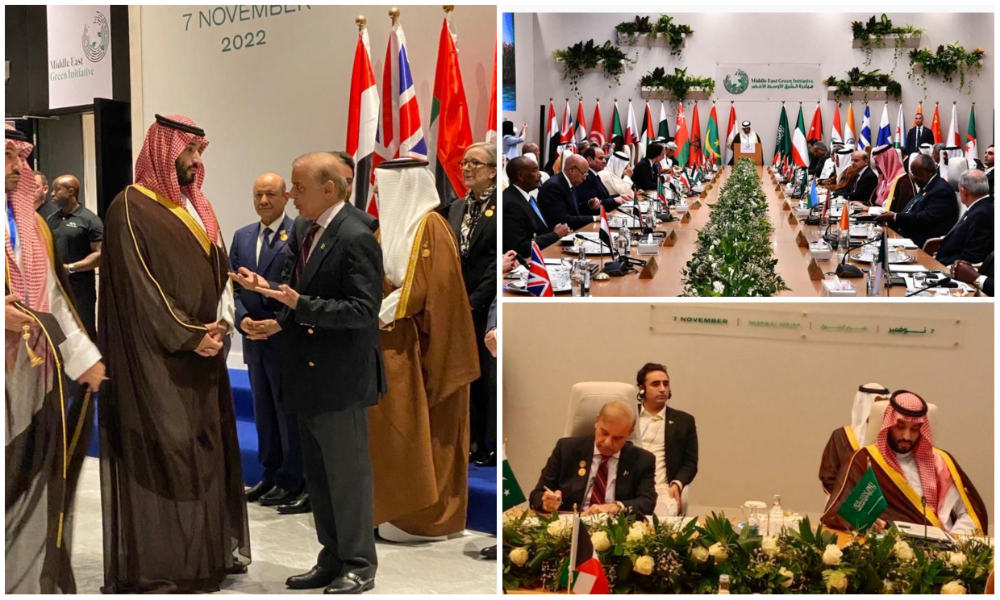
Bhutto Zardari was in Egypt’s Red Sea resort city of Sharm El-Sheikh last week as part of Pakistan’s delegation to the UN Climate Change Conference, which was led by Prime Minister Shahbaz Sharif. (Twitter/@pmln_org)
Not surprisingly, Pakistan’s delegation to COP27 was a key driving force behind efforts by developing nations to establish a dedicated “loss and damage finance facility” to encourage wealthy countries to assist those states most at risk from extreme weather.
“We’re very proud that Pakistan, as chair of G77, and particularly given our experiences with the catastrophic flooding, managed to play a key role in these negotiations,” Bhutto Zardari told Arab News.
“And, ultimately, at COP27 we managed (to establish) a consensus where, finally, not only mitigation and adaptation but also loss and damage has been added to the agenda for developing countries such as Pakistan.
“This is indeed a great achievement. It is a step in the right direction. But, as with everything else, be it adaptation and mitigation, or now also loss and damage, it’s great that we’ve got it on the agenda, but we are going to have to work on implementation.”
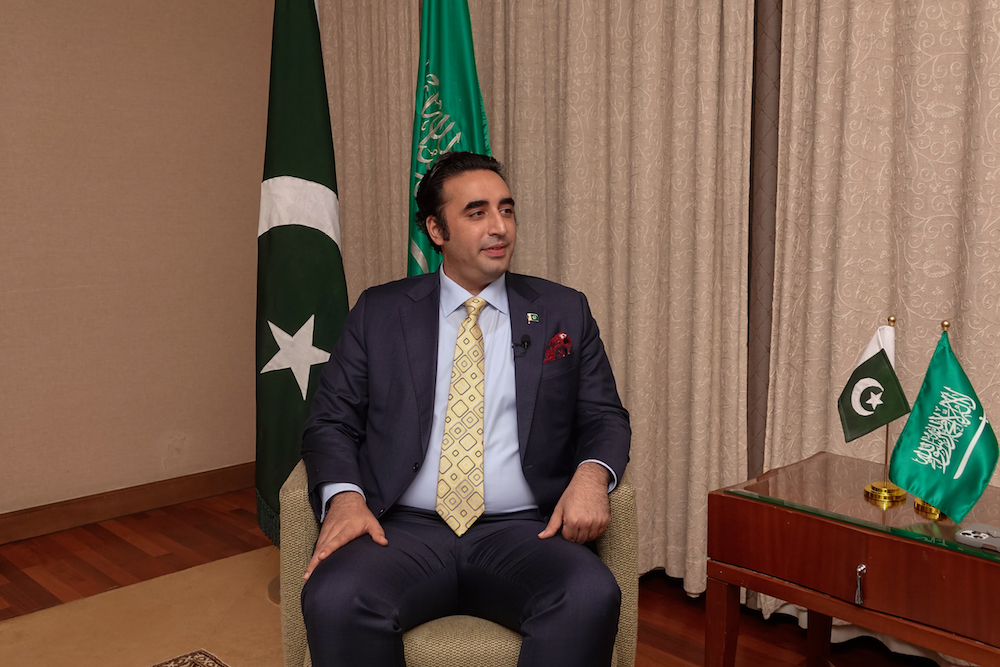
The Pakistani minister also praised Crown Prince Mohammed bin Salman’s “youthful leadership,” pointing to the “vision and the transformation that we’re witnessing.” (AN Photo/Huda Bashatah)
The Pakistan government’s high-profile presence in Sharm El-Sheikh also came against a backdrop of rising inflation, dwindling foreign-currency reserves and severe debt problems, to say nothing of a constitutional crisis surrounding the removal of Imran Khan from the prime minister’s post.
Khan, who was ousted by parliament in a no-confidence vote in April, has claimed he was toppled in a conspiracy orchestrated by the US and his successor — allegations that both Washington and Sharif deny.
Political tensions escalated on Nov. 3 when Khan was wounded in the leg when a gunman attacked his protest convoy. The shooter was arrested and has, according to police, confessed to a murder attempt.
In a recent interview with CNN’s Christian Amanpour, Bhutto Zardari, who is the son of Pakistan’s slain former prime minister Benazir Bhutto, offered “unequivocal condemnation” of the attack, calling for a “free, fair and impartial investigation.”
“The prime minister has already written to the chief justice of Pakistan (asking) him to hold a judicial inquiry into the attack on Mr. Khan. And we absolutely call for a free, fair and impartial investigation,” he told Arab News. “A free, fair, impartial investigation means that we shouldn’t politicize this tragedy, or use it to target individuals without proof.”
Since the attack, Khan has made claims that figures in the government and the nation’s military were behind the shooting, and cast doubt on the impartiality of any investigation.
“Of course, if Mr. Khan expresses doubts about the impartiality of the judiciary, then we will engage with him on what he believes to be an impartial investigation,” said Bhutto Zardari, who is also the chairman of the center-left Pakistan People’s Party, one of the three largest political parties of Pakistan and a rival of Khan’s Pakistan Tehreek-e-Insaf.

Brushing aside Khan’s accusations, he said: “Everybody is entitled to their own opinions, but not everybody is entitled to their own set of facts.”
However the political drama plays out in the coming days, many Pakistani families are preoccupied with the challenge of putting food on the table. With millions of displaced people living under canvas and winter fast approaching, the country is in urgent need of assistance.
An official Pakistani assessment has put the cost of recovery at more than $16 billion. This, on top of the nation’s existing economic woes.
“The damage to our economy is more than $30 billion, which is 10 percent of our GDP. So, the road ahead, as far as reconstruction and rehabilitation, is a long and arduous one,” said Bhutto Zardari. “But we are committed to turning this crisis, this catastrophe, into an opportunity and not only investing in building back but building back better, building back greener, building back in a more climate-resilient manner.”
Reports have circulated of late in the Pakistani news media raising expectations of more than $10 billion in Saudi investments, on top of the rollover of the $3 billion loan that Pakistan currently owes. Bhutto Zardari refused to be drawn into any details.
“I wouldn’t attempt to disclose anything beforehand,” he told Arab News.
He added: “As you are aware, Pakistan and Saudi Arabia have historic and brotherly relations that span not only across time and history but also have developed depth over the years.”