

Pakistan to contact Interpol after investigation in journalist Arshad Sharif’s killing hits ‘dead-end’ – official

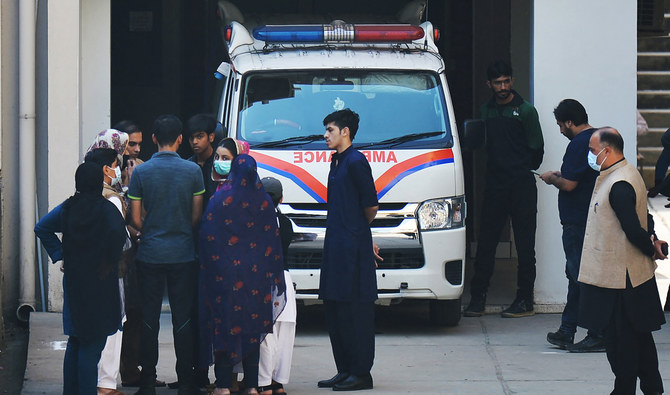
In this picture, taken on October 26, 2022, relatives (L) of Pakistani journalist Arshad Sharif, who was killed in Kenya, stand in front of an ambulance with his remains at a hospital in Islamabad. (Photo courtesy: AFP)
Short Url
Updated 10 November 2022
Follow

Pakistan to contact Interpol after investigation in journalist Arshad Sharif’s killing hits ‘dead-end’ – official

  • A senior Pakistani official familiar with the probe says Sharif was ‘ambushed,’ calls him victim of ‘targeted killing’
  • Investigators suspect that two brothers who hosted Sharif in Kenya might be involved in his murder or know his killers

KARACHI: Pakistani authorities investigating journalist Arshad Sharif’s killing in Kenya have decided to seek Interpol’s help after hitting “a dead-end,” an official familiar with the probe said on Thursday, adding Sharif’s hosts in the African state had to be brought to Pakistan to resolve the mystery surrounding the case.

A prominent Pakistani journalist who became a harsh critic of the incumbent government and the military toward the end of his life, Sharif was killed on October 23 when his car was said to have sped up and drove through a checkpoint outside the Kenyan capital, prompting the police to open fire. The law enforcement officials in Nairobi expressed regret over the incident, saying it was a case of “mistaken identity” during a search for a car involved in a child abduction case.

Pakistani investigators, however, believe the incident to be a case of targeted murder. They recently visited the East African state to determine the circumstances of Sharif’s death and recorded the statement of two brothers, Waqar and Khurram Ahmed, who hosted him at their guesthouse for about two months.

Waqar had reportedly invited the slain journalist to dine with him on the day of the killing at his lodge outside Nairobi while Khurram was driving him back when the shooting incident took place. Local media also reported quite widely Sharif’s postmortem report showed he had been tortured before being shot.

“Arshad Sharif was victim of targeted killing,” said the senior official who spoke to Arab News on condition of anonymity due to the sensitive nature of the issue. “There was an ambush, not a police picket, but since it is an international case involving three different countries, we have arrived at a dead-end for the time being.”

“The government has decided to contact Interpol after a planned visit to the United Arab Emirates by our fact-finding team to gather more clues next week,” he continued.

The official informed the Pakistani investigation team had requested the Kenyan authorities to access Sharif’s call data record and mobile phone. He also emphasized it was vital to get the custody of the two brothers to further probe the matter.

The slain journalist left his country after several cases related to charges of sedition and others were filed against him. He was believed to have been in the UAE since leaving Pakistan before he decided to travel to Kenya.

In a letter written to the two brothers and seen by Arab News, the Pakistani investigation team in Kenya sought CCTV footage of their penthouse where Sharif lived.

“Khurram and Waqar were either involved in the murder or have information about the killers,” the official suspected.

The two brothers could not be reached for comment.

The Pakistani official added there had been several loopholes in the claims made by the Kenyan police regarding the shooting incident that claimed Sharif’s life.

“Even at a picket, police fire at the driver to stop him from fleeing,” he said. “But Sharif got close-range bullets while Khurram, who was driving the car, remained unhurt. He did not even sustain a minor injury from a piece of broken window.”

The investigation team declined to speak to Arab News for the story.


Pakistan, seven Muslim nations back Palestinian technocratic body, stress Gaza-West Bank unity

Updated 15 January 2026
Follow

Pakistan, seven Muslim nations back Palestinian technocratic body, stress Gaza-West Bank unity

  • The National Committee for the Administration of the Gaza Strip was announced on January 14
  • Muslim nations call for consolidation of the ceasefire and unimpeded humanitarian aid into Gaza

ISLAMABAD: Pakistan and seven other Muslim-majority countries on Thursday welcomed the formation of a temporary Palestinian technocratic body to administer Gaza, stressing that it must manage daily civilian affairs while preserving the institutional and territorial link between the Gaza Strip and the West Bank amid the ongoing peace efforts.

In a joint statement, the foreign ministers of Pakistan, Egypt, Jordan, Saudi Arabia, Qatar, Türkiye, Indonesia and the United Arab Emirates said the newly announced National Committee for the Administration of the Gaza Strip would play a central role during the second phase of a broader peace plan aimed at ending the war and paving the way for Palestinian self-governance.

“The Ministers emphasize the importance of the National Committee commencing its duties in managing the day-to-day affairs of the people of Gaza, while preserving the institutional and territorial link between the West Bank and the Gaza Strip, ensuring the unity of Gaza, and rejecting any attempts to divide it,” the statement said.

The committee, announced on Jan. 14, is a temporary transitional body established under United Nations Security Council Resolution 2803 and is to operate in coordination with the Palestinian Authority, the ministers said.

The statement said the move forms part of the second phase of US President Donald Trump’s Comprehensive Peace Plan for Gaza, which the ministers said they supported, praising Trump’s efforts to end the war, ensure the withdrawal of Israeli forces and prevent the annexation of the occupied West Bank.

The top leaders of all eight Muslim countries attended a meeting with Trump in New York last September, shortly before he unveiled the Gaza peace plan.

The ministers also called for the consolidation of the ceasefire, unimpeded humanitarian aid into Gaza, early recovery and reconstruction and the eventual return of the Palestinian Authority to administer the territory, leading to a just and sustainable peace based on UN resolutions and a two-state solution on pre-1967 lines with East Jerusalem as the Palestinian capital.