

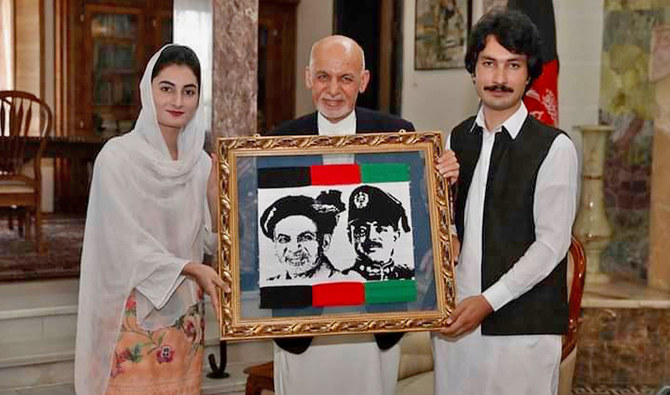

ISLAMABAD: A Pashtun girl who bagged the top position at an international art competition in the United Kingdom earlier this year has called for more art schools and colleges, particularly for women, in the conservative, restive northwestern Pakistani region that she hails from.
Almas Khanum, 19, who belongs to the militancy-hit Malakand division in Pakistan’s northern Khyber Pakhtunkhwa province, comes from a family of artists and specializes in embroidery and sculpture.
The high school graduate who plans to pursue media studies participated in an international competition organized by a British NGO, Bellwether International, in September, which encouraged artists from around the world to submit works on a wide variety of themes.
Khanum’s submission, a needle-on-thread piece, depicts a woman wearing traditional Afghan clothing and carrying a water pot on her head. The subject of the image is also playing the flute, but is surrounded by darkness, which the artist used to depict an atmosphere of cultural restrictions.
The artwork won the first prize in the category of “religious tolerance,” which came with a two thousand pound cash prize.
“I submitted my art piece in September,” Khanum told Arab News over the phone during an interview from Malakand. “On October 5, I got an email informing me that my work had ranked first [among submission from] all over the world, which is a matter of great pride and joy for me.”
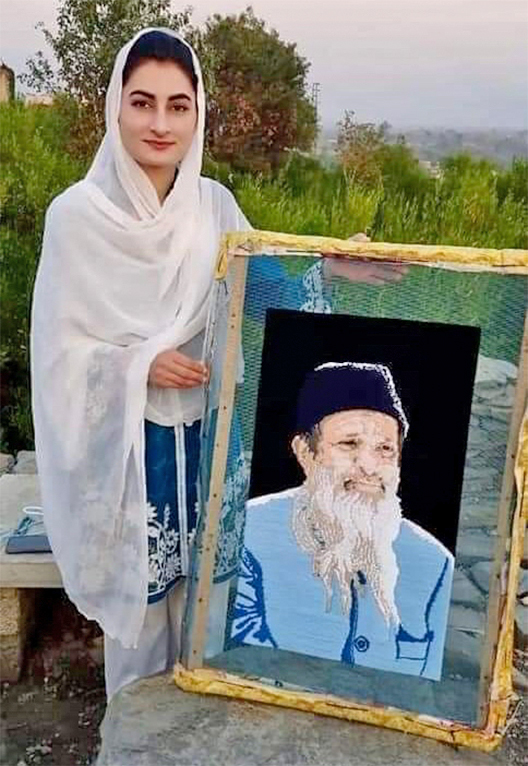
Pakistani artist Almas Khanum can be seen with a portrait of the philanthropist and social worker, Abdul Sattar Edhi, in Malakand, Pakistan, on April 20, 2020. (Photo courtesy: Almas Khanum)
Khanum said the organizers called her method of creating an image with a needle and threads “unique and impressive.”
“In this artwork, I depicted myself dressed in traditional Afghan clothing and holding a water pot over my head which is associated with my culture,” the artist said. “The woman in the artwork is using music to promote religious freedom as I believe that music can promote religious harmony across different faiths.”
Khanum was invited to attend the awards ceremony at British parliament in London on October 27, but faced visa issues.
“I applied for a [UK] visa but I couldn't get it, which was why I couldn't go there and receive the award myself,” she lamented. “But I am immensely proud and happy that the parents of Pakistani Nobel laureate Malala Yousafzai received the award on my behalf.”
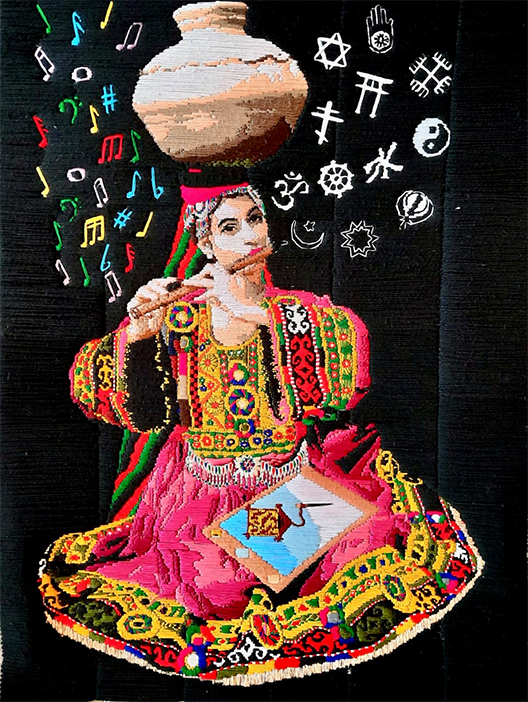
In a photograph taken on October 5, 2022, a needle-and-threat art piece by Pakistani artist Almas Khanum can be seen. The work won first prize at an international competition held in London, United Kingdom, in September. (Photo courtesy: Almas Khanum)
Asked how she got into creating art, Khanum said her first creation was a portrait of Malala Yousafzai, who also hails from KP province, made using the needle-on-thread technique.
“I have tried to promote my art as much as possible by making pictures of Pashtun leaders and famous people in other parts of the world,” she said. “Whether they were doctors or politicians, I made pictures of personalities who served humanity.”
About her future plans, Khanum said she wanted to promote art among women of the tribal region after completing her education.
“In the future, I intend to promote my art and turn it into an industry as many girls in the region are interested in it,” she added. “So, I feel that I should teach this art to all my sisters and brothers.”
“I request the present government to build art academies and colleges in our area because there are many in Islamabad and other big cities but not in KP [Khyber Pakhtunkhwa].”
The artist said getting an award in the UK was proof that people in other countries respected and recognized Pakistani traditional art more than it was appreciated by the country's own people:
“It is very unfortunate that our own art is not valued in Pakistan as much as it is valued and respected in foreign countries.”


