

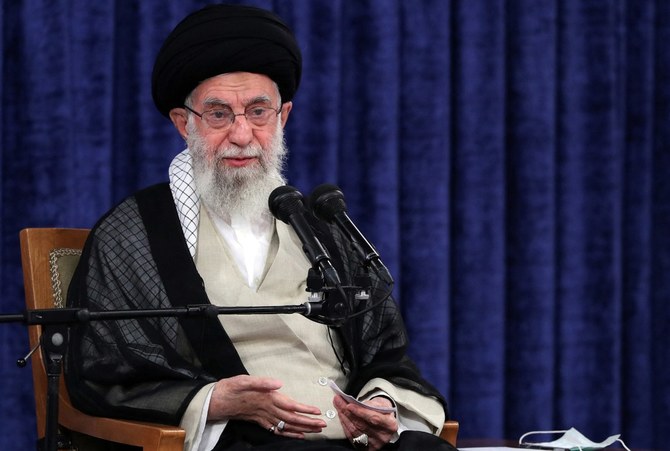

DUBAI: Twitter users have launched an online petition calling on Elon Musk, who recently bought the platform, to ban Iran’s Supreme Leader Ayatollah Ali Khamenei from Twitter.
Emily Schrader, an Israeli-American journalist and CEO of digital marketing agency Social Lite Creative, and other Twitter users, started the online petition on Change.org.
In an open letter to Musk, she wrote: “When it comes to technology, the Ayatollah’s regime has filtered the internet for its own public, banning social media platforms such as Twitter in their entirety, yet the Ayatollah himself uses the platform to spread blatant calls to violence which are then carried out by his own proxies, as well as Holocaust denial and other forms of conspiratorial hate.”
She added: “Unfortunately, these are not just words of a random Twitter user, they are calls to action from a world leader. The Ayatollah oversees the Islamic regime forces, including cyber forces, which have been repeatedly proven to use bots to target and harass activists who speak out against the regime outside of Iran. This is a stark violation of Twitter’s existing policies.”
Users from around the world have been calling on Twitter for years to ban Khamenei. Now, with Musk’s takeover of the platform, many are turning to him directly.
Peter Singer, a bioethics professor, questioned Musk: “How is it that Iran’s Ayatollah Khamenei, who has banned 83 million people from Twitter himself can freely post his messages denigrating women on that platform?”
Iranian journalist and activist Masih Alinejad is also among those demanding Khamenei’s ban from the platform
Several other users are asking for the same.
Khamenei is notorious for using his Twitter accounts to incite hate, violence and disinformation. Yet his many accounts in multiple languages still exist on the platform.
In January last year, an account linked to Khamenei’s personal office posted a graphic threatening “revenge” while appearing to depict former President Donald Trump under the shadow of a looming airstrike, which was retweeted by one of Khamenei’s personal accounts. Following a public backlash, Twitter suspended the account that posted the tweet but not the personal account.
It said it suspended the account due to a violation of its policy against fake accounts.
“The justification that Twitter reportedly gave for why it shut down that particular account but not others was not just unpersuasive, it was preposterous,” David Weinberg, Washington director for international affairs of the US-based Anti-Defamation League, told Arab News, at the time.
In the petition, Schrader asserted: “Any leader who bans a platform for his own citizens shouldn’t be able to use that platform as a tool to promote antisemitism, violence and extremism — especially that which leads directly to violence against innocent people.”
Over 27,000 people had signed the petition at the time of writing this article.


