

In Sharm el-Sheikh meetings, Pakistani PM calls for global support for flood victims 

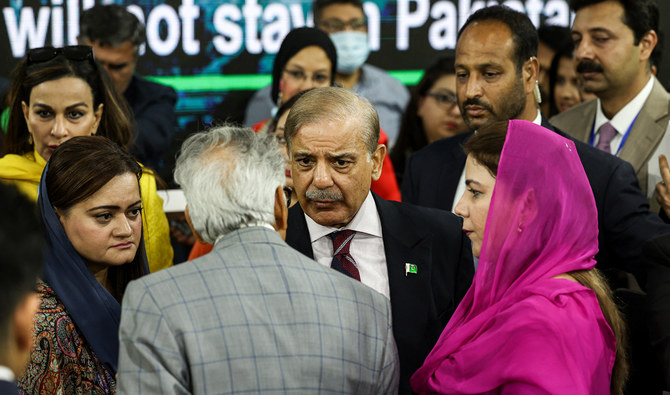
Pakistan's Prime Minister Shahbaz Sharif (C) speaks with delegates at the Pakistani pavilion at the COP27 climate conference at Sharm el-Sheikh International Convention Centre in Egypt's Red Sea resort city of the same name on November 7, 2022. (AFP)
Short Url
Updated 08 November 2022
Follow

In Sharm el-Sheikh meetings, Pakistani PM calls for global support for flood victims 

  • Sharif held a slew of bilateral meetings with world leaders on sidelines of UN climate summit on Monday 
  • Floods in Pakistan this year killed over 1,700 people, affected 33 million, and cost $30 billion in damages 

ISLAMABAD: In meetings with world leaders at the Climate Implementation Summit in Egypt, Pakistani Prime Minister Shehbaz Sharif said he had strived to highlight the importance of “continued international support” for flood victims. 
Sharif was last month invited to co-chair the United Nations Climate Change Conference, or COP27, by Egyptian President Abdul Fattah El-Sisi after the Pakistani PM ran an international campaign to raise awareness about climate change in the wake of floods this year that killed over 1,700 people, affected 33 million, and cost the South Asian nation more than $30 billion in damages. 
Weeks after the rains stopped, millions of Pakistanis are still living under the open sky, without shelter and livelihoods as winter arrives. 
“In my interaction with world leaders on the sidelines of #COP27, I explained the challenges of the post-flood reconstruction in Pakistan,” Sharif wrote on Twitter. 
“I threw light on govt’s efforts & highlighted the urgent need for continued international support for rehabilitation of flood victims.” 

On the second day of the COP27 summit on Tuesday, Sharif would co-chair an important roundtable on “Climate Change and Sustainability of Vulnerable Communities,” along with his Norwegian counterpart. 
Besides meetings on the sidelines, the Pakistani premier would participate in an important meeting jointly hosted by the German chancellor and the president of Ghana on “Scaling Up Action and Support on Loss and Damage — Global Shield Against Climate Risk.” 
On Monday, Sharif met with Saudi Crown Prince Mohammed bin Salman and reviewed cooperation between the two countries to confront climate change. He also met the President of the United Arab Emirates (UAE) Mohammed bin Zayed Al-Nahyan, Secretary General of the Arab League Ahmed Aboul Gheit and other world leaders on the sidelines of the climate summit to discuss joint efforts to confront climate change. 
The prime minister also attended a high-level round table, titled “Early Warning for All Executive Plans Launch,” on Monday, where he emphasized that Early Warning System (EWS) had become a must for underdeveloped and climate-affected countries. 
“Given the time, the use of advanced technology and the early warning chain will help improve the four elements of disaster risk awareness, risk detection, prevention and preparedness,” he informed the forum. 
Sharif and his team, which includes climate change minister Sherry Rehman, are attending COP27 with the aim to use the summit to get the world to commit to helping countries like Pakistan deal with growing climate-related “loss and damage.”


Pakistan, Qatar discuss Afghanistan situation, urge dialogue for regional stability

Updated 7 sec ago
Follow

Pakistan, Qatar discuss Afghanistan situation, urge dialogue for regional stability

  • The development comes amid renewed Islamabad-Kabul tensions after last week’s Pakistani airstrikes inside Afghanistan
  • Qatar, along with other states, helped mediate a ceasefire between the neighbors following weeklong skirmishes in Oct.

ISLAMABAD: Pakistan Prime Minister Shehbaz Sharif and Qatar’s Deputy PM Sheikh Saoud Al-Thani on Tuesday discussed the situation in Afghanistan and called for dialogue to promote regional stability during high-level talks held in Doha, Sharif’s office said.

The development comes amid renewed tensions between Pakistan and Afghanistan after Islamabad conducted airstrikes on what it said were Tehreek-e-Taliban Pakistan (TTP) targets in Afghanistan last week. Kabul said the strikes killed civilians and vowed to respond to the violation of its sovereignty.

This is the second time in less than six months that Pakistan has conducted airstrikes in Afghanistan. The last strikes triggered heavy, weeklong clashes between the neighbors along their border before Qatar and Turkiye mediated a ceasefire between them in Oct. last year.

During their meeting in Doha, PM Sharif and Qatari Deputy PM Sheikh Saoud Al-Thani, who is also the state minister for defense affairs, discussed defense and security relations between the two countries, according to Sharif’s office.

“Regional developments were also discussed, in particular the situation in Iran and Afghanistan,” Sharif’s office said in a statement. “Both sides emphasized the importance of dialogue, de-escalation and collective efforts to promote peace and stability in the region.”

Sheikh Saoud appreciated the professionalism and expertise of the Pakistani armed forces and conveyed Qatar’s interest in deepening defense partnership between the two countries, according to the statement.

The Pakistan premier expressed satisfaction over the ongoing collaboration and underscored Islamabad’s commitment to further expanding defense collaboration.

Separately, Sharif held meetings with Qatar’s State Minister for Trade Dr. Ahmed bin Mohammed Al-Sayed and a delegation of the Qatar Businessmen Association (QBA).

During his meeting with the Qatari trade minister, the two sides reviewed bilateral trade and economic cooperation and expressed satisfaction over the growing momentum in Pakistan–Qatar relations.

“The Prime Minister emphasized the importance of enhancing bilateral trade volumes and diversifying Pakistan’s exports to Qatar, particularly in agricultural products, food items and value-added goods,” the Pakistani information ministry said.

Pakistan has been seeking closer economic engagement with Gulf partners amid its broader push to stabilize the economy and attract investment, while maintaining security and defense cooperation with key regional states.

Sharif highlighted Pakistan’s investment-friendly reforms and the role of the Special Investment Facilitation Council (SIFC) in facilitating foreign investment, according to the Pakistani information ministry.

Dr. Al-Sayed, who is also the chairman of Pak-Qatar joint business taskforce, reiterated Qatar’s interest in expanding economic cooperation and strengthening private-sector and business linkages between the two countries.

“The two sides also agreed to convene a meeting of the task force comprising relevant officials of both countries, within the month of Ramadan, to discuss concrete investment proposals for Qatari investment in Pakistan,” it added.

In his meeting with QBA delegates, Sharif highlighted Pakistan’s improving macroeconomic indicators and invited QBA members to explore opportunities in infrastructure, logistics, energy, agriculture, technology and export-oriented manufacturing.

Sharif is also scheduled to meet Qatar’s Emir Sheikh Tamim bin Hamad Al Thani and Qatar’s Prime Minister Sheikh Mohammed bin Abdulrahman bin Jassim Al Thani in Doha today, Tuesday, to discuss ways to further strengthen bilateral relations, Sharif’s office said.

“Discussions will take place on further strengthening bilateral relations,” it added.