

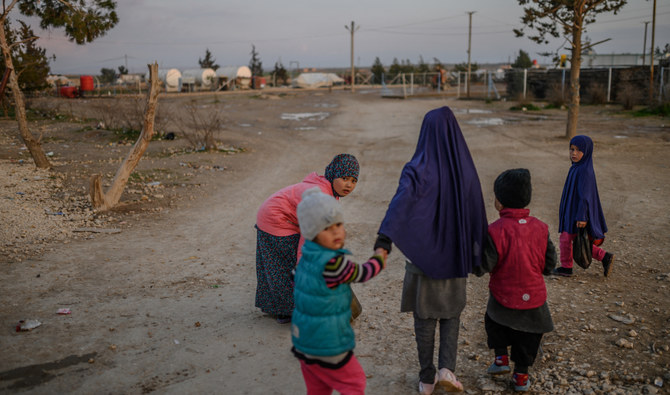
Children living in ‘open air prison’ at Syria’s Al-Hol camp: MSF

Al-Hol is the largest camp for displaced people who fled after Kurdish-led forces backed by a US-led coalition dislodged Daesh fighters from their last scrap of territory in Syria in 2019. (AFP/File)
Short Url
Updated 08 November 2022
Follow

Children living in ‘open air prison’ at Syria’s Al-Hol camp: MSF

BEIRUT: Doctors Without Borders (MSF) has deplored the fate of thousands of children living in “a giant open air prison” at Syria’s notorious Al-Hol camp.

Al-Hol is the largest camp for displaced people who fled after Kurdish-led forces backed by a US-led coalition dislodged Daesh fighters from their last scrap of territory in Syria in 2019.

In the country’s northeast near Iraq, Al-Hol is overpopulated with more than 50,000 residents including relatives of suspected terrorists, displaced Syrians, and Iraqi refugees.

Children make up 64 percent of the Kurdish-run camp’s population, and half are younger than 12, according to MSF.

“We have seen and heard many tragic stories,” the aid agency’s Syria operations manager, Martine Flokstra, said.

In a report, MSF cited Al-Hol’s lack of healthcare and incidents of violence, warning of the dangerous situation facing children.

Some died “as a result of prolonged delays in accessing urgent medical care,” and there are stories of “young boys reportedly forcibly removed from their mothers once they reach around 11 years old, never to be seen again,” Flokstra said.

Many of the camp’s child detainees were born there and are “robbed of their childhoods, and condemned to a life exposed to violence and exploitation, with no education, limited medical support and no hope in sight,” she added.

The report mentions the case of a five-year-old boy hit by a truck and who died after waiting several hours for hospitalization.

In 2021, 79 children lost their lives, MSF said.

Some were killed in violence, including shootings inside the camp where attacks on guards or aid workers are common. The majority of camp deaths are crime related.

Among Al-Hol’s detainees are more than 10,000 foreigners from dozens of countries.

Housed in a separate part of the camp called “the Annex,” MSF considers these foreign nationals the responsibility of their home countries which it said have failed in their obligations to repatriate them.

“Insufficient progress is being made to close the camp,” Flokstra said.

Kurdish authorities have repeatedly called on countries to repatriate their citizens from crowded camps.

But nations have mostly received them only sporadically, fearing security threats and a domestic political backlash.

Last month, four women and 13 children were repatriated to Australia from Al-Hol and another camp.


UN rights chief Shocked by ‘unbearable’ Darfur atrocities

Updated 18 January 2026
Follow

UN rights chief Shocked by ‘unbearable’ Darfur atrocities

  • Mediation efforts have failed to produce a ceasefire, even after international outrage intensified last year with reports of mass killings, rape, and abductions during the RSF’s takeover of El-Fasher in Darfur

PORT SUDAN: Nearly three years of war have put the Sudanese people through “hell,” the UN’s rights chief said on Sunday, blasting the vast sums spent on advanced weaponry at the expense of humanitarian aid and the recruitment of child soldiers.
Since April 2023, Sudan has been gripped by a conflict between the army and the paramilitary Rapid Support Forces that has left tens of thousands of people dead and around 11 million displaced.
Speaking in Port Sudan during his first wartime visit, UN Human Rights commissioner Volker Turk said the population had endured “horror and hell,” calling it “despicable” that funds that “should be used to alleviate the suffering of the population” are instead spent on advanced weapons, particularly drones.
More than 21 million people are facing acute food insecurity, and two-thirds of Sudan’s population is in urgent need of humanitarian aid, according to the UN.
In addition to the world’s largest hunger and displacement crisis, Sudan is also facing “the increasing militarization of society by all parties to the conflict, including through the arming of civilians and recruitment and use of children,” Turk added.
He said he had heard testimony of “unbearable” atrocities from survivors of attacks in Darfur, and warned of similar crimes unfolding in the Kordofan region — the current epicenter of the fighting.
Testimony of these atrocities must be heard by “the commanders of this conflict and those who are arming, funding and profiting from this war,” he said.
Mediation efforts have failed to produce a ceasefire, even after international outrage intensified last year with reports of mass killings, rape, and abductions during the RSF’s takeover of El-Fasher in Darfur.
“We must ensure that the perpetrators of these horrific violations face justice regardless of the affiliation,” Turk said on Sunday, adding that repeated attacks on civilian infrastructure could constitute “war crimes.”
He called on both sides to “cease intolerable attacks against civilian objects that are indispensable to the civilian population, including markets, health facilities, schools and shelters.”
Turk again warned on Sunday that crimes similar to those seen in El-Fasher could recur in volatile Kordofan, where the RSF has advanced, besieging and attacking several key cities.
Hundreds of thousands face starvation across the region, where more than 65,000 people have been displaced since October, according to the latest UN figures.