

UK one of ‘most important regions’ in Saudi bid to enhance pilgrim experiences: Hajj minister

1 / 2
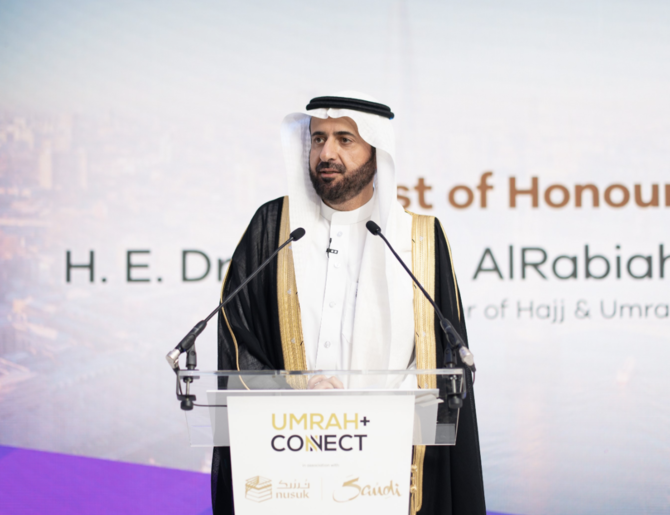
Saudi Arabia’s Minister of Hajj and Umrah Dr. Tawfiq Al-Rabiah speaks at the Umrah+ Connect event on Sunday. (@MyNusuk)
2 / 2
(L to R) Nusuk Managing Director Fahd Hamidaddin, Minister of Hajj and Umrah Dr. Tawfiq Al-Rabiah, and CBHUK CEO Rashid Mogradia. (Mohammed Rashid)
Short Url
Updated 07 November 2022
Follow

UK one of ‘most important regions’ in Saudi bid to enhance pilgrim experiences: Hajj minister

  • Kingdom was “now focused on creating seamless experiences for visitors to Saudi Arabia”: Hajj minister
  • Al-Rabiah pointed out that serving pilgrims from around the world was an honor for the Kingdom

LONDON: The UK was “one of the most important regions” for Saudi Arabia as the Kingdom embarked on a journey to enrich the experiences of Umrah pilgrims, the minister of Hajj and Umrah said on Sunday.

Speaking at the Umrah+ Connect event in London during his first visit to Britain in the ministerial role, Dr. Tawfiq Al-Rabiah noted that the Kingdom was “now focused on creating seamless experiences for visitors to Saudi Arabia.”

He said: “It is this spirit which led to the design of Nusuk, launched (in September) by the Ministry of Hajj and Umrah.”

Nusuk is a unified government platform through which pilgrims can plan and book their visits to Makkah and Madinah, and is among the Saudi Vision 2030 objectives to better the quality of services provided and enrich the religious and cultural experience of pilgrims.

“The UK is home to more than 3 million Muslims and one of the most important regions for us as we embark on our journey to enrich and enable the spiritual and beautiful experience of Umrah for Muslims across the globe,” the minister told the Umrah+ Connect audience.
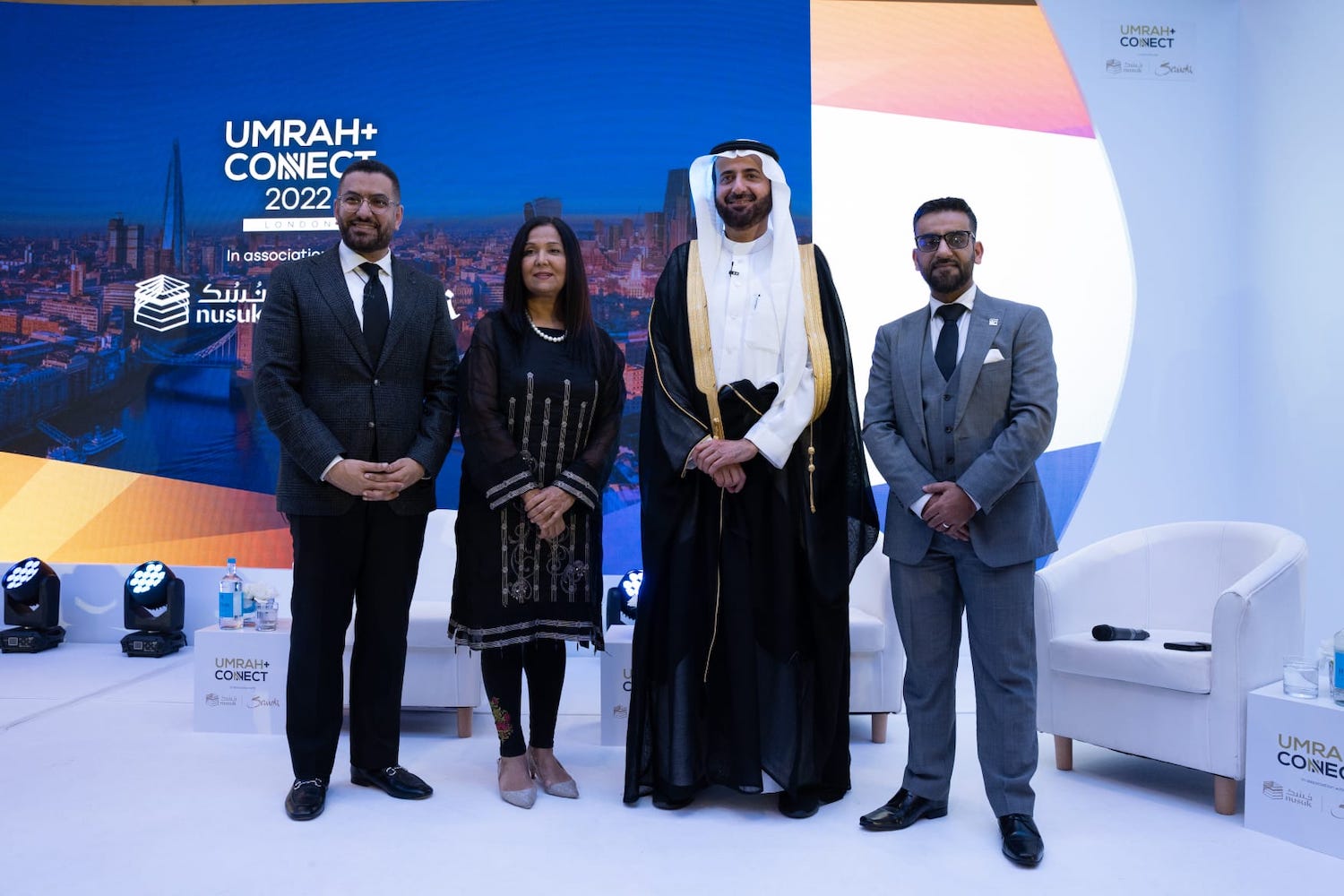


(L to R) Nusuk Managing Director Fahd Hamidaddin, MP for Bolton South East Yasmin Qureshi, Minister of Hajj and Umrah Dr. Tawfiq Al-Rabiah, and CBHUK CEO Rashid Mogradia. (Mohammed Rashid)

Umrah+ Connect is an annual business-to-business event, this year jointly hosted by the Council of British Hajjis (CBHUK) and the All-Party Parliamentary Group on Hajj and Umrah.

Al-Rabiah pointed out that serving pilgrims from around the world was an honor for the Kingdom that had witnessed an “unprecedented rise” in the number of people visiting Makkah and Madinah this year.

He said this was a “direct result” of efforts to strengthen digital infrastructure to enrich visitors’ experiences.
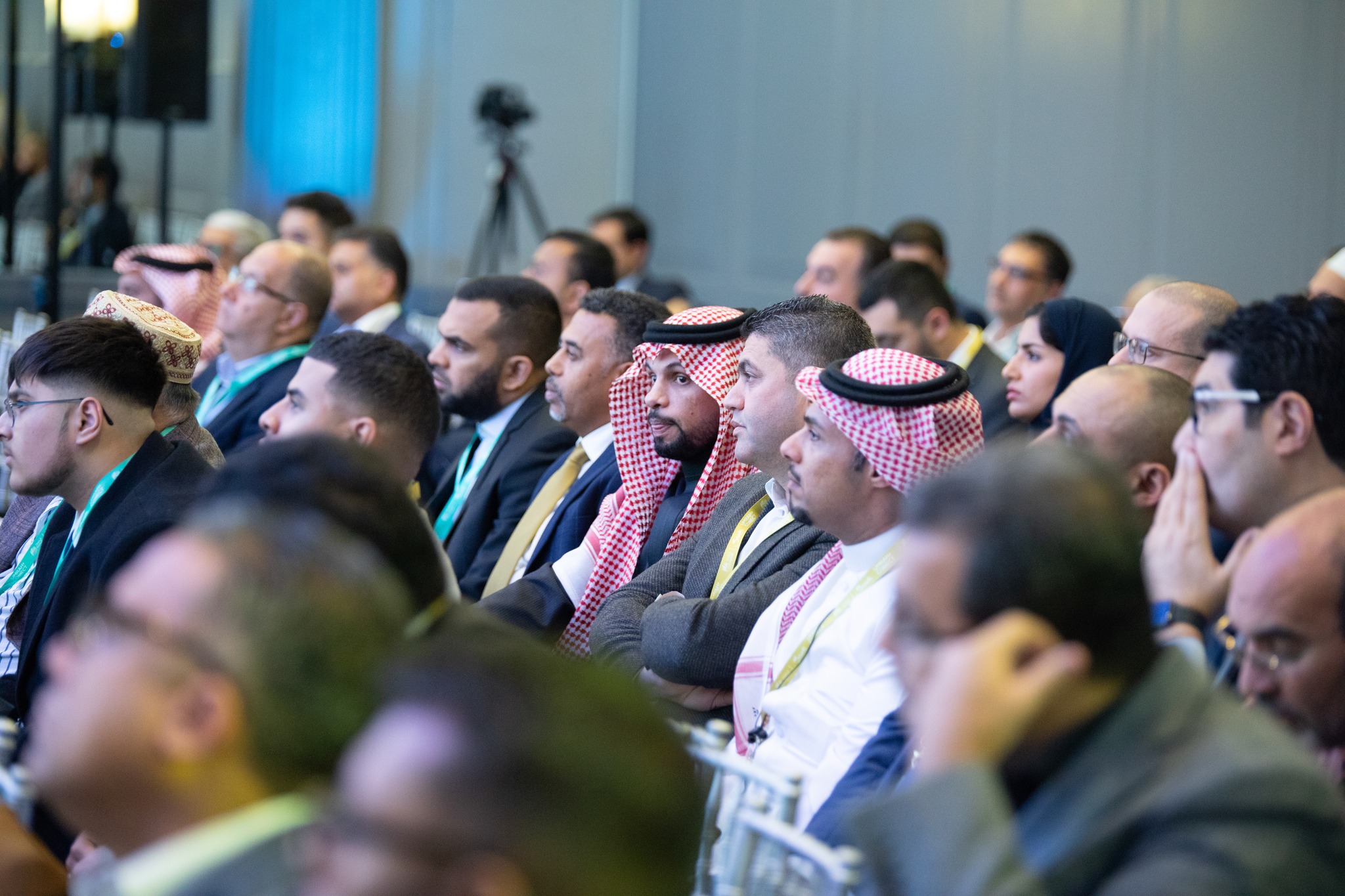


Guests listen to a presentation being delivered at the Umrah+ Connect event on Sunday. (Mohammed Rashid)

“We have a goal to continue advancing technological tools, or to use more advanced technological tools to provide solutions, services, and visas that will create seamless experiences to make the pilgrim visit easier than ever before,” he added.

The minister said that among steps taken to make the holy cities of Makkah and Madinah more accessible to pilgrims, COVID-19 and age restrictions had been lifted, the duration of Umrah visas had been extended from 30 to 90 days, and the need for a male guardian no longer existed.

“Saudi Arabia is eager to serve the Two Holy Mosques and pilgrims from all over the world and this is why we have also worked to digitize the process for all visa types,” Al-Rabiah added.
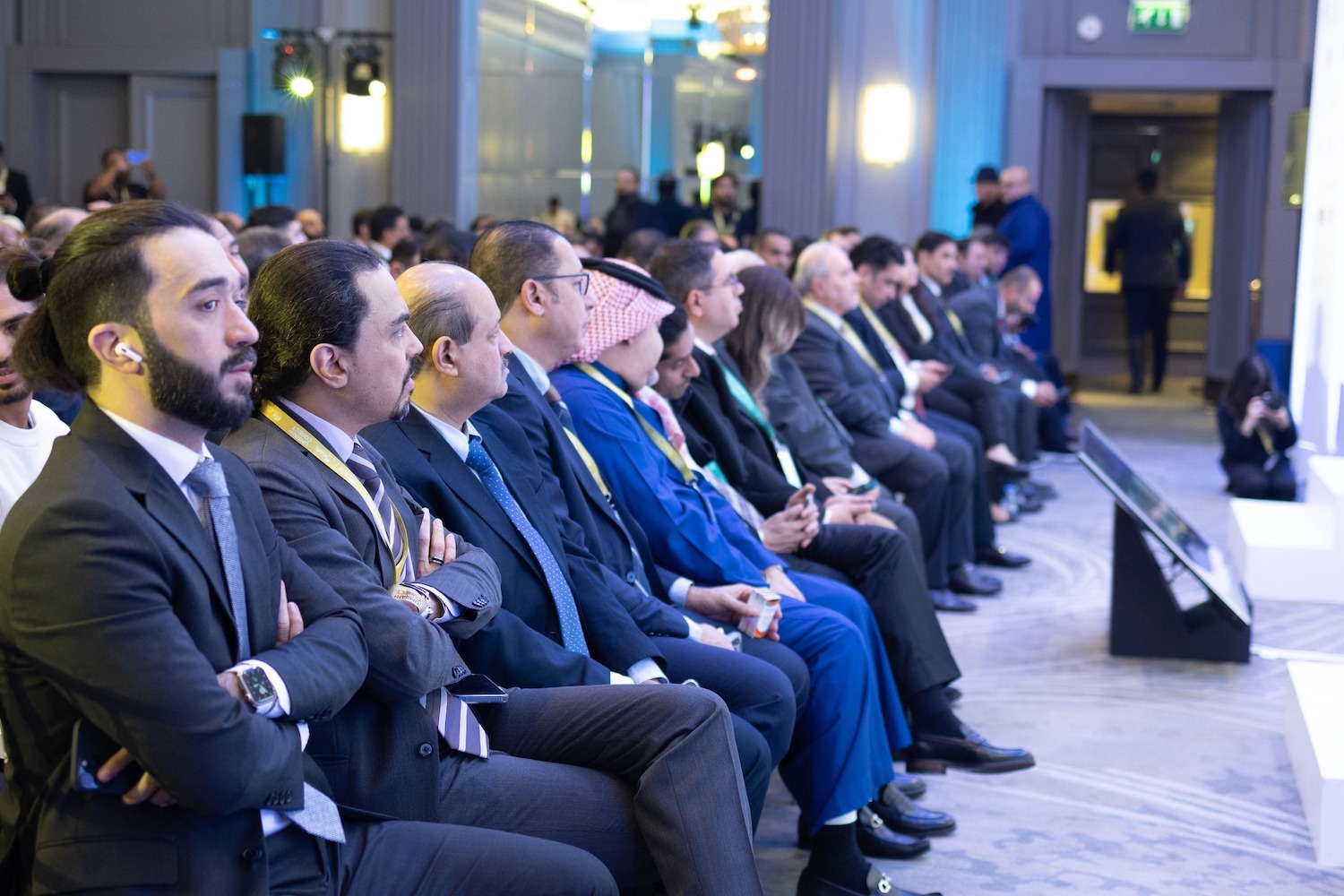


Guests listen to a presentation being delivered at the Umrah+ Connect event on Sunday. (Mohammed Rashid)

Chief executive officer of CBHUK, Rashid Mogradia, said it was an honor to host Al-Rabiah at the Umrah+ Connect event.

“We saw over 250 travel and tour operators and service providers from the Kingdom and around the world gather in the heart of London for a productive day of learning, networking, and providing solutions for challenges faced by the Umrah industry,” he added.


The CEO of CBHUK Rashid Mogradia delivers a speech at the Umrah+ Connect event on Sunday. (Mohammed Rashid)

And he noted that the team at Umrah+ Connect was “ready to deliver on the Kingdom’s Vision 2030 in enriching and enhancing pilgrim experiences and numbers.”

During the event council officials signed memoranda of understanding with Shomukh Aviation, and the Saudi Company for Visa and Travel Solutions.



A memoranda of understanding is signed at the event. (Mohammed Rashid)

Mogradia said: “We are creating partnerships and connecting with partners in Saudi Arabia that can offer value and service for British pilgrims.

“We’re looking at ways to develop products and initiatives that will enhance the pilgrimage experience in line with Vision 2030.

“Today we got to learn more about the Nusuk brand, what it means, and how it is an enabler for both the business-to-consumer and business-to-business markets and complements traditional businesses who offer Umrah packages,” he added.


The secret keepers of desert balance in Saudi Arabia

Updated 27 December 2025
Follow

The secret keepers of desert balance in Saudi Arabia

  • How the Kingdom’s wildcats control pests, protect public health, and sustain the ecosystem

RIYADH: During the summer of 2024, two desert lynx kittens were born in Taif as part of Saudi Arabia’s efforts to protect and increase the population of caracals in the country.

Although caracals are critically endangered, wildcats in general play a significant ecological role in the Kingdom. They act as natural pest control, and Saudi Arabia is committed to conserving these species while increasing their populations to support a thriving ecosystem.

Despite the Kingdom’s harsh, arid climate, conditions are suitable for wildcats not only to survive but also to flourish. Among the terrestrial species inhabiting Saudi Arabia are sand cats, Arabian wildcats, and the desert lynx.

Felis margarita, or sand cats, are small — around 40-60 cm — with pale sandy fur that allows them to blend into the desert. They have a broad head, large ears, and long hair on the bottom of their feet to walk on hot sand.

Sand cats have long hair on the bottom of their feet, allowing them to walk on hot sand and prevent them from sinking into the sand. (SPA/Visitsaudi)

“It is small in size and does not mate with other cats. It is the only cat species in the world with hair on the soles of its feet instead of skin to prevent it from sinking into the sand,” said Obaid Alouni, a Saudi environmentalist.

Alouni explained that one defensive technique sand cats use is to lie flat on the ground to avoid detection.
“It lies flat on the ground when it senses danger to avoid being noticed by other animals.”

These cats primarily feed on rodents and small reptiles, occasionally large insects, obtaining their water from their prey. Sand cats are native to West Asia and help regulate rodent and insect populations, preventing outbreaks and reducing disease spread.

Opinion

This section contains relevant reference points, placed in (Opinion field)

Interestingly, raising sand cats as domestic pets is becoming more popular, Alouni said. But he emphasized that adoption is easier when they are kittens, as they remain wild animals. Although widely distributed across the Kingdom, exact population numbers are difficult to determine due to their elusive nature. They are currently listed as “least concern” by the International Union for Conservation of Nature.

Similar to sand cats, Arabian wildcats (Felis lybica) are found across the Arabian Peninsula and play a vital role in environmental health.

“They are wild cats that live independently without human intervention,” Alouni told Arab News.

An Arabian wildcat at Olomouc Zoo in the Czech Republic. (Wikimedia Commons: Michal Maňas)

Arabian wildcats resemble domestic cats but have thicker, sandy to grey-brown coats with faint stripes or spots and ringed tails with blunt tips. Like sand cats, they feed on rodents, birds, reptiles, and insects and are listed as “least concern” by the IUCN.

However, Alouni warned that pure populations of Arabian wildcats in Saudi Arabia could be threatened by hybridization with domestic cats.

“Currently, wild cats face the problem of interbreeding with domestic cats. This weakens their immune systems and makes them more susceptible to diseases from other cats,” he said.

“This contributes to the extinction of the purebred lineage and, consequently, the disappearance of their wild instincts,” he added.

DID YOU KNOW?

• Sand cats are the only cat species with hair on the soles of their feet, allowing them to walk on hot sand without sinking.

• Caracals, locally known as Al-Washaq, are native and endangered, capable of jumping 3 to 4 meters in a single leap.

• Pure populations of the Arabian wildcat are at risk due to hybridization with domestic cats.

While both species are desert dwellers, sand cats are harder to spot as they avoid heavily trafficked areas. They are mainly found in the Ad Dahna desert and the Empty Quarter, where sand dunes dominate the landscape. Arabian wildcats, however, inhabit rocky or mountainous areas such as the Tuwaiq Mountains, valleys, and farms with abundant small prey.

“Wild cats come around towns and villages, and unfortunately, begin mating with domesticated cats that people release outside,” Alouni explained. He stressed the importance of keeping domestic cats away from wildcat habitats, including deserts and camping sites.

The third wildcat species native to Saudi Arabia, the caracal or desert lynx, is critically endangered. “The lynx is classified in size between large and small, and is distinguished by its jump, which can reach 3 meters or even 4 meters in the sky,” Alouni described.

This combination of photos released by the Saudi National Center for Wildlife (NCW) last year shows a female Caracal and its cub at the Prince Saud Al-Faisal Wildlife Research Center in Taif. (SPA file)

Locally known as Al-Washaq, desert lynx have reddish-tan coats, long legs, and black-tufted ears. They feed on birds, rodents, and sometimes small antelopes. Thankfully, these cats are protected under Saudi law due to their critically endangered status.

Hunting any sand cats, Arabian wildcats, or desert lynx can result in fines of approximately $20,000, according to the Saudi Ministry of Environment, Water, and Agriculture.
“There is a very severe financial penalty in Saudi Arabia for anyone who hunts it,” Alouni added.

The Kingdom has strict regulations to protect endangered animals, criminalizing not only hunting or killing but also trade. Violators could face penalties of up to $8 million, up to 10 years in prison, or both.

Overall, sand cats, Al-Washaq, and Arabian wildcats are essential to maintaining a healthy environment in Saudi Arabia. By controlling rodent populations, they help prevent outbreaks that could threaten agriculture and public health.