

Opposition PTI’s protest march, set to resume tomorrow, delayed by two days

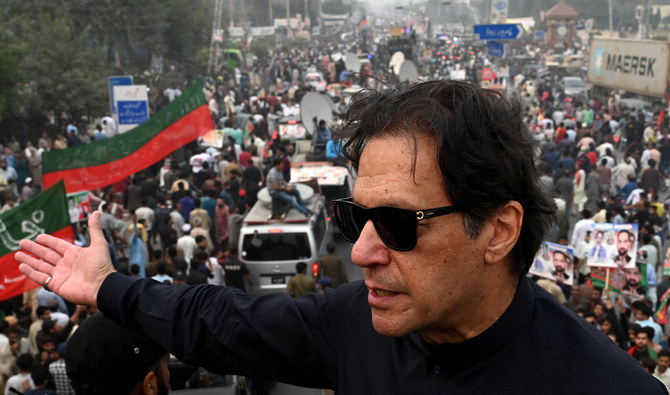
In this photograph taken on November 1, 2022, Pakistan's former prime minister Imran Khan speaks while taking part in an anti-government march in Gujranwala. (Photo courtesy: AFP/File)
Short Url
Updated 07 November 2022
Follow

Opposition PTI’s protest march, set to resume tomorrow, delayed by two days

  • Announcement comes after Imran Khan said march toward Islamabad would resume on Tuesday
  • Rawalpindi administration closes educational institutions for two days due to political unrest

ISLAMABAD: Former prime minister Imran Khan’s Pakistan Tehreek-e-Insaf (PTI) party said on Monday a planned protest march to the capital had been delayed to Thursday, a day after the ex-premier had said the movement toward the capital would resume on Tuesday.

Khan’s march on the capital was suspended in Wazirabad, a district in eastern Punjab province, after a gunman opened fire, wounding him and killing one of his supporters on Thursday. Thirteen others were injured.

Khan said the march would pick up again from Wazirabad on Tuesday and he would join it after it reached Rawalpindi, the neighboring city to Islamabad.

On Monday, PTI senior leader Chaudhry Fawad Hussain said on Twitter the “long march” would resume from Wazirabad at 2pm on Wednesdayinstead of Tuesday.

Just hours later, Senator Faisal Javed Khan, who was also wounded in Thursday’s gun attack, announced a new date for the relaunch of the march.

The announcement of delays in the movement’s resumption came as PTI supporters had blocked the Lahore and Peshawar motorways to Islamabad, as well as many other roads around the capital, to protest the attack on the former premier. In Rawalpindi, protesters set tires on fire and blocked the city’s main artery, Murree Road, while long queues of traffic were seen on different roads of Islamabad leading to the Grand Trunk Road, another highway connecting the country.

Islamabad police said in a statement it had dispatched capital police and paramilitary Rangers troops to the protest sites after the Islamabad motorway was blocked. Police have also requested the federal government to issue instructions to provincial governments to keep the motorways and roads leading to the airport open.

Islamabad police warned political activists against staging demonstrations in the capital without permission.

“All political people are requested to protest at the designated place with the permission of the administration,” police said.

In the eastern city of Lahore, the PTI staged a protest demonstration outside the Governor House, demanding the registration of the police first information report (FIR) in the attack on the party chief.

Addressing the protesters, provincial health minister Dr. Yasmin Rashid said thousands had gathered outside the Governor House to express solidarity with ex-premier Khan.

PTI senior leader Asad Umar shared a breakdown of the planned long march on Twitter:

The Rawalpindi district administration announced educational institutions would remain closed for two days in view of the ongoing political situation.

“Due to the prevailing law and order situation of the country, the competent authority has decided that all education institutions (government as well as private) situated in Tehsil Rawalpindi shall remain closed for two days (Nov 8 and Nov 9),” a notification issued by the deputy commissioner on Monday said.

During demonstrations in Rawalpindi, one protesters was electrocuted to death after he climbed up an electric pylon.


Pakistan disburses record $9.2 billion agricultural loans in FY25, central bank says

Updated 5 sec ago
Follow

Pakistan disburses record $9.2 billion agricultural loans in FY25, central bank says

  • State Bank says farm lending rose 16 percent year-on-year to Rs2.58 trillion
  • Inflation eased to 5.8 percent in January as GDP growth hits 3.7 percent in Q1 FY26

KARACHI: Pakistan disbursed a record Rs2.58 trillion ($9.2 billion) in agricultural loans during fiscal year 2024–25, a 16 percent increase from the previous year, State Bank of Pakistan (SBP) Governor Jameel Ahmad said on Thursday while chairing a meeting of the Agricultural Credit Advisory Committee (ACAC).

Agricultural financing is considered critical to Pakistan’s rural economy, where farming contributes nearly one-fifth of GDP and employs a large share of the workforce. The government has repeatedly emphasized expanding credit access to small farmers as part of broader efforts to boost productivity, stabilize food supply and support economic recovery under an IMF-backed reform program.

According to official data shared at the meeting, agricultural credit disbursement reached Rs2.58 trillion in FY25, marking a record high. In the first half of FY26 alone, banks disbursed Rs1,412 billion in agricultural loans, while the number of borrowers increased to 2.97 million.

“During fiscal year 2025, record agricultural loans of Rs2.58 trillion were disbursed, reflecting an annual growth of 16 percent,” the State Bank governor said, according to a statement issued after the meeting.

He added that Pakistan had regained macroeconomic stability and that the economy was moving toward sustainable growth.

The governor said GDP growth in the first quarter of FY26 stood at 3.7 percent, while full-year growth was projected between 3.75 percent and 4.75 percent.

He also noted that headline inflation had declined to 5.8 percent in January 2026.

The committee reviewed measures to further expand credit access, including greater use of the central bank’s Zarkhez-e scheme to facilitate agricultural lending. Members also discussed promoting electronic warehouse receipt financing to enhance post-harvest liquidity and reduce distress sales of crops.

The statement said the purpose of electronic warehouse receipt financing was to “reduce forced sales of crops and strengthen linkages within the agricultural market.”

Agricultural lending has been a focus of Pakistan’s financial inclusion strategy, particularly as policymakers seek to improve rural incomes, stabilize food prices and strengthen export-oriented crop production amid broader economic reforms.