

Head of government commission to probe Arshad Sharif’s killing says can’t proceed with assignment

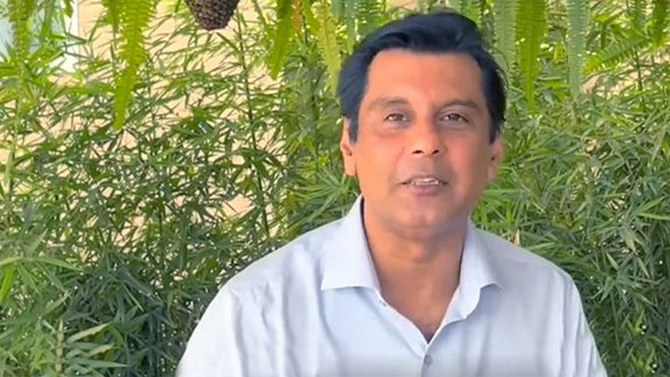
The image shows slain Pakistani journalist Arshad Sharif on October 6, 2022. (Arshad Sharif Official/YouTube)
Short Url
Updated 07 November 2022
Follow

Head of government commission to probe Arshad Sharif’s killing says can’t proceed with assignment

  • The retired Lahore High Court judge maintains Sharif’s family is not satisfied with the investigation mechanism
  • He says a media representative should also have been part of the commission in the interest of justice in the case

ISLAMABAD: A retired Pakistani judge, who was nominated by the government to head an inquiry commission to probe journalist Arshad Sharif’s killing in Kenya, told the federal authorities on Sunday his three-member team would not be able to proceed with the assignment.

The commission was announced at the beginning of the month to thoroughly investigate the circumstances of Sharif’s death in the East African state.

The government appointed a retired Lahore High Court judge, Abdul Shakoor Paracha, as its head while nominating additional inspector general Dr. Usman Anwar and Intelligence Bureau deputy director general Omar Shahid Hamid to assist him.

However, the retired judge said it was not possible for the commission to proceed since the mother of the slain journalist had already “expressed dissatisfaction” with the investigation mechanism.

“She has already moved an application to the [Honorable] Chief Justice of Pakistan seeking justice,” he said in a statement shared with journalists. “A member of the Commission [Omar Shahid Hamid] had already visited Nairobi and it is not legally sustainable that he can be part of the commission based on his previous findings. Finally, no representative of the media was part of the commission which in my thinking is necessary so that the justice is not only served but is seen when done so.”

Sharif, who did a talk show with a local news channel, was killed on October 23 when his car sped up and drove through a checkpoint outside the Kenyan capital, prompting the police to open fire.

The law enforcement officials in Nairobi expressed regret over the incident, saying it was a case of “mistaken identity” during a search for a car involved in a child abduction case.

Prior to that, the deceased journalist, who of late had been a harsh critic of the incumbent government and the military, had to leave the country after several cases related to charges of sedition and others were filed against him.

He was believed to have been in the United Arab Emirates since he left Pakistan, though he then traveled to Kenya from the Emirates.

Sharif’s mother, in a recent letter to the chief justice of Pakistan, demanded a “high-power judicial commission” to “determine the real motive and identify criminals behind this heinous crime.”

She also criticized how the government was dealing with her son’s killing.

“The Prime Minister in his statement had made an announcement that a letter will be written to Islamabad High Court to appoint a high-power judicial commission,” she continued. “However, unfortunately, contradictory to his statement one retired Justice Abdul Shakoor Piracha and two federal government officials have been made members of the commission which indicates malafide intentions of the government.”

The retired judge also said in his statement the prime minister had announced to let the chief justice constitute a commission in Sharif’s killing.


Pakistan court directs authorities to form medical board to assess Imran Khan’s eye condition

Updated 12 March 2026
Follow

Pakistan court directs authorities to form medical board to assess Imran Khan’s eye condition

  • Islamabad High Court rejects jailed ex-PM’s request for immediate transfer to private hospital
  • Medical board comprising doctors from PIMS and Shifa to submit report on possible transfer

ISLAMABAD: A Pakistani high court on Thursday directed authorities to form a medical board of government doctors to assess whether jailed former prime minister Imran Khan needs to be transferred to a hospital, his party said, following a rejection of his request to be moved to a private facility for treatment.

The development comes after the Pakistan Institute of Medical Sciences (PIMS) said last week that Khan’s vision had “improved remarkably” since he was given an Anti-VEGF injection amid concerns related to his eyesight.

Anti-VEGF injections are commonly used to treat retinal vein occlusion and other retinal vascular disorders by reducing swelling and abnormal blood vessel growth inside the eye. Prior to the development, the ex-premier had complained of rapid deterioration in vision in one of his eyes.

“The Islamabad High Court has rejected Imran Khan’s request for immediate transfer to Shifa International Hospital,” the Pakistan Tehreek-e-Insaf (PTI) party said in a post on X.

“The court directed that the Chief Commissioner immediately constitute a medical board comprising doctors from PIMS and Shifa Hospital,” it continued. “The medical board will submit a report, on the basis of which the Chief Commissioner will decide whether a hospital transfer is to take place or not.”

The PTI said the court’s decision had raised questions over the judiciary’s independence.

“Delaying a medical emergency and handing it over to administrative discretion is a violation of human rights,” it said. “The issue of Imran Khan’s health is not just about one individual but reflects the entire judicial and state system.”

The 74-year-old cricketer-turned politician has been in prison since August 2023 in cases that he and his party say are politically motivated.

Khan was taken to PIMS for a medical procedure earlier this year, as his party questioned the transparency of the medical update and demanded independent access to his care.

Khan was removed from office in April 2022 through a parliamentary vote of no confidence that he says was orchestrated at the behest of the former administration in Washington by his political rivals with backing from the military. His allegation has been denied by all parties involved.

Since his imprisonment, Khan has faced multiple convictions and ongoing legal proceedings that authorities say follow due process, while his party describes them as efforts to sideline him from politics.