

Pakistan in ‘perilous situation’ after Khan assassination bid 

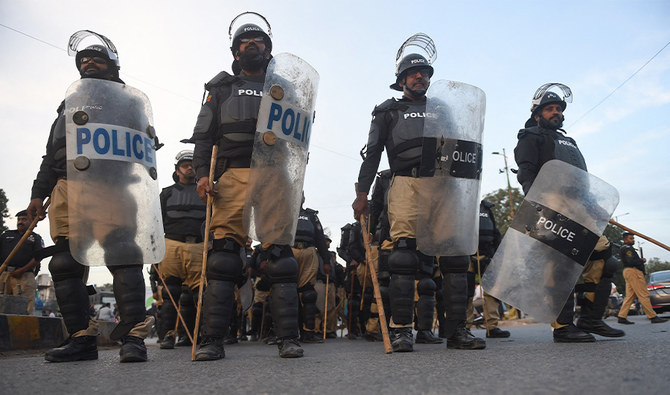
Police stand guard during a protest by supporters of former Pakistan prime minister Imran Khan against the assassination attempt on him in Karachi on November 5, 2022. (AFP)
Short Url
Updated 06 November 2022
Follow

Pakistan in ‘perilous situation’ after Khan assassination bid 

  • Imran Khan escaped with bullet wounds to his legs as he led supporters on a highly publicized march to the capital 
  • Khan says PM Shehbaz Sharif, Interior Minister Rana Sanaullah and an intelligence officer plotted to have him killed 

KARACHI: The assassination attempt on former prime minister Imran Khan and his accusation it was a plot involving a senior intelligence officer has pushed Pakistan into a “dangerous phase,” analysts say. 

Khan escaped with bullet wounds to his legs from an assassination attempt Thursday as he led supporters on a highly publicized march to the capital to press for early elections. 

He claimed Friday that Prime Minister Shehbaz Sharif, Interior Minister Rana Sanaullah, and Maj. Gen. Faisal Nasir — an intelligence officer — plotted to have him killed and have it blamed on “a religious fanatic.” 

“The political situation in Pakistan has entered into a dangerous phase,” said academic and political analyst Tauseef Ahmed Khan, who is also a board member of the Human Rights Commission of Pakistan. 

“In a country with a history of political chaos, the sounds echo.” 

Despite being ousted by a vote of no-confidence in April, Khan retains mass public support — winning a string of by-elections even as he battles a slew of legal cases brought by the current government. 

As the pressure rises, the government’s dependence on the country’s “deep state” — a term often used to refer to the powerful military — for its survival is increasing, Ahmed Khan said. 

“It is a perilous situation — not only for the democratic process but also for the country — especially with regards to economic development,” he said. 

“The issue(s) of poverty, hunger, and development fall into the background.” 

Khan and Sharif have been at each other’s throats for months, trading accusations of incompetence and corruption with language and tone dripping with contempt. 

But such a public accusation by Khan, and the naming of a senior military officer, has taken the situation to a new level of crisis. 

Khan has offered no evidence to back his claims, which the government has dismissed as “lies and fabrications.” 

Criticism of the military — which has ruled the country for roughly half of its 75-year history — has always been a red line, but Khan has been increasingly outspoken against a security establishment many say backed his original rise to power. 

On Friday, the military’s press wing issued a statement urging the government to take Khan to court for defamation. 

Officials from Khan’s Pakistan Tehreek-e-Insaf (PTI) party could also be in the crosshairs. 

Senior party members have already been charged with “sedition” and other offenses since Khan’s ouster, as have journalists considered sympathetic to the former PM. 

“It seems that now some sort of operation might be launched against PTI,” said analyst Ahmed Khan, adding there was a risk the party could fragment. 

As Khan’s huge rallies are designed to prove — to both his political opposition and the military — that he has the support of the public, the results could be “chaos, despair, and disappointment,” he added. 

In such a charged atmosphere, multiple accusations and denials from both sides are unlikely to ever be properly probed, said Karachi-based political analyst Kaiser Bengali. 

That, he added, leaves room for conspiracy theories to abound. 

“The state has lost its legitimacy... police, law and order institutions — even the judiciary,” he said. 

Bengali said the military was now “sitting and wondering what went wrong and what can they do.” 

The government has said the assassination bid against Khan was “a very clear case of religious extremism,” blaming a lone gunman who hailed from a poor village. 

Pakistan has long grappled with Islamist militancy, with right-wing religious groups having huge sway over the population in the Muslim-majority country. 

Khan and his PTI have been accused in the past of stoking religious sentiments to appeal to a wider support base. 

“Religious extremism is a weapon which the PTI use — and so do the army and the state,” said Bengali. “So we are heading toward an immensely dangerous situation.” 

Behind the political crisis, however, hides a more pervasive one: the economy. 

“The state is bankrupt, whatever resources it has are consumed in debt servicing and defense, and the government salaries,” Bengali said. 

“Whatever crumbs are available is what the politicians are fighting over... that is why the fight has become so petty.” 


Imran Khan’s party shutdown draws mixed response; government calls it ‘ineffective’

Updated 08 February 2026
Follow

Imran Khan’s party shutdown draws mixed response; government calls it ‘ineffective’

  • Ex-PM Khan’s PTI party had called for a ‘shutter-down strike’ to protest Feb. 8, 2024 general election results
  • While businesses reportedly remained closed in Khyber Pakhtunkhwa, they continued as normal elsewhere

ISLAMABAD: A nationwide “shutter-down strike” called by former prime minister Imran Khan’s party drew a mixed response in Pakistan on Sunday, underscoring political polarization in the country two years after a controversial general election.

Khan’s Pakistan Tehreek-e-Insaf (PIT) opposition party had urged the masses to shut businesses across the country to protest alleged rigging on the second anniversary of the Feb. 8, 2024 general election.

Local media reported a majority of businesses remained closed in the Khyber Pakhtunkhwa (KP) province, governed by the PTI, while business continued as normal in other provinces as several trade associations distanced themselves from the strike call.

Arab News visited major markets in Islamabad’s G-6, G-9, I-8 and F-6 sectors, as well as commercial hubs in Rawalpindi, which largely remained operational on Sunday, a public holiday when shops, restaurants and malls typically remain open in Pakistan.

“Pakistan’s constitution says people will elect their representatives. But on 8th February 2024, people were barred from exercising their voting right freely,” Allama Raja Nasir Abbas Jafri, the PTI opposition leader in the Senate, said at a protest march near Islamabad’s iconic Faisal Mosque.

Millions of Pakistanis voted for national and provincial candidates during the Feb. 8, 2024 election, which was marred by a nationwide shutdown of cellphone networks and delayed results, leading to widespread allegations of election manipulation by the PTI and other opposition parties. The caretaker government at the time and the Election Commission of Pakistan (ECP) both rejected the allegations.

Khan’s PTI candidates contested the Feb. 8 elections as independents after the party was barred from the polls. They won the most seats but fell short of the majority needed to form a government, which was made by a smattering of rival political parties led by Prime Minister Shehbaz Sharif. The government insists the polling was conducted transparently and that Khan’s party was not denied a fair chance.

Authorities in the Pakistani capital deployed a heavy police contingent on the main road leading to the Faisal Mosque on Sunday. Despite police presence and the reported arrest of some PTI workers, Jafri led local PTI members and dozens of supporters who chanted slogans against the government at the march.

“We promise we will never forget 8th February,” Jafri said.

The PTI said its strike call was “successful” and shared videos on official social media accounts showing closed shops and markets in various parts of the country.

The government, however, dismissed the protest as “ineffective.”

“The public is fed up with protest politics and has strongly rejected PTI’s call,” Pakistan’s Information Minister Attaullah Tarar said on X.

“It’s Sunday, yet there is still hustle and bustle.”

Ajmal Baloch, All Pakistan Traders Association president, said they neither support such protest calls, nor prevent individuals from closing shops based on personal political affiliation.

“It’s a call from a political party and we do not close businesses on calls of any political party,” Baloch told Arab News.

“We only give calls of strike on issues related to traders.”

Khan was ousted from power in April 2022 after what is widely believed to be a falling out with the country’s powerful generals. The army denies it interferes in politics. Khan has been in prison since August 2023 and faces a slew of legal challenges that ruled him out of the Feb. 8 general elections and which he says are politically motivated to keep him and his party away from power.

In Jan. 2025, an accountability court convicted Khan and his wife in the £190 million Al-Qadir Trust land corruption case, sentencing him to 14 years and her to seven years after finding that the trust was used to acquire land and funds in exchange for alleged favors. The couple denies any wrongdoing.