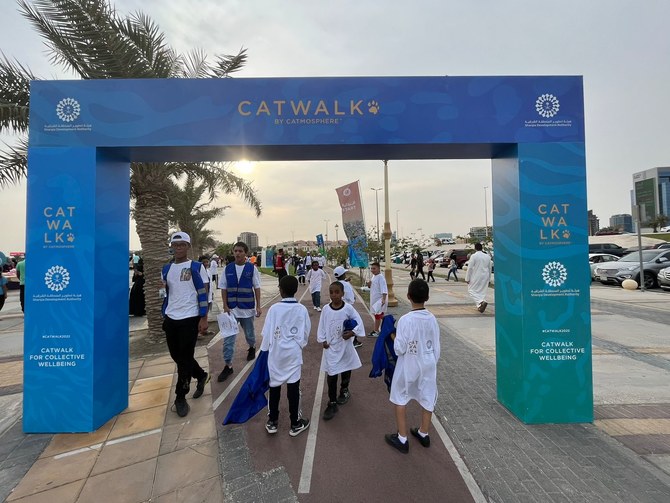
RIYADH: Catmosphere’s second annual Catwalk to raise awareness of endangered wildlife and collective well-being attracted thousands of participants in the Kingdom and around the world on Saturday.
“We were thrilled that the inaugural Catwalk in 2021 received such overwhelming support, showing a huge appetite for our message and support for action to conserve the iconic big cats throughout the world,” Princess Reema Bandar, founder of Catmosphere, said.
This year’s Catwalk is expected to be much bigger than last year’s, which had 27,000 participants in 102 countries.
More than 50 organized walks took place in the Kingdom alone, with many cities participating, including Asir, Riyadh, Alkhobar, Dharan, Al-Qassim, Makkah, Jeddah and Jazan.
The official number of participants have yet to be announced, but this year’s attendance already appears to be higher than the first Catwalk last year.
Catwalk is an annual global event that invites people to take part in a 7 km walk to promote interconnected well-being and preservation of wildlife, including the seven big cats — tigers, lions, leopards, jaguars, pumas, cheetahs and snow leopards, with a focus on the endangered Arabian leopard.
This year several locations in Riyadh hosted the catwalk, including Diriyah, the Diplomatic Quarter, Riyadh Front, and King Abdulaziz City for Science and Technology.
One of the participants, Amirulhusni Sahar walked in Diriyah. He said that some of his family took part in the first Catwalk, but this is his first time.
“I am here with my family and we are representing Malaysia as well,” Sahar, the first secretary of the Malaysian Embassy, said.
Sian Tichar, the Catwalk campaign manager in Riyadh, explained Catmosphere’s mission in promoting collective well-being.
“The concept of collective well-being means that in order to have a healthy planet we need to have healthy people. What the Catwalk does is invites people to take a walk outside. If you are walking outside, you are likely to feel better about yourself and you will notice nature, and if you care about nature, you will care about wildlife,” Sian Tichar said.
“Princess Reema’s initiative, the foundation Catmosphere, and its flagship campaign, Catwalk, invite people to go on a walk and learn about the stories of big cats and the challenges they face to interpret the concept of collective well-being,” she added.
Tichar said that last year during the first Catwalk many people used the opportunity to pick up trash and plant trees.
“I’m very proud to be a part of the Catwalk team and really excited to see Saudi leading by example in getting behind causes that help promote collective well-being.”
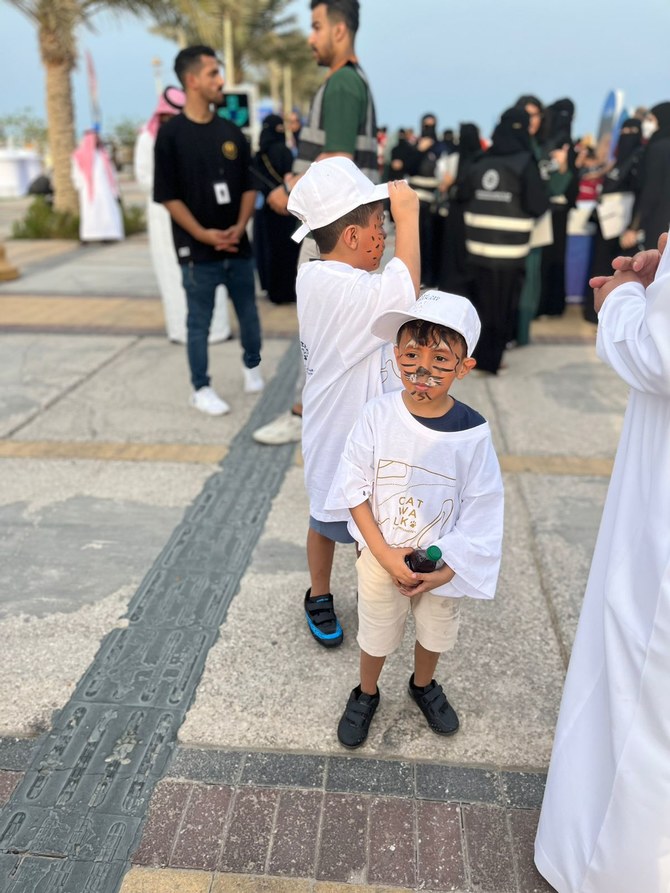
Diriyah Gate CEO Jerry Inzerillo joined this year’s Catwalk in the historic center. Many Saudi Scouts were present to assist and guide participants along the walk, while a Saudi Games mascot greeted children, and snacks and drinks were provided before and after the walk.
Northeast of the Riyadh Catmosphere festivities, the Alkhobar Corniche came to life as locals joined the annual Catwalk.
Families gathered at a spot overlooking the Alkhobar water tower as excited children — many of whom had their faces painted with an image of a wild cat — joined the walk.
“It’s a good turnout and it’s pretty interesting for the kids — they are excited to see something different after a long time. Most of these animals are in the endangered category, so it’s interesting to see how the artists have come up with different variations and colors,” local resident Shaila G. told Arab News.
One of the participating artists, Reem Alsaaq, had her paintbrush at the ready and was adding color on the spot.
“I found out about this event through my local artist group. They asked me to paint something live at the corniche and I decided to re-create an image of a wildcat that looks like it is pondering life,” Alsaaq told Arab News.
Laura Masoni found out about the event through her compound.
“I’m very sensitive about animals and wildlife matters. We are here with my family and friends of my kids just to be all together and do something for a good cause,” she said.
Giovanni Gennari added: “it’s a very important cause to protect our environment. It was a good day out and a good way to stay away from home and from tablets and video games. The day is perfect.”
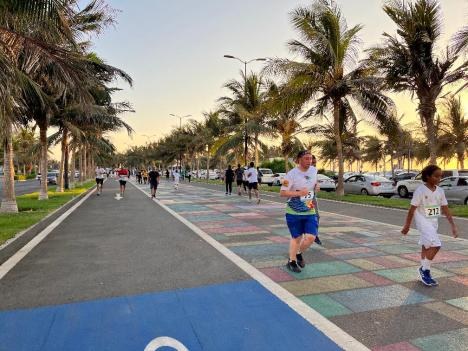
The catwalk was held in three different locations in Jeddah city, including the Corniche, Prince Majed Park and Prince Fawaz walkway.
Wesam Zailai, general manager of the Catwalk: said: “The event is divided into two categories, walking and running, and three distances: 1 km, 3.5 km and 7 km to preserve the Arabian leopard.”
He added: “We have 300 adults and 150 children participating today.”
Saudi participant Abdulrahman Al-Enizi, 43, was the first-place winner at the Jeddah Catwalk in Corniche.
After running the 7 km in 24 minutes, Al-Enizi told Arab News: “I am so happy with this initiative, and I showed up today to support the cause and spread awareness about saving the Arabian leopard from extinction. I personally appreciate sports, especially walking, which improves both mental and physical health.”
Al-Enizi came with his 6-year-old son Abdulmalik, who joined the 1 km category for children.
Arab News also interviewed children in the Kingdom to find out what they know about the Arabian leopard and what could be done to help the threatened species.
Saudi Raed Jawa, 13, said that the Arabian leopard is “considered one of the largest Arab cats and it is the most endangered animal.”
However, Jawa said that his favorite big cat is the lynx. “There are many endangered animals that I love and want to see,” he added.
His sister, 11-year-old Hala, explained that the Arabian leopard belongs to the feline family of carnivorous mammals and is found in the Arabian Peninsula.
“My favorite big cat is the tiger,” she said.
“I’m so glad we have animal conservations in this country because I love animals.”
Bangladeshi Aleena Haque, 9, said that her favorite big cats are lions, leopards, cheetahs and the Bengal tiger.
She is concerned about the Arabian Leopard being an endangered species. “I’m worried about it going extinct because I love animals so much,” she told Arab News.
In 2021, Catmosphere was launched by Princess Reema, Saudi Arabia’s ambassador to the US, who is on a mission to safeguard the future of big cats. The nonprofit aims to magnify the efforts of Panthera, a US-based charity devoted to the conservation of 40 species of wild cats.


![]()
![]()
![]()
![]()

Kingdom heeds call of the wild with Catwalk

Short Url
https://arab.news/yz4wg
Kingdom heeds call of the wild with Catwalk
- Thousands join walk for wildlife, well-being in Catmosphere’s second annual event
- This year several locations in Riyadh hosted the catwalk, including Diriyah, the Diplomatic Quarter, Riyadh Front, and King Abdulaziz City for Science and Technology


Latest updates


© 2026 SAUDI RESEARCH & PUBLISHING COMPANY, All Rights Reserved And subject to Terms of Use Agreement.