

Pakistan minister accuses Imran Khan of inciting violence in wake of ‘assassination’ attempt

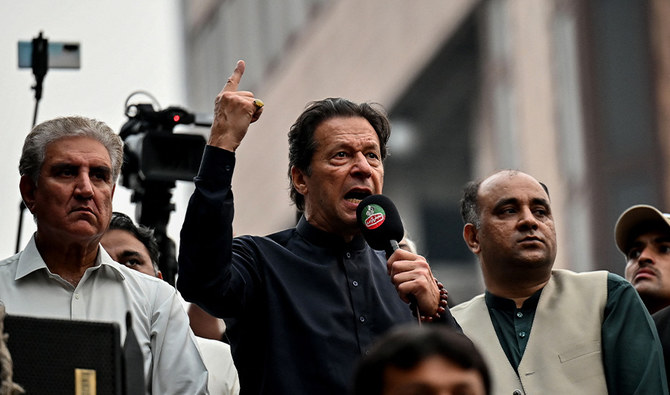
Pakistan's former prime minister Imran Khan (C) addresses his supporters during an anti-government march towards capital Islamabad, demanding early elections, in Gujranwala on November 1, 2022. (AFP)
Short Url
Updated 06 November 2022
Follow

Pakistan minister accuses Imran Khan of inciting violence in wake of ‘assassination’ attempt

  • Marriyum Aurangzeb says Khan’s demand PM Sharif resign ‘ridiculous,’ says he wants chaos
  • Imran Khan has accused PM Sharif, interior minister and ISI top official for plotting to kill him

DUBAI: The Pakistani information minister on Sunday accused former Prime Minister Imran Khan of inciting violence through his call for daily nationwide protests, saying he was welcome to call an international body to aid investigations into a gun attack in which he was injured this week. 

Khan was shot in the legs on Thursday as he waved to crowds from atop a truck-mounted container while leading a dayslong protest march to Islamabad from Lahore to pressure the government to announce early elections.

The leader of the Pakistan Tehreek-e-Insaf party was removed from office in a parliamentary vote of no-confidence in April, and has since frequently said his ouster was part of a US-backed “foreign conspiracy.” Washington and Khan’s opponents, including Prime Minister Shehbaz Sharif who heads the coalition government, deny the claim.

In a press talk from hospital on Friday, his legs bandaged and propped up on a chair, Khan said he would relaunch his protest march to the capital. Just hours before the former leader spoke, his supporters staged national wide demonstrations, blocking major roads and clashing with police. 

Khan also called on supporters to mobilize daily to protest the “assassination” attempt against him and demand the resignation of the sitting PM.
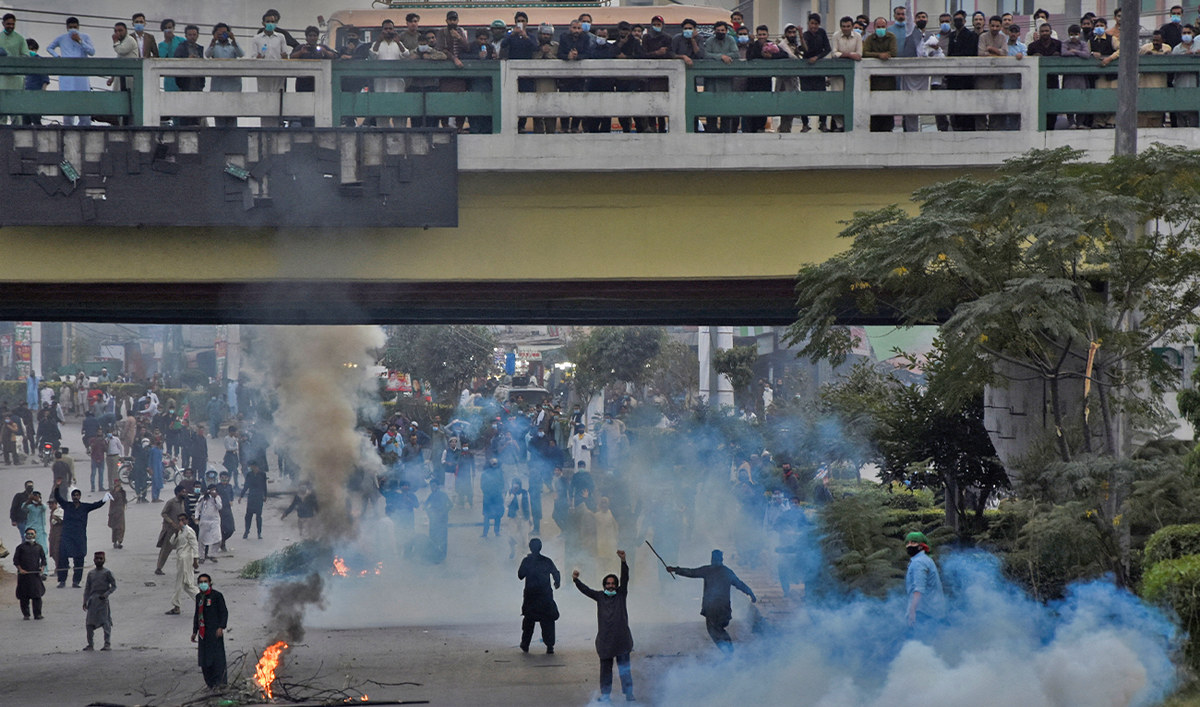


People react as police use tear gas to disperse them during a protest to condemn the shooting incident on a long march held by Pakistan's former Prime Minister Imran Khan in Wazirabad, in Rawalpindi, Pakistan, on November 4, 2022. (REUTERS)

In a phone interview with Arab News, Pakistan’s Information Minister Marriyum Aurangzeb said Khan wanted “chaos in the country.”

“Mr. Khan is inciting violence in Pakistan and instigating hate in Pakistan,” she said. 

Since Thursday’s attack, Khan has held three officials responsible: Prime Minister Shehbaz Sharif, Interior Minister Rana Sanaullah and Inter-Services Intelligence director-general for counter-intelligence Maj. Gen. Faisal Naseer. Khan has also called for all three to step down, saying a transparent probe was impossible while they remained in office. 

The ex-premier has not provided evidence to support his accusations. Both the government and the military have said the accusations are baseless. 

“It’s absurd, it’s ridiculous to the max … How is the prime minister connected to this incident?” the information minister said, adding that Khan could call an international agency to come to Pakistan and be involved in the probe if he wanted to. 


As the attack took place in Pakistan’s Punjab province, which is ruled by Khan’s Pakistan Tehreek-e-Insaf party, Aurangzeb said the former PM had everything at his disposal — the administration, police and intelligence — to conduct a probe but so far has not even filed a first information report, or FIR, which is the first step in Pakistan’s legal system before an investigation into a case. 

“It is a fact that it has been 48 hours since the incident and the FIR report has not been registered in any police station in Punjab,” she said.

Aurangzeb reiterated that the Sharif government immediately called for a probe after the attack.

“The moment this incident happened, the prime minister of Pakistan called the interior minister and immediately asked for an initial report from the chief secretary of Punjab and the IG (Inspector General) Punjab,” Aurangzeb said. “And the interior minister was instructed to give all recourses, all assistance to the Punjab government for any investigation they want, for any security they want.”

“And the interior minister was instructed to give all recourses, all assistance to the Punjab government, for any investigation they want, for any security they want.”



Islamabad dismisses claims about paying up to 8 percent interest on foreign loans as ‘misleading’

Updated 22 February 2026
Follow

Islamabad dismisses claims about paying up to 8 percent interest on foreign loans as ‘misleading’

  • Pakistan has long relied on external loans to help bridge persistent gaps in public finances and foreign exchange reserves
  • Pakistan’s total external debt, liabilities stand at $138 billion at an overall average cost of around 4 percent, ministry says

KARACHI: Pakistan’s finance ministry on Sunday dismissed as “misleading” claims that the country is paying up to 8 percent interest on external loans, saying the overall average cost of external public debt is approximately 4 percent.

Pakistan has long relied on external loans to help bridge persistent gaps in public finances and foreign exchange reserves, driven largely by a narrow tax base, chronic trade deficits, rising debt-servicing costs and repeated balance-of-payments pressures.

Over the decades, successive governments have turned to multilateral and bilateral lenders, including the International Monetary Fund, the World Bank and the Asian Development Bank, to support budgetary needs and shore up foreign exchange reserves.

The finance ministry on Sunday issued a clarification in response to a “recent press commentary” regarding the country’s external debt position and associated interest payments, and said the figures required contextual explanation to ensure accurate understanding of Pakistan’s external debt profile.

“Pakistan’s total external debt and liabilities currently stand at $138 billion. This figure, however, encompasses a broad range of obligations, including public and publicly guaranteed debt, debt of Public Sector Enterprises (both guaranteed and non-guaranteed), bank borrowings, private-sector external debt, and intercompany liabilities to direct investors. It is therefore important to distinguish this aggregate figure from External Public (Government) Debt, which amounts to approximately $92 billion,” it said.

“Of the total External Public Debt, nearly 75 percent comprises concessional and long-term financing obtained from multilateral institutions (excluding the IMF) and bilateral development partners. Only about 7 percent of this debt consists of commercial loans, while another 7 percent relates to long-term Eurobonds. In light of this composition, the claim that Pakistan is paying interest on external loans ‘up to 8 percent’ is misleading.

The overall average cost of External Public Debt is approximately 4 percent, reflecting the predominantly concessional nature of the borrowing portfolio.”

With respect to interest payments, public external debt interest outflows increased from $1.99 billion in Fiscal Year (FY) 2022 to $3.59 billion in FY2025, representing an increase of 80.4 percent, not 84 percent as reported. In absolute terms, interest payments rose by $1.60 billion over this period, not $1.67 billion, it said.

According to the State Bank of Pakistan’s records, Pakistan’s total debt servicing payments to specific creditors during the period under reference were as follows: the IMF received $1.50 billion, of which $580 million constituted interest; Naya Pakistan Certificates payments totaled $1.56 billion, including $94 million in interest; the Asian Development Bank received $1.54 billion, including $615 million in interest; the World Bank received $1.25 billion, including $419 million in interest; and external commercial loans amounted to nearly $3 billion, of which $327 million represented interest payments.

“While interest payments have increased in absolute terms, this rise cannot be attributed solely to an expansion in the debt stock,” the ministry said. “Although the overall debt stock has increased slightly since FY2022, the additional inflows have primarily originated from concessional multilateral sources and the IMF’s Extended Fund Facility (EFF) under the ongoing IMF-supported program.”

Pakistan secured a $7 billion IMF bailout in Sept. 2024 as part of Prime Minister Shehbaz Sharif’s efforts to stabilize the South Asian economy that narrowly averted a default in 2023. The government has since been making efforts to boost trade and bring in foreign investment to consolidate recovery.

“It is also important to note that the increase in interest payments reflects prevailing global interest rate dynamics. In response to the inflation surge of 2021–22, the US Federal Reserve raised the federal funds rate from 0.75-1.00 percent in May 2022 to 5.25–5.50 percent by July 2023. Although rates have since moderated to around 3.75 percent, they remain significantly higher than 2022 levels,” the finance ministry said.

“The government remains committed to prudent debt management, transparency, and the continued strengthening of Pakistan’s macroeconomic stability,” it added.