


KARACHI: Pakistan’s currency closed on a marginally bullish note against the US dollar while the equities witnessed a slim trading session on Friday after an apparent assassination attempt against former prime minister Imran Khan shook the country a day before, said traders and analysts.
The rupee gained only by 0.01% to close at Rs221.92 against the greenback amid lackluster trading activity in the interbank and open markets. However, the national currency lost its overall value by Rs1.03 against the US dollar.
The open market trade also remained subdued since buyers and sellers refrained from taking definitive positions amid growing political uncertainty, said traders.
“Trading was almost negligible today due to the political noise after yesterday’s firing incident that injured Imran Khan,” Zafar Sultan Paracha, general secretary of the Exchange Companies’ Association of Pakistan, told Arab News.
“People did not come to the market today after protest calls from the Pakistan Tehreek-e-Insaf [PTI] party, fearing possible deterioration in the law-and-order situation in case of widespread demonstrations,” he continued.
The Pakistani rupee has consistently remained under pressure due to the high market demand for US dollars since businesses have been under pressure to make import payments. The greenback has also remained in short supply despite the recent inflow of $1.5 billion from the Asian Development Bank.
According to a statement issued by the State Bank, Pakistan’s official forex reserves increased by $1.47 billion to $8.9 billion until October 28.
The country’s trade deficit declined to a 23-month low of $2.26 billion, down by 42% on an annual basis in October.
The Pakistan Bureau of Statistics said the July-October trade deficit posted a 26.6% decline with imports of $21.01 billion and exports of $9.54 billion.
Local currency dealers, however, remained optimistic that the situation would improve after political uncertainty dissipated.
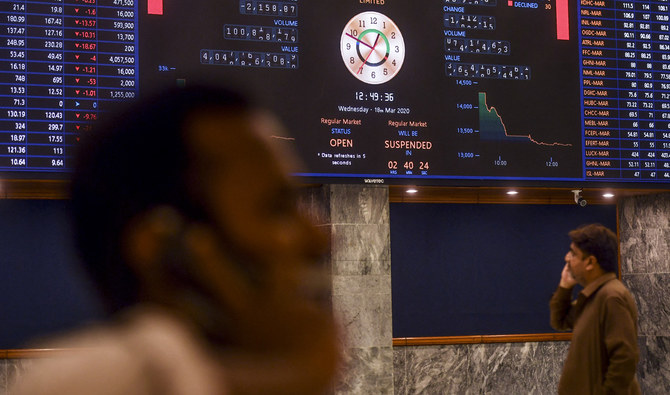
Meanwhile, Pakistan’s equities closed bearish with a loss of 234 points since investors sat on the sidelines throughout the trading session.
“The countrywide protests in the wake of the attack on the PTI chief and the global equity rout played a catalyst role in the bearish close,” Ahsan Mehanti, chief executive officer of Arif Habib Corporation, told Arab News.
The weekly inflation also increased by 0.53% in the outgoing week, as a major increase was observed in the prices of food items.
The weekly inflation increased to 30.6% in year-on-year basis, according to official data released on Friday.


