

‘Soft-spoken’ scrap trader accused of Imran Khan attack

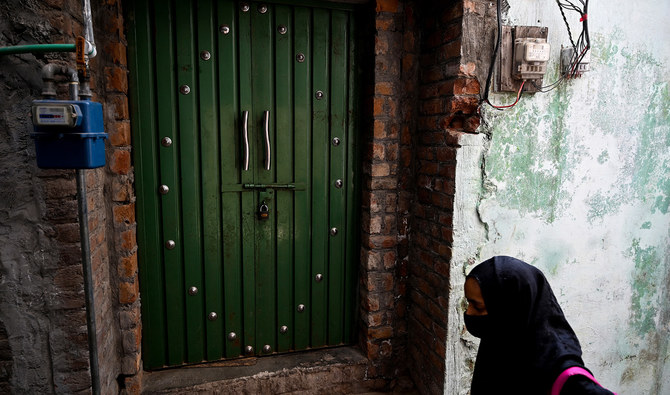
A child walks past a locked house of an attacker, who made an assassination attempt on former Pakistani prime minister Imran Khan, on his container truck a day after at Sodhra in Gujranwala district on November 4, 2022. (Photo courtesy: AFP)
Short Url
Updated 04 November 2022
Follow

‘Soft-spoken’ scrap trader accused of Imran Khan attack

  • Police picked up Naveed Ahmad’s mother, wife and two sons shortly after the shooting incident
  • People in his hometown say Ahmad worshipped in the mosque but displayed no militant sentiments

SODHRA, Pakistan: In an impoverished Pakistan suburb, neighbors of a mild-mannered scrap trader expressed shock Friday that he was being held over an attempt on the life of former prime minister Imran Khan.

“We used to exchange pleasantries whenever we crossed paths in the street,” 34-year-old Shamshad Ali told AFP. “I found him to be a soft-spoken person, without an iota of anger.”

Naveed Ahmad is the sole suspect in custody after Khan was wounded by a spray of gunfire at a political rally in the eastern city of Wazirabad on Thursday.

An apparent confession video leaked by police -- and cited by the government -- shows Ahmad saying he attacked Khan because his protest interrupted the call to prayer which summons Muslims to mosques five times daily.

The government’s interior minister Rana Sanaullah said the attack was motivated on religious grounds.

Khan’s Pakistan Tehreek-e-Insaf (PTI) party, however, has condemned what it called a “conspiracy,” accusing government ministers and military generals of masterminding the attack.

In the town of Sodhra -- on the outskirts of Wazirabad -- AFP found Ahmad’s family home padlocked shut, down a dingy narrow alley lined by an open sewer.

Neighbors said his mother, wife and two sons were picked up by police shortly after the attack in which Khan suffered non-life-threatening leg injuries, halting his march towards the capital Islamabad.

Police have not yet commented on the incident, but Punjab government officials confirmed the suspect’s name.

Muhammad Munir, who makes the call to prayer at the local mosque, watched Ahmad come to worship there “quite often” but considered him “the kind of a person who minds his own business.”

“I never heard anything negative about him,” the 55-year-old said. “I never saw him fighting or exchanging harsh words with anyone.”

Hardline religious parties hold influence over swathes of Pakistan, but Ahmad’s fellow worshippers said he expressed no militant sentiments.

“Naveed was a simple boy and had no leanings towards any religious parties,” said 26-year-old Abrar Ahmad, no relation of the alleged attacker.

Numerous neighbors said Ahmad inherited a junk store from his deceased father and had worked in Saudi Arabia, a common destination for impoverished Pakistanis who send remittance payments to their families back home.

“I am surprised at how Naveed, who belongs to a poor family, dared to make such an attempt,” said local grocer 36-year-old Muhammad Saleem.


Pakistan, UK sign £35 million Green Compact to strengthen climate resilience

Updated 21 December 2025
Follow

Pakistan, UK sign £35 million Green Compact to strengthen climate resilience

  • Pakistan ranks among nations most vulnerable to climate change and has seen erratic changes in its weather patterns
  • UK will help Pakistan mobilize climate finance, strengthen regulatory frameworks and develop bankable climate projects

ISLAMABAD: Pakistan and the United Kingdom (UK) have formalized a comprehensive climate partnership with the launch of a Green Compact that aims to enhance climate resilience, accelerate clean energy transition and scale up nature-based solutions, including mangrove conservation, Pakistani state media reported on Sunday.

The agreement, signed in Islamabad by Federal Minister for Climate Change and Environmental Coordination Dr. Musadik Malik and UK Minister for International Development Jennifer Chapman, unlocks £35 million in targeted support for green development and long-term climate action, according to Radio Pakistan broadcaster.

Pakistan ranks among nations most vulnerable to climate change and has seen erratic changes in its weather patterns that have led to frequent heatwaves, untimely rains, storms, cyclones, floods and droughts in recent years. In 2022, monsoon floods killed over 1,700 people, displaced another 33 million and caused over $30 billion losses, while another 1,037 people were killed in floods this year.

Mohammad Saleem Shaikh, a spokesperson for Pakistan’s Ministry of Climate Change, described the compact as a “decisive move toward action-oriented climate cooperation,” noting that its implementation over the next decade will be critical for Pakistan which regularly faces floods, heatwaves and water stress.

“The Compact is structured around five core pillars: climate finance and investment, clean energy transition, nature-based solutions, innovation and youth empowerment, and adaptation and resilience,” the report read.

“Under the agreement, the UK will work with Pakistan to mobilize public and private climate finance, strengthen regulatory frameworks for green investment, and develop bankable climate projects.”

Clean energy forms a central component of Pakistan’s transition, with Islamabad planning to expand solar and wind generation to reduce fossil fuel dependence, improve energy security and stabilize power costs, according to Shaikh.

“Renewable energy is now economically competitive, making the transition both environmentally and financially viable,” he was quoted as saying.

“Nature-based solutions, particularly large-scale mangrove restoration, will protect coastal communities from storm surges and erosion while enhancing biodiversity and carbon sequestration.”

Under the Compact, technical support, mentoring and access to investors will be provided to climate-smart startups and young innovators, reflecting Pakistan’s recognition of youth-led initiatives as central to future climate solutions.

On the occasion, Chapman, on her first official visit to Pakistan, underscored the urgency of climate action, highlighting the UK’s support for renewable energy, mangrove and ecosystem restoration, early-warning systems, climate budgeting and international investment flows into Pakistan.

Shaikh described the Green Compact as “a strategic turning point” in Pakistan–UK relations on climate change, saying its effective implementation is essential for Pakistan to meet its national climate targets.