

Dhaka eyes opportunity to send health workers to Saudi Arabia

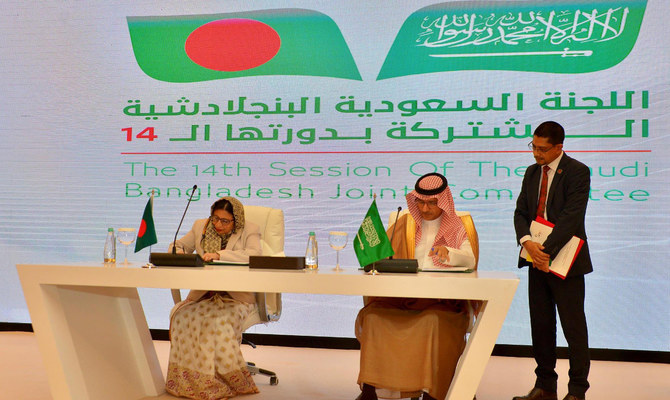
The MoU signing to establish a Saudi-Bangladesh business council. (SPA)
Short Url
Updated 01 November 2022
Follow

Dhaka eyes opportunity to send health workers to Saudi Arabia

  • Only about 50 Bangladeshi clinicians reside in the Kingdom
  • Bangladesh health sector struggling to employ medical graduates

DHAKA: Bangladesh is eyeing a new opportunity to send its clinicians to Saudi Arabia, officials said on Wednesday, after an initial agreement was reached during a Bangladesh-Saudi Arabia Joint Commission meeting in Riyadh.

The 14th session of the joint commission took place on Oct. 30-31, focusing on wide-ranging cooperation, including in the fields of energy, security, labor, investment and health.

During the meeting, the two countries agreed to form a business council to increase trade and a task force to enhance energy cooperation. The two sides also signed an expedited memorandum of understanding for the recruitment of Bangladeshi medics.

“We agreed to initiate an executive program to bring Bangladeshi health sector professionals into the Kingdom. Under this program, Bangladeshi doctors, nurses and other health professionals will get the opportunity to work in the Kingdom,” Dr. Mohammad Javed Patwary, Bangladeshi envoy to Riyadh and permanent representative to the Organization of Islamic Cooperation, told Arab News.

“A big development took place on this point,” he added.

“I hope this program will move forward very fast. It’s almost final and I hope the deal will be signed shortly.”

According to Bangladesh Medical Association data, only about 50 Bangladeshi clinicians reside the Kingdom, which otherwise is home to some 2.5 million expat workers from the South Asian country.

The potential to increase that number would not only enhance the Kingdom’s workforce in the health sector, but would also be an investment in the quality of Bangladeshi medics, given the top quality of equipment at Saudi clinics, according to Dr. Ehteshamul Huq Choudhury, the medical association’s secretary general.

“Sending health workers to the Kingdom will create win-win opportunities for both countries. Hospitals in the Kingdom are very well equipped with state-of-the-art technology. When our doctors and nurses work with this equipment, it will obviously increase their skills also,” Choudhury told Arab News.

“Eventually, when they return home with these skills, they will be able to serve the people back home.”

Employment abroad would also help them to retain their profession, as thousands of medical graduates in Bangladesh are now without jobs despite their high education levels.

Bangladesh’s more than 100 medical colleges produce large numbers of certified doctors, and many nursing graduates have completed master’s degrees. But the country’s health infrastructure is unable to accommodate them all.

“At present we have 110,000 registered doctors in the country while there are 123,000 trained nurses. Of them, the government health sector employs 40,000 doctors. The rest are either employed by the private sector or remain unemployed,” Choudhury said.

“As per my knowledge, around 30,000 doctors are currently unemployed,” he added.

“If these health workers remain unemployed for a longer period of time, their knowledge and skills will somehow derail.”

The number of clinicians Bangladesh could send to Saudi Arabia would depend on demand.

“But I think Saudi Arabia is in need of expert doctors, nurses and health technologists. This sort of shortage is seen in many parts of the world now, like in the UK, Australia etc.,” Choudhury said.

“Since we have a huge number of skilled doctors and trained nurses, we can send as many as the Kingdom requires.”


Zelensky says Ukrainian air force needs to improve as Russian drone barrages take a toll

Updated 9 sec ago
Follow

Zelensky says Ukrainian air force needs to improve as Russian drone barrages take a toll

  • Zelensky said Friday he had discussed with his defense minister and the air force commander what new air defense measures Ukraine needs to counter the Russian barrages
  • Russia fired 328 drones and seven missiles at Ukraine overnight and in the early morning

KYIV: Ukrainian President Volodymyr Zelensky on Friday described the performance of the air force in parts of the country as “unsatisfactory,” and said that steps are being taken to improve the response to large-scale Russian drone barrages of civilian areas.
The repeated Russian aerial assaults have in recent months focused on Ukraine’s power grid, causing blackouts and disrupting the heating and water supply for families during a bitterly cold winter.
With the war about to enter its fifth year later this month following Russia’s all-out invasion of its neighbor, there is no sign of a breakthrough in US-led peace efforts following the latest talks this week.
Further US-brokered meetings between Russian and Ukrainian delegations are planned “in the near future, likely in the United States,” Zelensky said.
Zelensky said Friday he had discussed with his defense minister and the air force commander what new air defense measures Ukraine needs to counter the Russian barrages. He didn’t elaborate on what would be done.
Russia fired 328 drones and seven missiles at Ukraine overnight and in the early morning, the air force said, claiming that air defenses shot down 297 drones.
One person was killed and two others were injured in an overnight Russian attack using drones and powerful glide bombs on the central Dnipropetrovsk region, according to the head of the regional military administration, Oleksandr Hanzha.
A Russian aerial attack on the southern Zaporizhzhia region during early daylight hours injured eight people and damaged 18 apartment blocks, according to regional military administration head Ivan Fedorov.
A dog shelter in the regional capital was also struck, killing 13 dogs, Zaporizhzhia City Council Secretary Rehina Kharchenko said.
Some dogs were rushed to a veterinary clinic, but they could not be saved, she said. Seven other animals were injured and are receiving treatment.
Amid icy conditions in Kyiv, more than 1,200 residential buildings in multiple districts of the capital have had no heating for days due to the Russian bombardment of the power grid, according to Zelensky.
The UK defense ministry said Friday that Ukraine’s electricity network “is experiencing its most acute crisis of the winter.”
Mykola Tromza, an 81-year-old pensioner in Kyiv, said he has had his power restored, but recently went without heating and water at home for a week.
“I touched my nose and by God, it was like an icicle,” Tromza said. He said he ran up and down to keep warm.
Russia’s Defense Ministry said that air defenses downed 38 Ukrainian drones overnight, including 26 over the Bryansk region.
Bryansk Gov. Alexander Bogomaz said the attack briefly cut power to several villages in the region.
Another Ukrainian nighttime strike damaged power facilities in the Russian city of Belgorod, disrupting electricity distribution, Gov. Vyacheslav Gladkov said.
Local reports said that Ukrainian missiles hit a power plant and an electrical substation, cutting power to parts of the city.
Fierce fighting has also continued on the front line despite the frigid temperatures.
Ukraine’s Commander in Chief, Col. Gen. Oleksandr Syrskyi, said the front line now measures about 1,200 kilometers (750 miles) in length along eastern and southern parts of Ukraine.
The increasing technological improvements to drones on both sides mean that the so-called “kill zone” where troops are in greatest danger is now up to 20 kilometers (12 miles) deep, he told reporters on Thursday in comments embargoed until Friday.