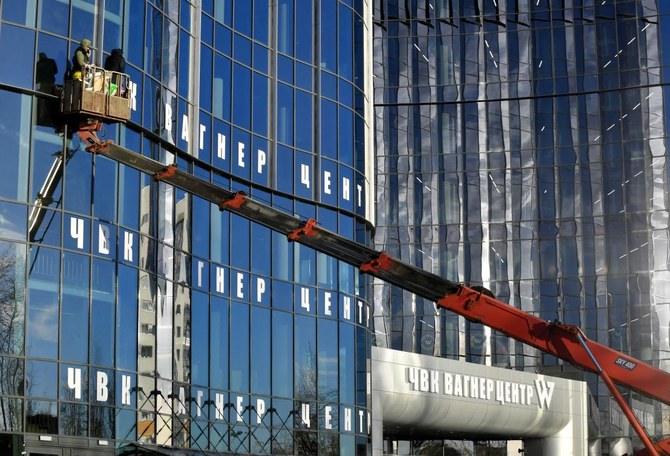
LONDON: Lawyers in Britain on Tuesday took the first step toward what they said was “groundbreaking” legal action against Russia’s shadowy Wagner group over allegations it committed “terrorism” in Ukraine.
The proposed legal action is aimed at uncovering billions of dollars in reparations for victims of the mercenary fighters.
Wagner emerged in 2014 in Ukraine and is suspected by the West of doing the Kremlin’s dirty work in countries such as Syria and the Central African Republic — a charge Russia has always denied.
Jason McCue, senior partner at McCue Jury and Partners, said Wagner and its alleged boss Yevgeny Prigozhin “engaged in a campaign of terrorism” in Ukraine including murder, rape, the targeting of infrastructure and the planting of explosives around nuclear facilities.
“Their purpose was to spread terror and chaos in Ukraine,” he told Britain’s House of Commons Foreign Affairs Committee on Tuesday.
Ukrainian officials have said Wagner has been sending thousands of soldiers recruited in Russian prisons to the front line, with the promise of a salary and an amnesty.
According to communications intercepted by German intelligence, Wagner group mercenaries may have been involved in atrocities in the Ukrainian town of Bucha soon after the invasion on February 24.
McCue told the lawmakers Wagner had to be stopped and that “every option must be pursued to further protect victims of Wagner elsewhere in the world.”
Legal action “on behalf of courageous Ukrainian victims has just this second been commenced” against Wagner group and Prigozhin, he said.
“The claim has been commenced with formal service of a Letter Before Action on Prigozhin and Wagner. This is the first time in the world that Wagner and their likes have been sued by its victims for terrorism, used as a weapon of war, Putin’s illegal war,” he told members of parliament.
McCue said evidence would be produced before the High Court in London aimed at establishing that “Wagner engaged in terrorism against the Ukrainian people” and that “Putin’s war machine engaged in an unlawful conspiracy to deploy terrorism to facilitate their illegal invasion of Ukraine.”
The case was being brought by a group of Ukrainian victims in the UK but also “symbolically represents” all Ukrainians who have “suffered loss as a result of the war,” he added.

Russia’s Wagner group facing UK court action over Ukraine ‘terrorism’
Short Url
https://arab.news/6fywf
Russia’s Wagner group facing UK court action over Ukraine ‘terrorism’
- Jason McCue, senior partner at McCue Jury and Partners, said Wagner and its alleged boss Yevgeny Prigozhin ‘engaged in a campaign of terrorism’ in Ukraine
- According to communications intercepted by German intelligence, Wagner group mercenaries may have been involved in atrocities in the Ukrainian town of Bucha
Filmmakers defend Berlin festival chief in Gaza row
- Actors and filmmakers rushed to defend the head of the Berlin film festival Thursday following a media report that her job was on the line over a director’s anti-Israel speech at the event
BERLIN: Actors and filmmakers rushed to defend the head of the Berlin film festival Thursday following a media report that her job was on the line over a director’s anti-Israel speech at the event.
Syrian-Palestinian filmmaker Abdallah Al-Khatib kicked off a controversy during Saturday’s closing ceremony by accusing Germany of being complicit in genocide in Gaza through its support for Israel.
German tabloid Bild had reported that Tricia Tuttle was due to be dismissed at an emergency meeting on Thursday, citing sources close to state-owned KBB, the company that runs the festival.
Culture minister Wolfram Weimer’s office confirmed the meeting had taken place but made no mention of Tuttle being sacked, stating that discussions had been “constructive and open” and would “continue in the coming days.”
A group of cinema luminaries including Tilda Swinton, Todd Haynes, Sean Baker and Tom Tykwer signed an open letter defending the Berlinale as a forum for free expression.
“As filmmakers in Germany and beyond, we are following the debates surrounding the Berlinale and the discussion about the dismissal of Tricia Tuttle with great concern,” they wrote. “We defend the Berlinale for what it is: a place of exchange.”
Angry rows over the Israel-Palestinian conflict have repeatedly rocked the Berlinale, held every February as Europe’s first major film festival of the year.
Environment Minister Carsten Schneider walked out of Saturday’s closing ceremony, labelling Khatib’s remarks “unacceptable.”
Germany, as it has sought to atone for the horrors of the Holocaust, has been a steadfast supporter of Israel, and criticism of Israel’s conduct in Gaza has been more muted than in many other countries.
Conservative lawmaker Ellen Demuth was among those who condemned the “antisemitic incident” at the awards ceremony and urged “a fresh start at the top of the film festival.”
The Berlinale Team in an Instagram post meanwhile defended Tuttle, praising her “clarity, integrity and artistic vision.”
The writers’ association PEN Berlin said Khatib’s comments were protected by freedom of expression and that if Tuttle were to be sacked over them, it would cause “immense damage” to the festival.
“Such wanton destruction of the German cultural scene, such self-inflicted insularity, must not be allowed to happen,” it said.
The backdrop of the Middle East conflict led to a tense 76th edition of the festival from the start.
More than 80 film professionals criticized the Berlinale’s “silence” on the Gaza war in an open letter, accusing the festival of censoring artists “who reject the genocide” they believe Israel has committed in Gaza.
Award-winning Indian writer Arundhati Roy withdrew from the festival after the jury president, German director Wim Wenders, said cinema should “stay out of politics” when asked about Gaza.
Syrian-Palestinian filmmaker Abdallah Al-Khatib kicked off a controversy during Saturday’s closing ceremony by accusing Germany of being complicit in genocide in Gaza through its support for Israel.
German tabloid Bild had reported that Tricia Tuttle was due to be dismissed at an emergency meeting on Thursday, citing sources close to state-owned KBB, the company that runs the festival.
Culture minister Wolfram Weimer’s office confirmed the meeting had taken place but made no mention of Tuttle being sacked, stating that discussions had been “constructive and open” and would “continue in the coming days.”
A group of cinema luminaries including Tilda Swinton, Todd Haynes, Sean Baker and Tom Tykwer signed an open letter defending the Berlinale as a forum for free expression.
“As filmmakers in Germany and beyond, we are following the debates surrounding the Berlinale and the discussion about the dismissal of Tricia Tuttle with great concern,” they wrote. “We defend the Berlinale for what it is: a place of exchange.”
Angry rows over the Israel-Palestinian conflict have repeatedly rocked the Berlinale, held every February as Europe’s first major film festival of the year.
Environment Minister Carsten Schneider walked out of Saturday’s closing ceremony, labelling Khatib’s remarks “unacceptable.”
Germany, as it has sought to atone for the horrors of the Holocaust, has been a steadfast supporter of Israel, and criticism of Israel’s conduct in Gaza has been more muted than in many other countries.
Conservative lawmaker Ellen Demuth was among those who condemned the “antisemitic incident” at the awards ceremony and urged “a fresh start at the top of the film festival.”
The Berlinale Team in an Instagram post meanwhile defended Tuttle, praising her “clarity, integrity and artistic vision.”
The writers’ association PEN Berlin said Khatib’s comments were protected by freedom of expression and that if Tuttle were to be sacked over them, it would cause “immense damage” to the festival.
“Such wanton destruction of the German cultural scene, such self-inflicted insularity, must not be allowed to happen,” it said.
The backdrop of the Middle East conflict led to a tense 76th edition of the festival from the start.
More than 80 film professionals criticized the Berlinale’s “silence” on the Gaza war in an open letter, accusing the festival of censoring artists “who reject the genocide” they believe Israel has committed in Gaza.
Award-winning Indian writer Arundhati Roy withdrew from the festival after the jury president, German director Wim Wenders, said cinema should “stay out of politics” when asked about Gaza.
© 2026 SAUDI RESEARCH & PUBLISHING COMPANY, All Rights Reserved And subject to Terms of Use Agreement.