


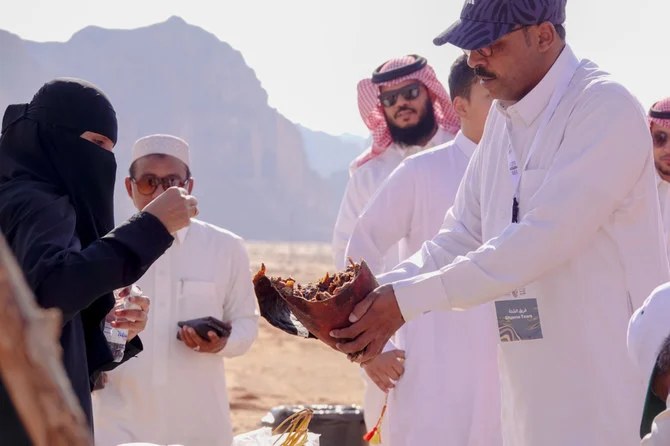

ALULA: There is much more to historic AlUla than ancient rock formations and luxury resorts.
The ancient site is also home to 10,000 hectares of palm plantations, consisting of 2.3 million palm trees producing 90,000 tons of dates per year.
And it is not uncommon to see groups of tourists and locals watching farmers demonstrate the process of Al-Shannah — a traditional method of preserving dates unique to AlUla.
Al-Shannah involves dried animal skins being stuffed with washed and dried dates and stored for as little as four months or up to four years.
The process begins with the slaughtering of farm-raised sheep or goats. The farming family uses the meat and other parts for food and fuel, and the animal’s skin is cleaned and dried in the sun.
It is then used as a water dispenser for a year or more. When it no longer serves a purpose, it is once again dried in the sun and re-purposed for use in the Al-Shannah process.
Hamed Al-Showikan, an expert on Al-Shannah, told Arab News that if stored properly, dates could last up to four years.
“Al-Shannah is from our heritage, it’s more than 300 years old. Our fathers and grandfathers used it before electricity. It was how they stored the dates — it can be used for many years.
“It’s full of carbohydrates, sugar — all the minerals. AlUla valley has more than 3 million palm trees,” Al-Showikan said.
Due to AlUla’s low humidity, the dates to be used in Al-Shannah are sprinkled with fresh water to add moisture and bulk them up and they are naturally heated in the afternoon sun.
When ready, they are stuffed into the dried shell. Sesame seeds, cinnamon, mint, or other herbs and spices can be added to provide more flavor to the mixture before the container is sewn shut.
A year or so later, the skins are ripped open using a sharp knife and the gooey, sweet, nutritious contents removed.
Families typically store the date parcels on a shelf in a small room. No refrigeration is necessary, and the skins can be folded and tucked down if the contents are not consumed in one go.
Historically, Al-Shannahs were often used to barter goods such as fabrics or materials with merchants arriving in AlUla from the Levant or other countries.
Khalid Al-Harbi, another Al-Shannah expert, said: “Al-Shannah ritual is the finale of the dates season in AlUla. Dates are the main source of nourishment to us in AlUla, since we are blessed to have fresh, abundant water.
“The palm tree is the mother of AlUla, and we use her to build everything in our lives; it goes into our furniture, building our homes, we even have a version similar to Al-Shannah made from palms to preserve dates.
“Al-Shannah needs the air to be removed, so it’s important to push it all the way down tightly to not allow any air to pass through since oxygen might prevent it from preserving.
“Also, we don’t remove the pits because the pit has a role, it helps to keep the date intact and it’ll help fill out any space between the dates. If no air enters, it won’t spoil. If we keep it for over a year, it tastes even better,” Al-Harbi added.
The Royal Commission for AlUla has been helping to empower local farmers by offering them a platform to sell their goods and to form stronger bonds within the community.
Recently, the AlUla Dates Festival provided farmers with the opportunity to demonstrate their family rituals for stuffing the dates into Al-Shannah.
At the end of the festival, Al-Shannahs created at the site were sold off at an open-air auction.


