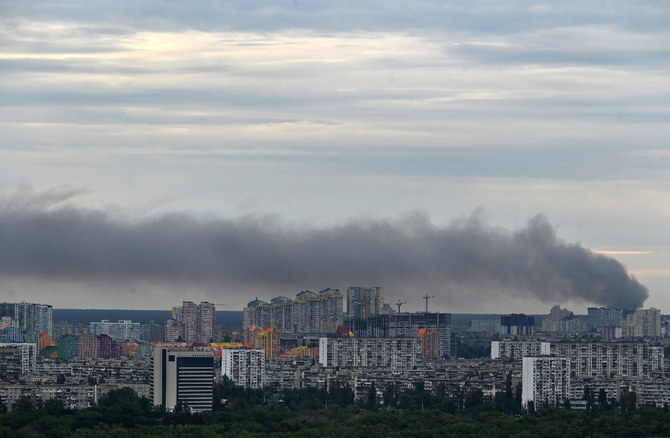
KYIV, Ukraine: Several blasts shook Kyiv on Monday, days after Russia blamed Ukraine for drone attacks on its Crimea fleet in the Black Sea.
At least five explosions were heard in the Ukrainian capital between 8:00 am (0600 GMT) and 8:20 am, according to AFP journalists.
Kyiv had already been hit on October 10 and 17 by drones.
After Monday’s blasts, mayor Vitali Klitschko said in a Telegram message: “An area of Kyiv is without electricity and certain areas without water following Russian strikes.”
Monday’s attack on the Ukrainian capital comes after Russia pulled out of a landmark agreement that allowed vital grain shipments via a maritime safety corridor.
The July deal to unlock grain exports signed between warring nations Russia and Ukraine — and brokered by Turkey and the United Nations — is critical to easing the global food crisis caused by the conflict.
“(A) bulk carrier loaded with 40 tons of grain was supposed to leave the Ukraine port today,” Infrastructure Minister Oleksandr Kubrakov tweeted.
“These foodstuffs were intended for Ethiopians, that are on the verge of famine. But due to the blockage of the ‘grain corridor’ by Russia the export is impossible,” the Ukrainian minister said.
The agreement, which established a corridor through which vessels could travel to Istanbul for inspections, had already allowed more than nine million tons of Ukrainian grain to be exported and was due to be renewed on November 19.
But Russia announced Saturday it would pull out of the deal after accusing Kyiv of a “massive” drone attack on its Black Sea fleet, which Ukraine labelled a “false pretext.”
US President Joe Biden called the move “purely outrageous” while Secretary of State Antony Blinken said Moscow was “weaponizing food.”
Russia’s defense ministry alleged Sunday the attack drones had “Canadian-made navigation modules,” and that they “were moving in the safe zone of the ‘grain corridor’.”
UN Secretary-General Antonio Guterres on Sunday expressed “deep concern” about the situation, his spokesman said, and delayed his departure for an Arab League Summit in Algiers by a day “to focus on the issue.”
The EU on Sunday urged Russia to “revert its decision.”
The center coordinating the logistics of the deal said in a statement that no traffic would move through the safety corridor on Sunday.
“A joint agreement has not been reached... for the movement of inbound and outbound vessels on 30 October,” it said. “There are more than 10 vessels both outbound and inbound waiting to enter the corridor.”
Turkey’s defense ministry later Sunday said ships would not leave Ukraine “during this period” but Turkey would continue checks of ships in Istanbul carrying Ukrainian grain “today and tomorrow.”
It also said Russia had formally notified Turkey of its suspension but “Russian personnel remained at the coordination center” in Istanbul.
The Istanbul-based Joint Coordination Center (JCC) announced later Sunday that Russia had also suspended its participation in the grain inspections.
Ninety-seven loaded ships were waiting for clearance off Istanbul’s coast Sunday, the United Nations, which coordinates the JCC, said in a statement, adding it was proposing reopening the “maritime humanitarian corridor” to about a dozen vessels on Monday.
In his evening address, Ukrainian President Volodymyr Zelensky said “more than 2 million tons of food” were at sea, but stalled by Russia’s actions.
“This is an absolutely transparent intention of Russia to return the threat of large-scale famine to Africa and Asia,” he added.
Sevastopol in Moscow-annexed Crimea has been targeted several times in recent months and serves as the Black Sea fleet’s headquarters and a logistical hub for operations in Ukraine.
Russia’s army claimed to have “destroyed” nine aerial drones and seven maritime ones in an attack on the port early Saturday.
It alleged British “specialists” based in the southern Ukrainian city of Ochakiv had helped prepare and train Kyiv to carry out the strike.
In a further singling out of the UK — which Moscow sees as one of the most unfriendly Western countries — Russia said the same British unit was involved in explosions on the Nord Stream gas pipelines last month.
Britain strongly rebutted both claims, saying “the Russian Ministry of Defense is resorting to peddling false claims of an epic scale.”
Moscow’s military said ships targeted at their Crimean base were involved in the grain deal.
Russia had recently criticized the deal, saying its own grain exports have suffered due to Western sanctions.
Mikhail Razvozhayev, the Moscow-installed governor of Sevastopol, said Saturday’s drone attack was the “most massive” the peninsula had seen.
Attacks on Crimea, annexed by Moscow in 2014, have increased recently as Kyiv presses a counter-offensive in the south to retake territory held by Moscow.
In early October, Moscow’s key bridge linking Crimea to the Russian mainland was damaged by a blast that President Vladimir Putin blamed on Ukraine.
Kyiv said Sunday its troops in the south are “holding their positions and hit the enemy in order to create conditions for further offensive actions.”
Moscow-installed authorities in Kherson, just north of Crimea, have vowed to turn the city into a fortress, preparing for an inevitable assault.


![]()

Explosions rock Kyiv days after Russia blames Ukraine for Black Sea attack
Short Url
https://arab.news/rmdbw
Explosions rock Kyiv days after Russia blames Ukraine for Black Sea attack
- At least five explosions were heard in the Ukrainian capital
- Kyiv had already been hit on October 10 and 17 by drones


Latest updates


© 2026 SAUDI RESEARCH & PUBLISHING COMPANY, All Rights Reserved And subject to Terms of Use Agreement.