


ISLAMABAD: Pakistan’s former prime minister Imran Khan said on Sunday he was only negotiating with the country’s powerful security establishment for free and fair elections, adding he had not reached out to Prime Minister Shehbaz Sharif who did not have much political power.
Khan, who is also the chairman of Pakistan Tehreek-e-Insaf (PTI) party, was ousted from power in a parliamentary vote of no-confidence in April. He kicked off his “long march” to Islamabad from Lahore’s Liberty Chowk on Friday, hoping to mount pressure on the government and ultimately force it to announce a date for early elections.
His comment to the protest march earlier today was made in response to Sharif’s statement that the PTI chief had contacted him through a mutual acquaintance one month ago to suggest names of possible candidates who could be appointed as army chief.
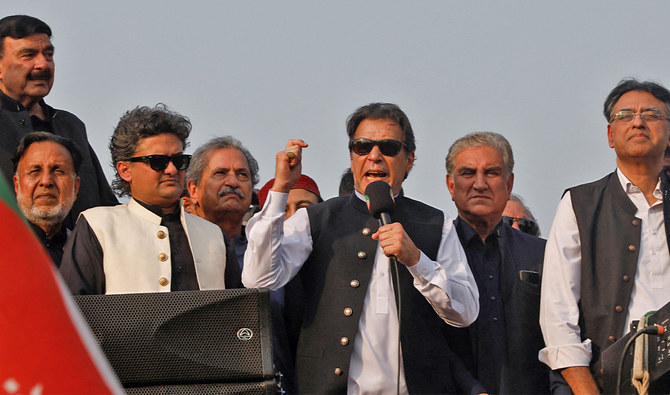
“Sharif said I had sent him a message to sit down and discuss the army chief’s appointment,” Khan said while addressing the participants of his protest march to Islamabad near Muridke.
“Is there any point in talking to you,” he asked. “Do you have the power to give to me anything?”
However, Khan acknowledged he held negotiations with the establishment on the single-point agenda focusing on free and fair elections.
“I only spoke to them [the establishment] and demanded one thing which was to conduct fair and transparent elections in the country and did not say anything else,” he added. “I still say today that we want clean and transparent elections. We will accept whatever decision the people of Pakistan make.”
“Today I will ask the establishment: It was you who filed cases against these people [leaders of the current coalition government],” he continued. “You told us how corrupt they were. Your JIT [joint investigation team] proved how corrupt Nawaz Sharif was during his time. It was said how big a thief Asif Ali Zardari was. And now you have decided to support them?”
Addressing the notion that his rift with the army had been played up by the Indian media, Khan said the whole nation stood with the country’s military, adding that his criticism was only for the betterment of the institution.
“In India, the media is celebrating that Imran Khan and the army are at odds with each other,” he said. “There is no such thing. We stand with our army, but when we criticize it, it is constructive criticism.”
“I want my army to be strong and the whole nation stands with the army since the army is mine and the country is also mine and we need a strong army to protect the freedom of the country,” he added.
Khan told his protest march on Saturday the army chief, General Qamar Javed Bajwa, should take action against officials of Pakistan’s Inter-Services Intelligence (ISI) agency, who, he said, were allegedly involved in the custodial torture of his party leaders.
The PTI leader also maintained during an interview with an international news organization that a recent press conference held by the directors general of the military’s media wing, ISPR, and the ISI spy agency contained “lies and half-truths” against him.
According to his senior party leaders, Khan’s protest march is moving toward Islamabad at a glacial pace since thousands of his supporters are walking with his container.
They also maintain that their caravan will only continue its journey during daytime for “security reasons.”
Speaking to Arab News, Farrukh Habib, the central information secretary of Khan’s PTI party, said the march would travel from Muridke to Gujranwala where its participants would stay overnight.


