

Saudi Arabia ‘very keen’ to enhance economic relations with Pakistan — finance minister

Pakistani commuters drive their vehicles under a banner welcoming Saudi Arabian Crown Prince Mohammed bin Salman displayed on a bridge, ahead of his arrival, in Islamabad, Pakistan, on February 15, 2019. (AFP/File)
Short Url
Updated 29 October 2022
Follow

Saudi Arabia ‘very keen’ to enhance economic relations with Pakistan — finance minister

  • PM Sharif visited Saudi Arabia earlier this week to attend an investment conference
  • Finance Minister Ishaq Dar says PM Sharif’s recent visit was “very successful”

ISLAMABAD: Finance Minister Ishaq Dar said on Saturday that Saudi Arabia is “very keen” to further enhance bilateral economic relations with Pakistan, on the heels of Prime Minister Shehbaz Sharif’s two-day visit to the kingdom.

Earlier this week, PM Sharif arrived in Riyadh where he met Saudi Crown Prince Mohammed bin Salman and the senior Saudi leadership. Sharif and the crown prince reviewed historical relations between their countries, aspects of bilateral cooperation, and ways to develop it in various fields.

Pakistan’s prime minister had undertaken a visit to the kingdom to attend the sixth edition of the Future Investment Forum.



This handout picture released by Saudi Press Agency shows Saudi Arabia’s Crown Prince Mohammed bin Salman received Pakistani Prime Minister Shehbaz Sharif in Riyadh on October 25, 2022. (SPA)

On Saturday, Dar chaired a meeting with the president and CEOs of various commercial banks in Pakistan. He informed participants of the meeting about PM Sharif’s recent visits to the US and Saudi Arabia.

“He [Dar] also explained that the Prime Minister’s recent visit to Saudi Arabia was also very successful and Saudi side is very keen to further enhance our bilateral economic relations,” the Finance Division said in a statement.
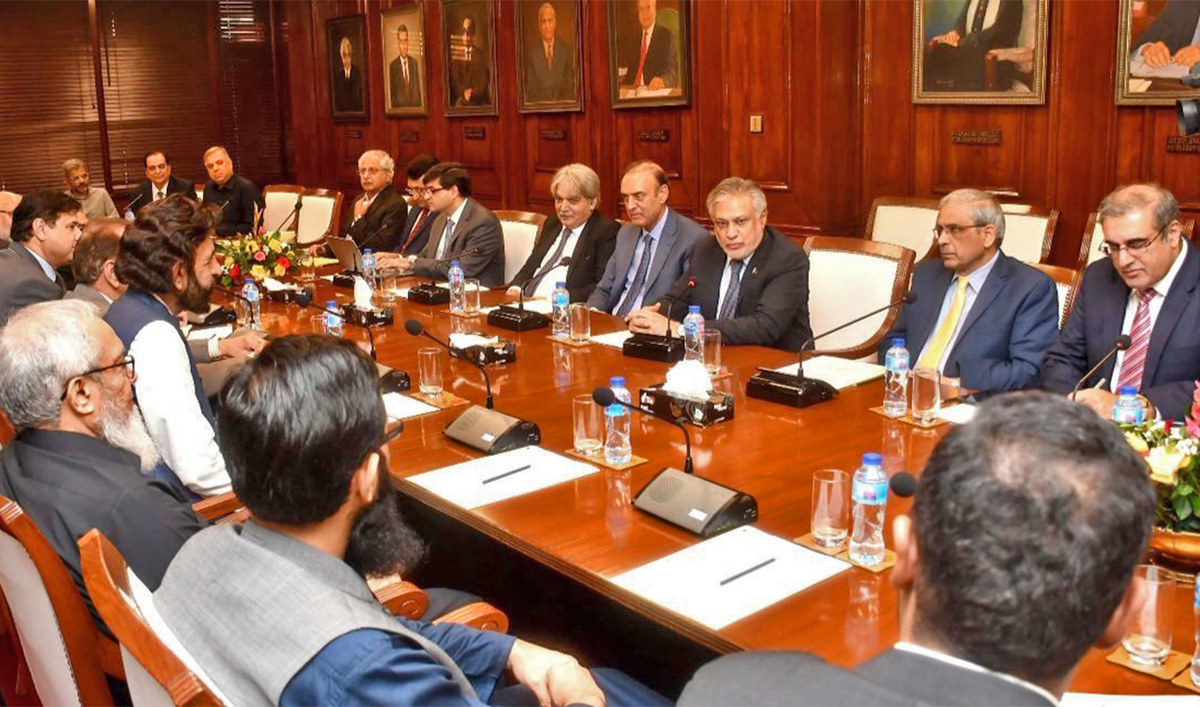


Pakistan's finance minister Ishaq Dar (third from right) chairs meeting meeting with the president and CEOs of various commercial banks in Pakistan in Islamabad, Pakistan, on October 29, 2022. (@FinMinistryPak/Twitter)

Pakistan and Saudi Arabia enjoy cordial ties with one another. The two Muslim nations have wide-ranging ties in diverse sectors such as economy, trade, defense, energy and others.

Saudi Arabia is also home to over 2.2 million Pakistani expatriates, making the kingdom a huge source of remittances for Pakistan.

During the meeting, Dar credited the government’s prudent economic policies, saying that the country’s economy is “on a firmer footing.”

“He assured that Government’s financial situation is very stable and Government is committed to fulfil its local and international commitments,” the Finance Division said.


Pakistan tax revenue rises in January as direct taxes drive growth

Updated 5 sec ago
Follow

Pakistan tax revenue rises in January as direct taxes drive growth

  • Federal tax collection grows 16% year-on-year at the outset of 2026, led by income tax gains
  • Seven-month revenues reach Rs.7.18 trillion as authorities bank on recovery in manufacturing

ISLAMABAD: Pakistan’s Federal Board of Revenue (FBR) on Saturday reported a strong pickup in tax collection in January, driven by a sharp rise in direct taxes, as the government seeks to shore up public finances under a reform-led revenue mobilization drive.

The tax authority collected a provisional Rs1.02 trillion ($3.65 billion) in January, up 16% from Rs.873 billion ($3.14 billion) in the same month last year, surpassing the six-month average growth rate of 10-11%, according to an official statement.

“This month’s tax performance reveals a nuanced and strategically significant fiscal outcome, characterized by substantial increase in direct taxation, modest growth in indirect and excise streams and an overall healthy and improved performance in January 2026,” the statement said.

“It also reinforces the credibility of reform-driven revenue mobilization and transformation plan of FBR,” it added.

Income tax collection rose 26% to Rs483 billion ($1.74 billion) from Rs381 billion ($1.37 billion) a year earlier, reflecting what the FBR described as the impact of enforcement measures and efforts to unlock revenue tied up in litigation.

Sales tax receipts increased 12% to Rs360 billion ($1.30 billion) from Rs322 billion ($1.16 billion) last year, which the tax authority linked to signs of recovery in large-scale manufacturing.

The FBR said the results underscored the effectiveness of its reform program, including the use of digital infrastructure and enforcement tools to improve compliance and expand the tax base, while encouraging voluntary taxpayer participation.

Cumulatively, the FBR collected Rs7.18 trillion ($25.83 billion) in the first seven months of the 2026 fiscal year, compared with Rs6.49 trillion ($23.36 billion) in the same period last year.

The tax authority said it was optimistic that continued recovery in manufacturing would help it meet its full-year revenue targets, adding that it aimed to maintain momentum in the remaining months of the fiscal year.