

‘Dream journey’: With backpack and umbrella, Pakistani sets out for Makkah on foot

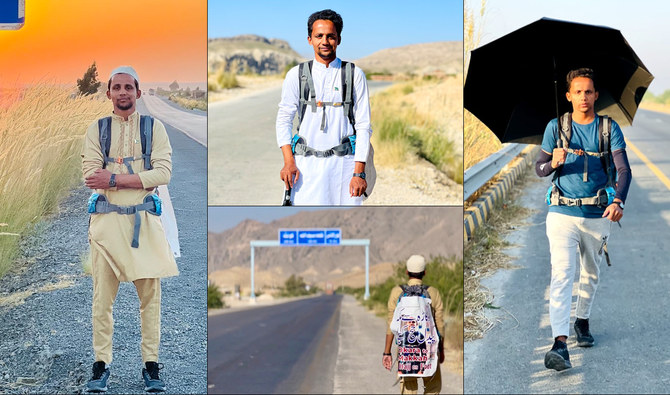
This combination of file pictures, created on October 28, 2022, shows Usman Arshad's road journey to reach Makkah from Okara, Punjab to perform Hajj next year. (Photos: Usman Arshad)
Short Url
Updated 29 October 2022
Follow

‘Dream journey’: With backpack and umbrella, Pakistani sets out for Makkah on foot

  • Traveling through at least five countries, Usman Arshad plans to cover 5,400-kilometer journey to participate in next year’s Hajj
  • Idea to travel to Makkah by foot came last year when he finished 34-day-long walk from his hometown Okara to China border

ISLAMABAD: Since he began his journey earlier this month, Usman Arshad has already walked over a tenth of a 5,400-kilometer route to reach his dream destination, Makkah, in time to participate in next year’s Hajj.

Carrying a small backpack and umbrella, and wearing a pair of trekking shoes, the 25-year-old student’s pilgrimage, which started from his hometown of Okara in Pakistan’s Punjab province, will take him across parts of at least five countries, before he arrives in the holiest city of Islam.

“From Pakistan to Iran, Iran to Iraq, from Iraq to Kuwait, and from Kuwait, I will enter Saudi Arabia,” Arshad told Arab News from Pakistan’s southwestern Balochistan province, from where he will enter neighboring Iran later this week.

“It will take about eight months, which means that I will reach Makkah in May.”


Pakistani student Usman Arshad is pictured in his hometown Okara, Punjab, on October 1, 2022 before embarking on a 5,400 km walk to Makkah on foot. (Photo courtesy: Usman Arshad)

The idea to travel to Makkah by foot came to him last year, when he covered 1,270 km during a 34-day-long walk from Okara to the Khunjerab Pass on the border with China “to promote a peaceful Pakistan.”

“I got the idea for this journey (of Hajj) after completing my last journey and I thought if I can travel on foot this much within Pakistan, then I should also go on foot to the place which is the desire of every human being,” he said. “I made it my dream journey and started working on it.”

It took Arshad nine months to prepare and, with his family’s help, save about $6,800 to cover the trip’s expenses. Support with documents and visas came from the Pakistani government.

“Besides this, they will also support me wherever security is needed,” Arshad said, explaining that he tried to cover up to 45 km a day, and made overnight stopovers at mosques, seminaries, and people’s homes along the way.

Wherever he stopped, he said, he was welcomed and embraced by his hosts who were intrigued to hear about his pilgrimage plan.
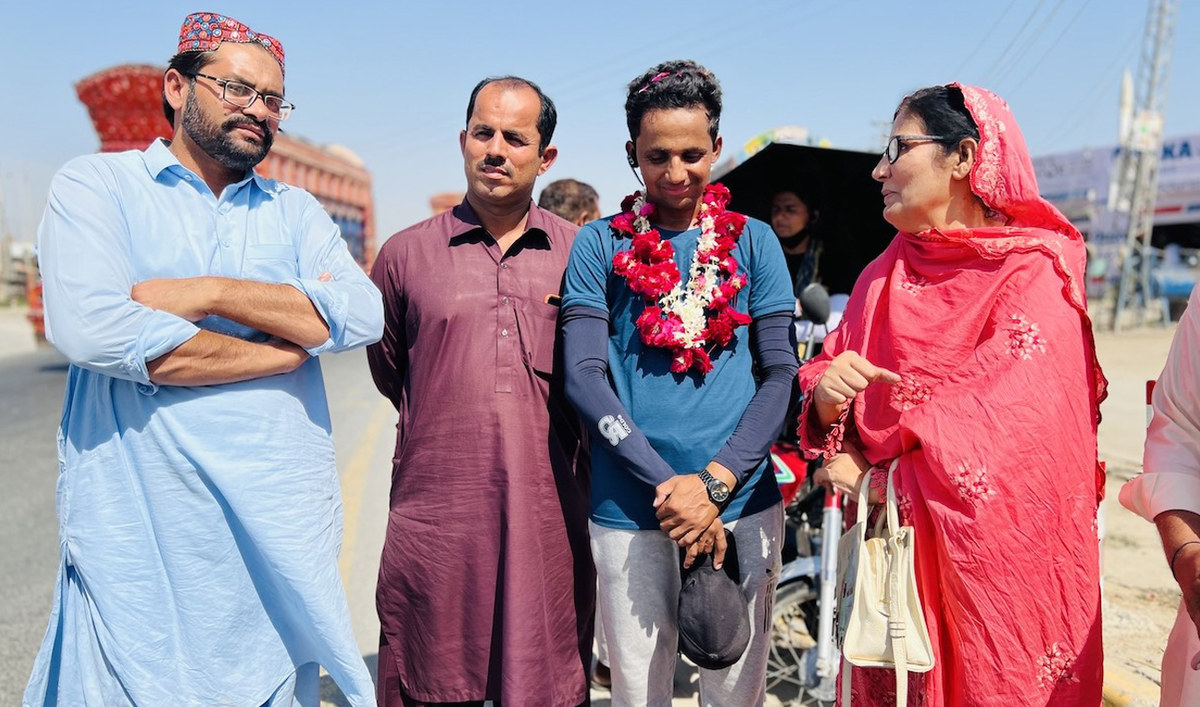


Pakistan's Usman Arshad is interacting with people in Dera Ghazi Khan, Punjab, on his way to Makkah on foot, Oct. 17, 2022. (Photo courtesy: Usman Arshad)

“People’s response has been very good,” Arshad said. “All our people in Pakistan, they are very loving.”

As he walks on, the journey is also changing Arshad and shaping his future plans. He completed his studies in media and communications at the University of Okara but now plans to travel full time.

“Earlier, I wanted to join the media,” he said, “but now I have plans to continue traveling in the future, and tell people about different places and countries by visiting them either on foot or otherwise.”


Pakistan clears global crypto exchanges Binance, HTX under new regulatory framework

Updated 7 sec ago
Follow

Pakistan clears global crypto exchanges Binance, HTX under new regulatory framework

  • NOCs allow Binance, HTX to conduct engagement activities within Pakistan, says regulator PVARA
  • Says move allows entities to open subsidiaries in Pakistan but doesn’t constitute as operating license

ISLAMABAD: The Pakistan Virtual Assets Regulatory Authority (PVARA) announced on Friday that it has granted no objection certificates (NOCs) to global crypto exchanges Binance and HTX, the latest in a series of moves by Islamabad to regulate its fast-growing virtual assets market. 

PVARA said the NOCs were granted following a review process it conducted with public sector stakeholders which focused on governance structures, compliance frameworks, risk management controls and alignment with Pakistan’s emerging regulatory requirements for virtual asset activities.

Pakistan has been moving to regulate its fast-growing crypto and digital assets market by bringing virtual asset service providers (VASPs) under a formal licensing regime. Officials say the push is aimed at curbing illicit transactions, improving oversight and encouraging innovation in blockchain-based financial services.

“The introduction of this structured NOC framework demonstrates Pakistan’s commitment to responsible innovation and financial discipline,” Finance Minister Muhammad Aurangzeb was quoted as saying in a press release issued by PVARA. 

The regulatory authority said the NOCs allow Binance and HTX to conduct preparatory and engagement activities within Pakistan under “defined regulatory oversight,” clarifying that it does not constitute a “full operating license.”

The NOCs allow Binance and HTX to begin registration on the FMU goAML, Pakistan’s anti–money laundering reporting platform, as reporting entries. It also allows them to engage with the Securities and Exchange Commission of Pakistan (SECP) regulator to incorporate their subsidiaries in the country. 

HTX and Binance can also prepare and submit their full VASP license applications once licensing regulations are promulgated and provide anti-money laundering (AML) registered services after the completion of their goAML registration.

“PVARA will continue to engage with domestic and international stakeholders as it advances subsequent phases of its regulatory framework,” the authority said. 

“Additional guidance regarding licensing standards, compliance obligations and supervisory expectations for virtual asset service providers will be issued in due course.”

Chairman PVARA Bilal Bin Saqib said issuing the NOCs marks the first step toward a fully licensed and regulated environment for digital assets in Pakistan. 

“By adopting a phased and internationally aligned approach, Pakistan is ensuring that only well-governed, fully compliant global platforms progress toward full licensing,” Saqib was quoted as saying by PVARA.

According to PVARA, Pakistan already ranks at number three in crypto adoption and is home to an estimated 30 to 40 million users.

It said industry-wide assessments estimate that annual digital asset trading activity linked to Pakistan exceeds $300 billion. 

The development takes place days after Prime Minister Shehbaz Sharif met a delegation of Binance in Islamabad, led by its CEO Richard Teng, to discuss regulating digital assets in Pakistan.