

Coveted Thai oud is heady new entry into Saudi perfume market

1 / 2
Workers distill agarwood resin at a Treedom Oud plant in Trat, Thailand, in 2020. (Courtesy: Treedom Oud)
2 / 2
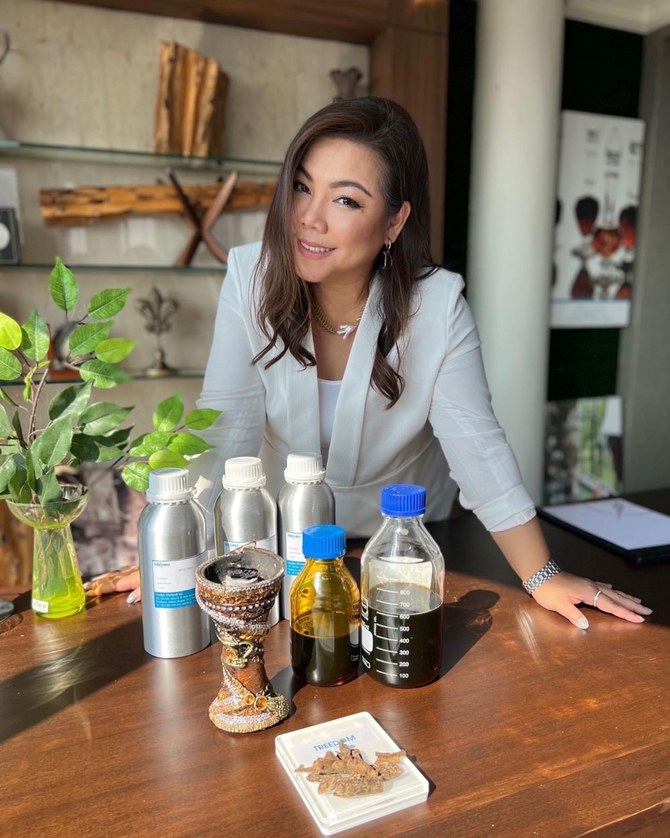
Yuwapak Saktangcharoen, sales and marketing director of Treedom Oud, one of Thailand's leading producers of oud, poses with the company's agarwood oil products. (Courtesy: Treedom Oud)
Short Url
Updated 27 October 2022
Follow

Coveted Thai oud is heady new entry into Saudi perfume market

  • ‘Liquid gold’ oil derived from rare agarwood trees
  • Largest producer is Trat province, near Cambodia border

BANGKOK: Thailand’s producers of oud are rushing to enter Saudi Arabia’s perfume market with the fragrant resin coveted in the Middle East, as they seek a new world of opportunities after a recent resumption of ties between the two kingdoms.

Known as “liquid gold,” oud oil is derived from increasingly rare agarwood trees and has been the basis of many high-end fragrances. Exuded by these trees as a protection from mold, the sticky resin has a unique spicy, woody, ambery and animalistic scent.

Native to Southeast Asia, oud is particularly prized in the Middle East, with its oil turned into perfume and bark into incense, which is often burned at homes to welcome guests and in religious rituals, including Islamic purification.

Thailand’s largest oud producer is the Trat province, near the Cambodian border, where the resin is extracted from over 4.1 million trees, reaching annual exports of more than $130 million, according to Trat Federation of Thai Industries data.

“Thailand is the world’s leading exporter of oud oil, with the finest quality,” Chalermchai Sommung, president of the Agarwood Community of Thailand, told Arab News.

“Our Trat species has the greatest scent on the planet.”

For Sommung the ruby red Trat oud is “more valuable than gold.” And its worth is increasing, as many decades of overlogging the evergreen Aquilaria trees in Asia have depleted its supply on the international market.

A kilogram of woodchips at D.D. Oud Oil in Bangkok, a shop run by Dum Phutthakaesorn, president of the Trat Agarwood Association, can cost up to $5,300.

The price of oil is even higher — it takes about a kilogram of agarwood to yield just 1 milliliter of oud resin.

While some 75 percent of Trat oud is already exported to the Middle East, according to the Thai Customs Department, producers are now seeking to focus especially on Saudi Arabia, seeing a great opportunity to expand after the restoration of bilateral ties between the two kingdoms earlier this year.

The relationship was renewed when Thai Prime Minister Prayut Chan-o-cha visited Riyadh in January, in what was the first top leadership meeting between Thailand and Saudi Arabia since the late 1980s.

The visit was followed by a series of cooperation agreements, including in investment and trade.

For oud producers, it opened a new horizon to expand.

“Saudi Arabia’s market has a large volume. As a result, everyone wants to get into that market as quickly as possible and connect the links as soon as possible,” Yuwapak Saktangcharoen, sales and marketing director of Treedom Oud, one of the leading Thai manufacturers of agarwood oil, told Arab News.

“I recently traveled to the Middle East and Saudi Arabia and sampled non-Thai oud and discovered that it is very different, right down to the woodchips. What distinguishes Thai oud and makes it popular among locals is the cleanliness of our woods.”

While Saktangcharoen, Chalermchai, Dum and others are still exploring the olfactory preferences of their Saudi clients, who differ from their customers in Asia, they know they must be quick to grasp the opportunity.

“Understanding the Middle Eastern market is the right approach. If we want to look at sustainability, we must immerse ourselves in their culture and fully comprehend their demands,” Saktangcharoen said.

“We have to be an early bird, you know. Getting in touch with them as soon as possible. We then may be the market leader, that is our goal.”


Afghan barbers under pressure as morality police take on short beards

Updated 4 sec ago
Follow

Afghan barbers under pressure as morality police take on short beards

KABUL: Barbers in Afghanistan risk detention for trimming men’s beards too short, they told AFP, as the Taliban authorities enforce their strict interpretation of Islamic law with increasing zeal.
Last month, the Ministry for the Propagation of Virtue and Prevention of Vice said it was now “obligatory” to grow beards longer than a fist, doubling down on an earlier order.
Minister Khalid Hanafi said it was the government’s “responsibility to guide the nation to have an appearance according to sharia,” or Islamic law.
Officials tasked with promoting virtue “are obliged to implement the Islamic system,” he said.
With ministry officials patrolling city streets to ensure the rule is followed, the men interviewed by AFP all spoke on condition of anonymity due to security concerns.
In the southeastern province of Ghazni, a 30-year-old barber said he was detained for three nights after officials found out that one of his employees had given a client a Western-style haircut.
“First, I was held in a cold hall. Later, after I insisted on being released, they transferred me to a cold (shipping) container,” he said.
He was eventually released without charge and continues to work, but usually hides with his clients when the patrols pass by.
“The thing is that no one can argue or question” the ministry officials, the barber said.
“Everyone fears them.”
He added that in some cases where both a barber and clients were detained, “the clients have been let out, but they kept the barber” in custody.
Last year, three barbers in Kunar province were jailed for three to five months for breaching the ministry’s rules, according to a UN report.

‘Personal space’

Alongside the uptick in enforcement, the religious affairs ministry has also issued stricter orders.
In an eight-page guide to imams issued in November, prayer leaders were told to describe shaving beards as a “major sin” in their sermons.
The religious affairs ministry’s arguments against trimming state that by shaving their beards, men were “trying to look like women.”
The orders have also reached universities — where only men study because women have been banned.
A 22-year-old Kabul University student said lecturers “have warned us... that if we don’t have a proper Islamic appearance, which includes beards and head covering, they will deduct our marks.”
In the capital Kabul, a 25-year-old barber lamented that “there are a lot of restrictions” which go against his young clients’ preference for closer shaves.
“Barbers are private businesses, beards and heads are something personal, they should be able to cut the way they want,” he said.
Hanafi, the virtue propagation minister, has dismissed such arguments, saying last month that telling men “to grow a beard according to sharia” cannot be considered “invading the personal space.”

Business slump

In Afghanistan, the majority are practicing Muslims, but before the Taliban authorities returned to power in 2021, residents of major cities could choose their own appearance.
In areas where Taliban fighters were battling US-backed forces, men would grow beards either out of fear or by choice.
As fewer and fewer men opt for a close shave, the 25-year-old Kabul barber said he was already losing business.
Many civil servants, for example, “used to sort their hair a couple of times a week, but now, most of them have grown beards, they don’t show up even in a month,” he said.
A 50-year-old barber in Kabul said morality patrols “visit and check every day.”
In one incident this month, the barber said that an officer came into the shop and asked: “Why did you cut the hair like this?“
“After trying to explain that he is a child, he told us: ‘No, do Islamic hair, not English hair’.”