

‘Pakistanis eagerly looking forward to visit,’ PM Sharif tells Saudi crown prince in Riyadh

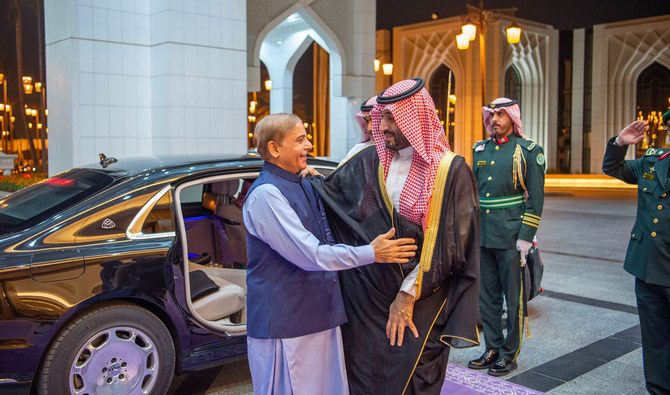
This handout picture released by Saudi Press Agency shows Saudi Arabia’s Crown Prince Mohammed bin Salman received Pakistani Prime Minister Shehbaz Sharif in Riyadh on October 25, 2022.
Short Url
Updated 26 October 2022
Follow

‘Pakistanis eagerly looking forward to visit,’ PM Sharif tells Saudi crown prince in Riyadh

  • Sharif is in Riyadh for Future Investment Initiative where he invited Saudi entrepreneurs to invest in green energy in Pakistan
  • Pakistani PM says had “excellent” meeting with crown prince, agreed to enhance “bilateral ties and fraternal bonds”

ISLAMABAD: Pakistani Prime Minister Shehbaz Sharif said on Wednesday he had an “excellent” meeting with Saudi Crown Prince Mohammed bin Salman in Riyadh, adding that the Saudi royal’s upcoming visit to Pakistan was being eagerly awaited by the country’s public.

Sharif is in Riyadh for the Future Investment Initiative (FII) conference where he spoke on Tuesday, inviting Saudi finance moguls to invest in green energy in Pakistan.

“Just had excellent meeting with HRH Crown Prince Mohammed Bin Salman,” the Pakistani PM said on Twitter. “We agreed to upgrade & enhance bilateral ties & fraternal bonds ... to new heights in line with the requirements of changing world. I told HRH people of Pakistan are eagerly looking forward to his visit.”

In his address with attendees at the sixth edition of the FII summit, Sharif called the conference a “remarkable” forum launched by his Saudi “friends.”

“I would like to propose to my brothers and sisters sitting here from Saudi Arabia and other countries that here is an opportunity as we want to have green energy to avoid pollution and minimize our problems in the air,” Sharif said, saying clean energy was the “driver” of the new economy.

“For the investment in solar and wind energy projects in Pakistan, I am standing before you, inviting you to please come forward and invest in these fields.”

He urged the attendees to establish a satellite center in Pakistan to explore the rapidly growing South Asian market.

“I propose therefore that the Future Investment Initiative should consider establishing a satellite center at one of Pakistan’s leading universities to explore the rapidly growing Pakistani market and spur innovation among our young population,” the Pakistan premier said.

The satellite center could foster a network of researchers, innovators, investors and service providers to take Pakistan to the next level of social and economic development, Sharif said.

Pakistan had started an initiative of installing solar power plants with a combined capacity of 10,000 megawatts to shift its energy needs away from oil and gas, the PM said.

“Pakistan, which is a developing country, cannot afford to finance the import bill to the extent of $24 billion. Therefore, we have launched a program to generate energy through solar power and we are upgrading our rail, ports, airways, power, and digital infrastructure,” he said.

“Pakistan is open for investment and let me assure you as the chief executive officer of Pakistan today that we as a nation are ready to reach out to all of you and the entire globe and find potential investors and grab the future with both hands.”


Curfew extended in Gilgit-Baltistan, probe ordered after deadly Khamenei protests

Updated 03 March 2026
Follow

Curfew extended in Gilgit-Baltistan, probe ordered after deadly Khamenei protests

  • At least 15 people were killed in clashes with law enforcement agencies over the weekend in Gilgit-Baltistan
  • Government also announces a de-weaponization campaign, crackdown on hate speech and cybercrime in region

ISLAMABAD: The government in Pakistan’s Gilgit-Baltistan (GB) region on Tuesday extended a curfew in Gilgit district and ordered a judicial probe into violent protests over the killing of Iranian Supreme Leader Ali Khamenei in US-Israeli strikes last week, an official said.

At least 15 people were killed in clashes with law enforcement agencies over the weekend in GB, where protesters torched and vandalized several buildings, including United Nations regional offices, an army-run school, software technology park and a local charity building.

The violence prompted regional authorities to impose curfew in Gilgit and Skardu districts on March 2-4 as officials urged people to stay indoors and cooperate with law enforcers, amid widespread anger in Pakistan, particularly among members of the Shiite minority, over Khamenei’s killing.

On Tuesday, the GB government convened to review the situation and announced the extension of curfew in Gilgit among a number of security measures as well as ordered the establishment of a judicial commission to investigate the weekend violence in the region.

“The government has made it clear that the law will strictly take its course against elements involved in vandalism at government institutions, private properties and incidents of vandalism in Gilgit and Skardu and no kind of mischief will be tolerated,” Shabbir Mir, a GB government spokesperson, said in a statement.

“In view of the security situation, curfew will remain in force in Gilgit, while the decision to extend the curfew in Skardu will be taken keeping the ground realities and the changing situation in view.”

The statement did not specify how long the curfew will remain in place in Gilgit.

Besides the formation of the judicial commission to investigate the violent clashes, the government also decided to launch a large-scale de-weaponization campaign in the entire Gilgit district, for which relevant institutions have been directed to immediately complete all necessary arrangements, according to Mir.

In addition, a crackdown has been ordered on hate speech, spread of fake news and cybercrime.

“The aim of these decisions is to ensure the rule of law, protect the lives and property of citizens and crack down on miscreants,” he said. “Approval has also been given to immediately survey the affected infrastructure and start their restoration work on priority basis.”

Demonstrators in Pakistan’s southern port city of Karachi also stormed the US Consulate on Sunday, smashing windows and attempting to burn the building. Police responded with batons, tear gas, and gunfire, leaving 10 people dead and more than 50 injured.

Pakistani authorities have since beefed up security at US diplomatic missions across the country, including around the US consulate building in Peshawar, to avoid any further violence.