

Iran protestor shot dead after tearing down supreme leader poster

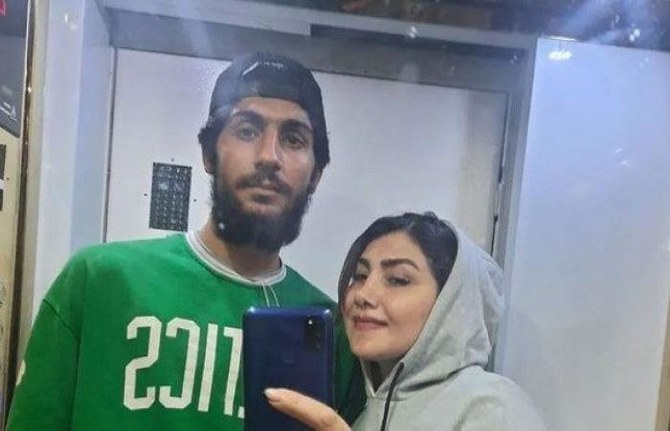
Erfan Rezaei’s mother Farzaneh Barzekar posted a picture of them together two days before his death. (Social media)
Short Url
Updated 25 October 2022
Follow

Iran protestor shot dead after tearing down supreme leader poster

  • Erfan Rezaei, 21, was shot in the shoulder and back by a pistol at close range during protests
  • A source said his family was under pressure to say he had been killed by protesters

LONDON: Security forces in Iran killed a man in September after he tore down a poster of Supreme Leader Ali Khamenei in the city of Amol, BBC Persian reported on Monday.

Erfan Rezaei, 21, was shot in the shoulder and back by a pistol at close range during protests.

A source said his family was under pressure to say he had been killed by protesters.

Not long after the protest, Rezaei’s mother, Farzaneh Barzekar, was told by officials that he had been admitted to hospital.

Hospital nurses refused to tell her where Rezaei was, but after three hours of trying to find him, Barzekar found his blood-soaked clothes outside an operating theater and fainted.

Rezaei died as a result of severe damage to his kidney and spleen caused by the bullet wound to his back. The bullet was fired by a pistol from a distance of 5 meters, the BBC reported.

His body was given to his family on the condition that they held a quiet funeral, which reportedly was only allowed because Rezaei's father was a veteran of the Iran-Iraq War, and Iranians revere those who fought in the 1980-88 conflict.

“Every day, I look at your picture for hours and cry. I look at your empty bed and your books. I read your books out loud to your empty bed,” Rezaei's mother posted on Instagram two weeks ago, underneath a video of his grave.

Anti-government protests were sparked across the country following the death in custody of Mahsa Amini, a 22-year-old woman who was detained by the Iranian morality police for allegedly wearing her hijab “improperly.”

Wednesday will mark 40 days since Amini’s death and the end of the traditional mourning period in Iran.


The art of war: fears for masterpieces on loan to Louvre Abu Dhabi

Updated 8 sec ago
Follow

The art of war: fears for masterpieces on loan to Louvre Abu Dhabi

  • UAE paid more than €1 billion to borrow priceless works, but experts in France want them back

PARIS: The Middle East war has raised fears for the safety of priceless masterpieces on loan from France to the Louvre Abu Dhabi, the museum’s only foreign branch.
The Abu Dhabi museum, which opened in 2017, has so far escaped damage from nearly 1,800 Iranian drone and missile strikes launched since the conflict erupted on Feb. 28.
However, concerns are mounting in France. “The works must be removed,” said Didier Selles, who helped broker the original agreement between France and the UAE.
French journal La Tribune de l’Art echoed that alarm. “The Louvre’s works in Abu Dhabi must be secured!” it said.
France’s culture ministry said French authorities were “in close and regular contact with the authorities of the UAE to ensure the protection of the works loaned by France.”
Under the agreement with the UAE, France agreed to provide expertise, lend works of art and organize exhibitions, in return for €1 billion, including €400 million for licensing the use of the Louvre name. The deal was extended in 2021 to 2047 for an additional €165 million.
Works on loan include paintings by Rembrandt and Chardin, Classical statues of Isis, Roman sarcophagi and Islamic masterpieces: such as the Pyxis of Al-Mughira.

A Louvre Abu Dhabi source said the museum was designed to protect collections from both security threats and natural disasters.