

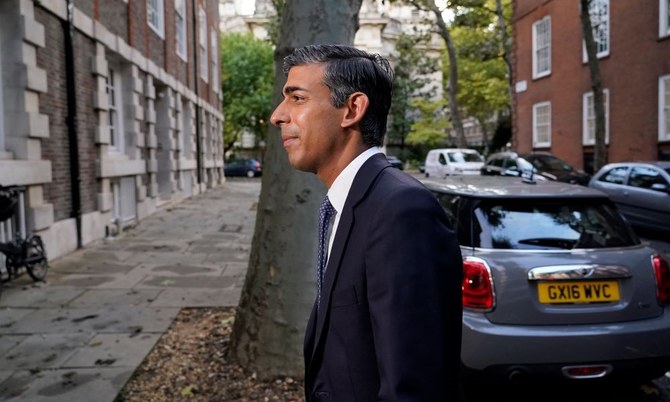

LONDON: The UK witnessed a temporary respite from its ongoing political crisis on Monday as Rishi Sunak, the former chancellor of the exchequer, was declared winner of the ruling Conservative Party’s latest leadership contest.
The new prime minister is already a history maker as the first Asian and Hindu to assume the role, but he enters office with an economy in the doldrums, crumbling infrastructure, war rumbling on in Ukraine and a fractured party.
How he addresses these issues, and what it means for the rest of the world — in particular the Middle East and North Africa — remains to be seen.
For the Arab world perhaps more than any other region, the Sunak ascent poses the most unanswered questions, less due to what he has said and more by what he has not.
His relatively short stint in government has coincided almost exactly with the COVID-19 pandemic, leaving little room for public discussion on other issues.
But even if that was not the case, Sunak is a man who keeps his cards close to his chest, with a smaller team of advisors around him than is typical of other prime ministers.
“Nobody knows anything,” a former Whitehall official, now working in the aerospace sector dealing predominantly with MENA-based clients, told Arab News of Sunak’s strategy for the region.
“Sunak’s rapid rise left many in the dark over what he actually thinks beyond his views on the economy. We may need to wait and see who he appoints to certain roles.”
In that sense, though, an economy-conscious prime minister means real opportunities for strengthening ties between the Gulf states and the UK on business, investment and energy.
The Spectator magazine has called him “the most market-literate PM in history.” This can only bode well for a Gulf region looking to diversify away from fossil fuels and becoming a global business hub, but which still holds many cards in global energy markets dealing with Western nations shell-shocked by the Russia-Ukraine conflict.
Michael Stephens, a former Conservative councillor and a Middle East expert, told Arab News that the immediate focus would be on furthering business and commercial ties.
“What we’ve seen is a continuous engagement from the UK into the Gulf states to get money. It’s that simple,” he said.
“It’s about dollars, pounds, dirhams — we (the UK) need the foreign direct investment, we need them to prop up certain areas of the economy, and we need the strength of export licensing agreements and remittances from expats.”
The former Whitehall official said the economically oriented Sunak could make a welcome change from his predecessor Boris Johnson when it comes to business in the Middle East.
“Under Boris, there was actually not a lot of leadership or direction on doing business here — it was down to firms to take the lead ourselves.”
Stephens said the UK needs to be bold and ambitious in making the most of the opportunities that Saudi Arabia provides.
“Saudi is clearly the most important state in the Middle East, and you have to mitigate the fallout of the change of relationship with the US,” he said.
“But (Sunak) also has to be ruthless: Go in and see (Crown Prince) Mohammed bin Salman’s Vision 2030 as (the UK’s) opportunity.”
Sunak is thought to be something of a hawk when it comes to Iran. Earlier this year Liam Fox, a former defense minister and Sunak supporter, said the new prime minister “regards Iran as a major threat to regional stability” and “believes the JCPOA (Joint Comprehensive Plan of Action) doesn’t actually stop Iran’s nuclear program.”
However, Stephens said Sunak may end up being sidelined on Iran, especially if his views clash with the prevailing wind in Washington.
“On OPEC+, Iran … the US has first-mover advantage,” he said. “Sunak has no independence there.”
There will be questions, though, over other areas of interest for MENA, especially when it comes to aid.
Sunak will keep Jeremy Hunt as chancellor, whose interventions in the past few weeks have signaled that a period of austerity in government spending lies ahead for the UK.
One area it is feared could be affected particularly badly is aid spending, already hammered by Sunak himself while chancellor in the wake of the pandemic — and which impacts various countries in the region, especially Syria, Lebanon, Somalia, Yemen and Afghanistan.
On Israel, Sunak has said claims that it is an apartheid state are “not only factually incorrect but quite frankly offensive,” and has toyed with the idea of relocating the UK Embassy from Tel Aviv to Jerusalem.
Ultimately, given the circumstances that Sunak finds himself in, Stephens said foreign policy “isn’t a priority” in the way the economy is, but failure to engage properly with the Arab world could still see clear economic opportunities squandered.
“To my mind, you’ve clearly got separate areas of policy: You’ve got the economic, you’ve got the security and you’ve got the geopolitical,” Stephens said.
“You can pursue your financial objectives in the region without necessarily coming into clashes on the geopolitical side.
“The world that Sunak inherits is fundamentally unstable. States act in their own interests again, and you can get away without grand ideas.
“He can pick and choose his battles, but he needs to create a perception that he does care, or there are other movers who will take advantage.
“I suspect with us (the UK) … we’re more predisposed to keep the relationships (in the Gulf) going (than the US).”


