

Saudi envoy to US claims disagreement ‘not political, purely economic’

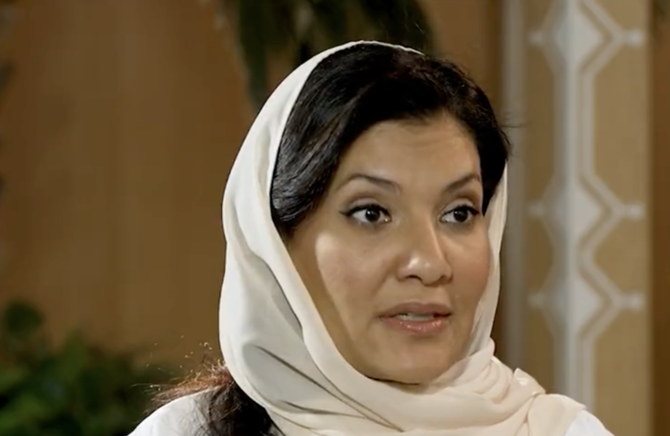
Saudi Arabia’s ambassador to the US Princess Reema bint Bandar talks to CNN’s Becky Anderson on Tuesday. (Screenshot)
Short Url
Updated 25 October 2022
Follow

Saudi envoy to US claims disagreement ‘not political, purely economic’

  • Refuting accusations that the Kingdom was siding with Russia in its war in Ukraine, Princess Reema noted that Saudi Arabia was actually a “mediator”
  • The envoy pointed out that talk of reforming the strategic Saudi-US relationship was a move in the right direction

RIYADH: Disagreement between Saudi Arabia and the US was “not political” but “purely economic,” the Kingdom’s ambassador to Washington said on Tuesday.

Speaking to CNN’s Becky Anderson, Princess Reema bint Bandar said the Kingdom did not “engage in the politics of anyone, we engage simply as a balancer and a stabiliser of the economy through the energy market, as we’ve done historically.

“It’s clear we’re at a point of disagreement. And many people have tried to politicise this, but you’re hearing it from the horse’s mouth. This is not political. This is purely economic, based on the expertise of 40 or 50 years of mapping and trends,” she added.

Refuting accusations that the Kingdom was siding with Russia in its war in Ukraine, Princess Reema noted that Saudi Arabia was actually a “mediator and a communicator” in the conflict.

“The relationship that we had with Russia is what allowed us to free prisoners of war: two Americans, five Brits, one Croat, and a selection from other countries.

“We’ve supported Ukraine humanitarianly, we have given over $400 million, we collaborated with Ukraine and Poland to give $10 million to allow for the refugees that were coming out of Ukraine and spilling into Poland a safe landing.

“That’s what we do. That’s the value of our engagement. Is it siding with Russia? No,” the princess said.

The envoy pointed out that talk of reforming the strategic Saudi-US relationship was a move in the right direction.

She added: “I hear a lot of people talk about reforming or reviewing the relationship with the Kingdom. And I think, actually, that’s a positive thing.

“This Kingdom is not the Kingdom it was five years ago. It’s not the Kingdom that it was 10 years ago. So, every piece of analysis that existed is no longer relevant.

“We are a young population, we have young leadership, we have an aspiration and a goal to engage with the world in a way we never did before.”


Japanese researchers hope to restore coral from Saudi-made structures

Updated 05 January 2026
Follow

Japanese researchers hope to restore coral from Saudi-made structures

  • Coral skeletons made for Saudi Pavilion at Japan expo last year
  • Results of Japanese study to be revealed at Riyadh Expo 2030

TOKYO: Japanese universities are seeking to restore coral reefs and marine ecosystems after receiving artificial structures that Saudi Arabia made and showcased at last year’s Osaka-Kansai Expo.

The coral skeletons were donated to the University of the Ryukyus in Okinawa and Kansai University in Osaka Prefecture, Kyodo News reported at the weekend.

The structures are made from calcium carbonate, a material on which corals are believed to grow more easily compared to artificial alternatives such as concrete or metal.

The skeletal structures were created using 3-D printers, with one piece produced a day during the expo, and displayed across an entire wall in the Saudi Arabia Pavilion, which had an area focusing on sustainable marine environments.

Coral reefs serve as habitats for much marine life, but over 40 percent of the world’s 892 species face possible extinction, according to the International Union for Conservation of Nature.

The University of the Ryukyus, which received about 150 of the artificial coral skeletons, will place them in waters off the eastern coast of Okinawa’s main island and then examine their impact on the ecosystem.

Kansai University has placed theirs in the sea around Kagoshima Prefecture’s Yoron Island to observe their growth after transplanting coral polyps onto the structures.

The results of the research are expected to be revealed at the Riyadh Expo in 2030.

“I had never imagined that Japan and Saudi Arabia would cooperate on coral research,” said Masato Ueda, a professor specializing in regenerative medicine at Kansai University.

Ueda said he wants to demonstrate to children that “humanity is attempting to restore the environment.”