

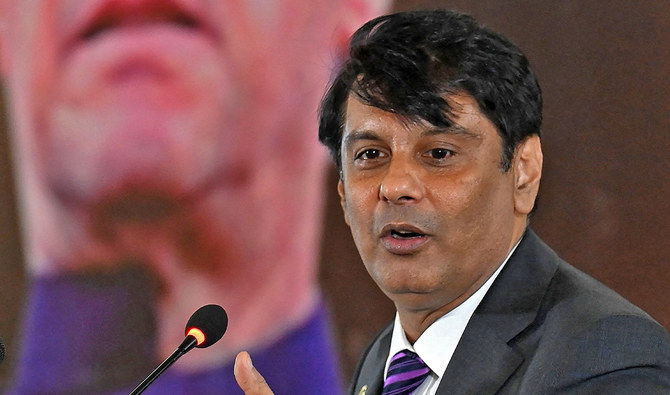

ISLAMABAD: The wife of Pakistani journalist Arshad Sharif, who was shot dead in Kenya Sunday night, has said she advised her husband to seek asylum but he refused, media reported, while his lawyer called for the Islamabad High Court (IHC) to probe why the anchorman left Pakistan and what he was doing in the East African nation when he was killed.
Sharif, a hugely popular talk show host at ARY News from which he resigned in August, was of late a harsh critic of the current ruling coalition and army and fled the country in August after remarks by a politician on a news bulletin he hosted were deemed “seditious” by the country’s media regulator and government.
Sharif was already at the time facing a slew of court cases related to charges of sedition. He was believed to have been in the United Arab Emirates since he left Pakistan in August and had recently travelled to Kenya from the Emirates.
"Arshad was receiving threats for the last six months because of which he decided to leave the country," Javeria Siddique, the wife of the slain journalist, told Independent Urdu.
"When [I] asked Arshad to file a request for asylum, he said 'Pakistan is my country, I live and die there'. He said he would return to Pakistan in a few days."
Siddique said she last spoke to her husband around 10pm Pakistani time on Sunday and later did not receive answers to her text messages.
"I thought he might be busy with work. After a while, his number was switched off too," she said.
"His friend from Nairobi called at 2am and informed he had an accident. Then after a while informed that [he] had been shot in the head and murdered."
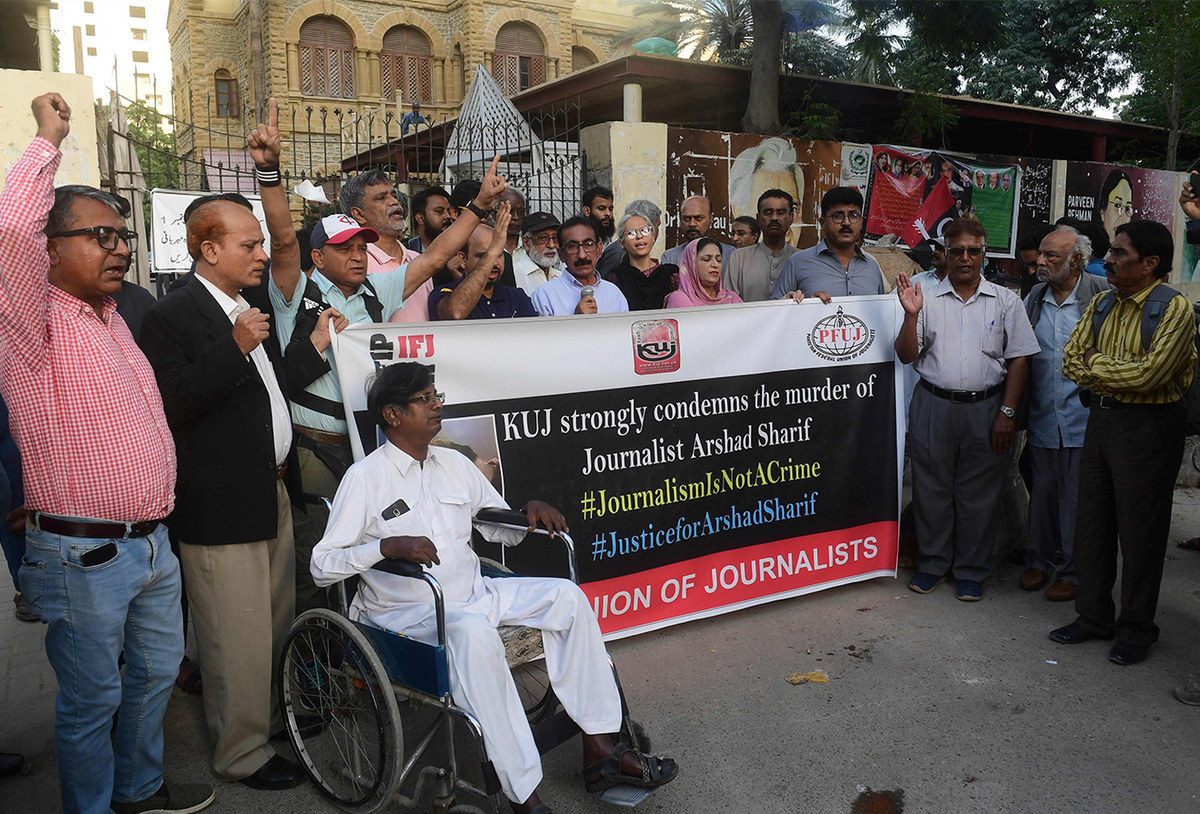
Media representatives shout slogans during a protest in Karachi on October 24, 2022, against the killing of Pakistani news anchor Arshad Sharif in Kenya. Arshad Sharif was shot dead in Kenya, his wife said on October 24, 2022. (AFP)
Sharif's lawyer Shoaib Razzaq said he had called on the Islamabad High Court (IHC) to form a judicial commission to investigate why the anchorman had left Pakistan and what he had been doing in Kenya at the time of his murder.
“We have asked the [Islamabad High] court in our appeal to form a judicial commission to dig out the circumstances which lead to his killing, why he had to leave the country [Pakistan],” Razzaq told Arab News over the phone on Monday.
The IHC later has ordered the secretaries of the interior and foreign ministries to immediately meet Sharif’s family after an application seeking a probe into the matter was filed in the high court, Pakistan's Express Tribune paper reported.
While hearing the petition on Monday, IHC Chief Justice Athar Minallah inquired where the body of the deceased journalist was to which Razzak said the body was still in Nairobi.
Upon this, the court issued notices to the Interior and Foreign Ministry to meet with the deceased’s family at the earliest and submit a report in court by Tuesday. It also ordered authorities to take necessary steps required to transport Sharif’s body to Pakistan.
A family member of Sharif’s who declined to be named said his UAE visa had expired and he traveled to Kenya by his own choice. The UAE has not yet commented on Sharif's visa status.
Sharif was also refused a visa for the United Kingdom, his lawyer said, adding that he had planned to file a protective transit bail request for Sharif today, Monday, but instead filed a plea for the early repatriation of his body.
“I was in contact with him on a daily basis and the last time we talked on the phone was yesterday [Sunday],” Razzaq said. “He always asked said he wanted to come back as he was missing Pakistan … He asked me yesterday to get his protective transit bail so that he can come back home.”
The family was “completely broken” over the tragic death, the lawyer said, and it was hard to console them.
“I got this news at 2am and went to Sharif’s home as I knew Sharif for the last 27 years and had family relations with them,” he said. “His daughter is doing an internship at my law firm and his elder son went to Canada for studies last month.”
In a statement released on Monday, Kenya’s inspector general of police said Sharif’s car was shot at after a circular was issued for a stolen car. The journalist’s vehicle did not stop at a police barricade set up for the search of the missing car and was thus shot at, fatally wounding Sharif.
Following the killing, Pakistani prime minister Shehbaz Sharif telephoned Kenyan President William Ruto and requested a “fair and transparent investigation.”
“He promised all-out help including fast-tracking the process of return of the body to Pakistan,” PM Sharif said in a Twitter post.
Kenya’s Independent Police Oversight Authority (IPOA), a civilian watchdog, has started an investigation into Sharif’s killing, IPOA’s chairwoman Ann Makori told journalists at a news conference on Monday.
“There’s an alleged police killing of a Pakistani national at Tinga market, Kajiado county, last evening. Our rapid response team has already been dispatched,” she said.
On the instructions of the federal government, Pakistan’s attorney general Ashtar Ausaf Ali will write a letter to the Kenyan government to establish legal contact.
“The Federal Government has decided to contact the Kenyan Government on the legal front and Attorney General will contact the will write a letter to them today,” the attorney general’s office said in a statement.
The Pakistani foreign office said the country’s high commissioner in Kenya received initial information about Sharif's death early in the morning.
“The High Commissioner accordingly contacted the police authorities and senior officials at the ministry of foreign affairs and other departments. Office of the vice president was also contacted for confirmation,” the statement said, adding that the high commissioner and other officers from the mission reached the location and identified the journalist’s body.
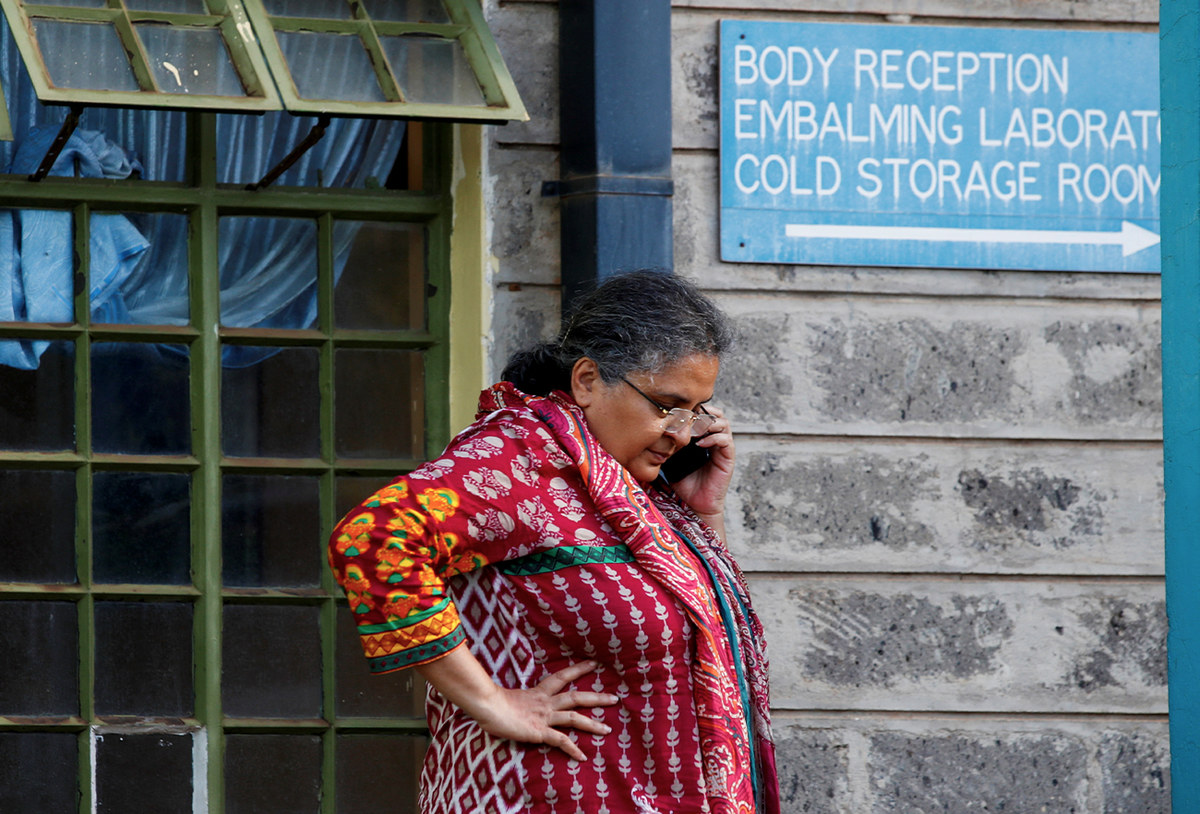
Pakistan High Commissioner to Kenya Saqlain Syedah talks on her mobile phone outside the Chiromo Mortuary, following the killing of Pakistani journalist Arshad Sharif who was shot dead when police opened fire on the vehicle as it went through a roadblock without stopping, in Magadi road on the outskirts of Nairobi, Kenya, on October 24, 2022. (REUTERS)
“Further procedures including a police report are awaited,” the foreign office said. “The High Commission will facilitate expeditious repatriation of mortal remains of Sharif in coordination with the host authorities.”


