

League of Islamic Universities launches climate action at campuses

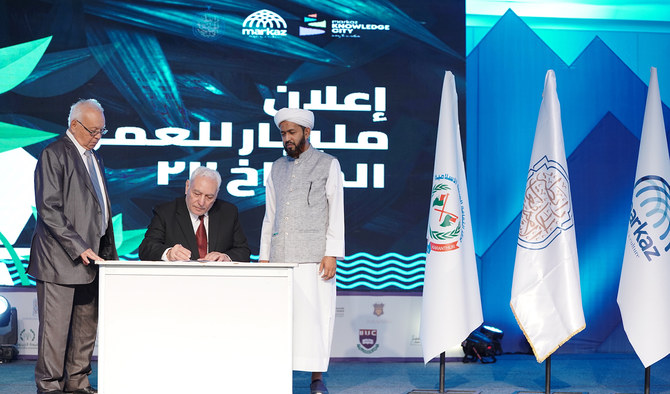
Caption: Dr. Osama Al-Abed, secretary general of the League of Islamic Universities, signs the Malabar Declaration on climate action in Kozhikode southern India, on Oct. 20, 2022. (Photo courtesy: League of Islamic Universities)
Short Url
Updated 21 October 2022
Follow

League of Islamic Universities launches climate action at campuses

  • Representatives of 200 Islamic varsities gathered in India for International Climate Action Summit
  • Center dedicated to environmental studies will be established by the league in Calicut, India

NEW DELHI: The League of Islamic Universities will launch environment courses at the campuses of its member institutions, following a climate action summit held in India earlier this week.

Based in Cairo, Egypt, the league is an association of Islamic universities all over the world.

Its members representing 200 universities from 60 countries gathered at Jamia Markaz, an Islamic university in Kozhikode, Kerala, for International Climate Action Summit on Oct. 17-20.

It was inaugurated by the league’s secretary general Dr. Osama Al-Abed with a message urging global stakeholders to employ new strategies in addressing climate problems as the world is “facing challenges that are structurally different from the past.”

“Even a minor variation in the ecosystem in a remote village can have huge global impact. Human population across the globe is now entangled with each other in unprecedented ways,” he said. “This demands policy makers and governments to resort to more international approaches towards issues such as climate change and come up with global solutions for even local issues.”

The summit has concluded with a joint declaration for climate action that obliges the league’s members to include environmental science in their curricula and allocate resources for research on confronting climate change-related problems.

“We thought that the real community who has to work on climate change is students. In every country, if the universities go for some course on climate then the future generation would be working on climate change,” Jamia Markaz rector Dr. Abdul Hakeem Al-Kandi told Arab News on Friday.

“Students, who are the future leaders, when they are getting aware of climate change (they) will impact the whole world.”

Al-Kandi added that a center dedicated to environmental studies will be established by the league in Calicut, India.

“This would be part of the League of Islamic Universities,” he said. “Anyone can come and study here.”

Dr. C. Abdul Samad, environmentalist and principal of Markaz Law College, who coordinated the summit, said the idea of the university league’s action was to mobilize community members in different societies and make them stakeholders in protecting the environment.

“Introducing environmental science courses in universities is important as the young leaders need to be educated to think about nature and climate change and its impact,” he said. “It is the new generation that can preserve the diversity of nature and respect the environment. The whole idea is to save the planet for the future.”

Saudi environmentalist Ahmed Sabban, who participated in the summit, has also highlighted the urgency of climate action dedicated to the young generation.

“Let’s start teaching the environmental science course to young graduates because the universities are places where research and development and professors and students will come up with solutions quicker than other organizations,” he told Arab News, adding that such courses are already underway at Saudi universities.

“Educational institutions are bodies which will come with solutions. This is why it’s important for the new generation to understand and start helping and thinking about this problem.”


US envoy urges nations to commit ‘time and treasure’ to Gaza recovery ahead of first Board of Peace meeting

Updated 5 sec ago
Follow

US envoy urges nations to commit ‘time and treasure’ to Gaza recovery ahead of first Board of Peace meeting

  • America’s ambassador to the UN, Mike Waltz, describes new body as a ‘board of action’ that will usher in ‘era of security, prosperity and opportunity for the Middle East’
  • Inaugural meeting of US-led board in Washington on Thursday will bring together 27 nations, including Saudi Arabia and several other Arab and Muslim countries

NEW YORK CITY: The US ambassador to the UN, Mike Waltz, on Wednesday called on member states to commit “time and treasure” to Gaza’s recovery, as he urged countries to back the newly created “Board of Peace” which he said would soon announce more than $5 billion in reconstruction pledges.

The US-led board, established in November under UN Security Council Resolution 2803, is due to hold its inaugural meeting in Washington on Thursday, which will bring together 27 nations, including Saudi Arabia and several other Gulf Arab and Muslim-majority countries.

“The Board of Peace is a board of action,” Waltz said, arguing it marked a break from what he described as the failed approaches of the past.

The board will oversee the implementation of US President Donald Trump’s 20-point peace plan, which includes the deployment of an international stabilization force and the introduction of a technocratic National Committee for the Administration of Gaza.

Waltz said thousands of troops have been pledged to the stabilization force, which would ensure security and help establish a “durable, terror-free environment.”

The National Committee will operate under the board’s oversight, he added, to restore basic services and help build a productive economy.

The ceasefire has reduced hostilities and secured the return of all hostages held by Hamas, both living and deceased, Waltz said. Just months ago, he added, Gaza was controlled by Hamas, who were holding 48 hostages in tunnels it had built “instead of rebuilding Gaza.” However, he stressed that reconstruction cannot proceed without security guarantees.

“Before reconstruction can move forward, Hamas must, and will, disarm,” he said. He also called for the destruction of the group’s tunnels, its weapons-production facilities and other militant infrastructure.

“Reconstruction cannot and will not take place in areas where Hamas has not demilitarized,” Waltz said.

He dismissed criticism of the unconventional structure of the Board of Peace, saying that “the old ways were not working” and the alternative was either continuing Hamas control of Gaza or occupation.

“As chair of the Board of Peace, we are confident that we will see an era of security, prosperity and opportunity for the Middle East emerge,” he added.