

Saudi Agriculture Development Fund invests $14.6bn over six decades

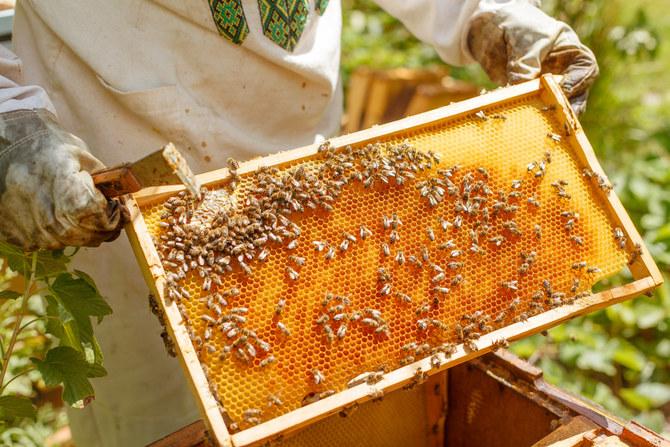
Bee keeping is one of the industries to benefit from the Saudi Agriculture Development Fund
Short Url
Updated 21 October 2022
Follow

Saudi Agriculture Development Fund invests $14.6bn over six decades

RIYADH: The Saudi Agricultural Development Fund has financed 467,000 loans, with a total value of SR55 billion ($14.6 billion), since its inception in 1962 until the end of 2021.

The figures were revealed within the Agricultural Exhibition Forum sessions on the sidelines of the Saudi Agriculture Exhibition 2022 and the Saudi Agri-Business Forum, under the title “Securing the Kingdom's diversified food needs in various sub-sectors.”

The services are represented in financing specialized projects such as poultry, greenhouses, fish farming, and food manufacturing industries, the ADF advisor Alaa Siddid explained.

Development loans target farmers, livestock breeders, beekeepers and fishermen, in addition to financing external agricultural investment projects, Siddiq said.

He added that the loans also focus on the working capital initiative to import agricultural products with the aim of enhancing food security and supporting strategic stocks.

Third Milling Co. board member Ahmad Hijazi reviewed the importance of activating innovative methods in increasing production. 

The company succeeded in investing this by raising the production capacity from 100,000 tons to 400,000 tons per year, with the same available resources and factories, in order to secure local production of flour and feed, Hijazi explained.

Fahad Aljadaan, marketing and business development director at Alkhorayef Commercial Co., talked up the importance of using new technologies and automation on innovative equipment to ensure maximum returns, reduce losses and costs, and increase production efficiency.

The company exports irrigation devices to 40 countries — ranking fourth in the world — and the sprinkler system was able to introduce modern irrigation techniques, raise production efficiency and reduce consumption by up to 30 percent, he said.

Organic production in the Kingdom amounted to 105,000 tons in 2021, with a value of SR1.03 billion per year, and an area of more than 27,100 hectares, and an increase in organic production areas that reached 138 percent, Saudi Organic Farming Association Director Yazeed Alfifi said, citing the Ministry of Environment, Water and Agriculture data.

The Kingdom achieved second place in the world in the development of the organic sector during the period from 2018 to 2021, he said.


Saudi Absher platform delivers over $5.3bn in annual economic impact 

Updated 18 December 2025
Follow

Saudi Absher platform delivers over $5.3bn in annual economic impact 

RIYADH: The Saudi government’s Absher digital services platform generates more than SR20 billion ($5.3 billion) in annual economic impact, highlighting the scale of savings created by the Kingdom’s transition from paper-based government procedures to digital services, according to the Ministry of Interior. 

Speaking to Al-Eqtisadiah, Bandar bin Mashari, assistant minister of interior for technology affairs, said the savings reflect broader efficiency gains from digitization. 

This comes as government services previously delivered through manual, paper-driven processes have moved onto a unified digital platform used by millions of citizens and residents. 

“Absher is one of the oldest platforms that has had a direct impact on strengthening the efficiency of spending and in opening new avenues for providing added value services,” said Mashari. 

He said the platform’s economic impact is closely linked to the government’s digital transformation agenda, which aims to reduce operational costs while improving service delivery across public agencies. 

The assistant minister further stated that the economic impact was at SR17 billion and grew to SR20 billion according to the ministry’s latest data. 

He added that Absher has completed a shift in its financial structure, transitioning from direct state capital funding to a sustainable financing model based on self-generated income. 

Mashari also said the Ministry of Interior is moving to expand its digital capabilities beyond service delivery, with a focus on security and financial protection. 

Authorities are working toward building a secure digital ecosystem designed to combat financial fraud and crime, he said, as digital transactions and online government services continue to expand. 

Absher is the flagship digital services platform of Saudi Arabia’s Ministry of Interior and one of the Kingdom’s earliest large-scale e-government initiatives. 

Launched in 2010, the platform provides citizens, residents, visitors, and businesses with access to hundreds of government services through a unified digital portal and mobile application. 

Its services span civil affairs, passports, residency and visa services, as well as traffic and vehicle transactions, and business administration, significantly reducing the need for in-person government visits. 

Absher is widely used across the Kingdom, handling millions of electronic transactions each month and serving as a core pillar of Saudi Arabia’s broader digital transformation and Vision 2030 agenda.