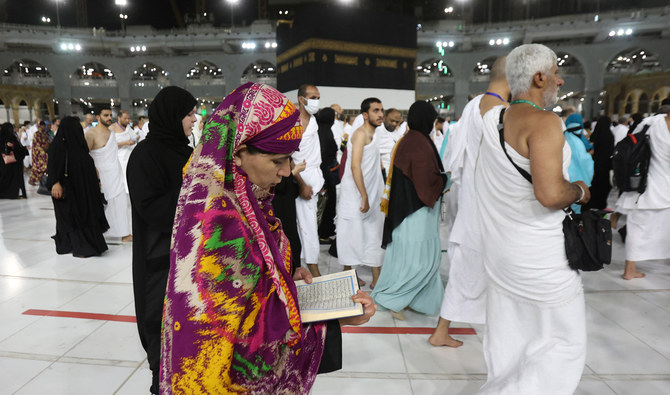

ISLAMABAD: The Saudi government’s decision to implement new visa rules for Umrah pilgrims earlier this month has been widely welcomed by the people of Pakistan who say they can now spend more time and travel freely in the kingdom.
According to the new rules, which were put into practice on October 10, women no longer require a male guardian to travel to Saudi Arabia to perform Umrah pilgrimage. The duration of the visa provided to foreign pilgrims has also been extended to three months and they can use it to travel to other places in the kingdom.
According to the official statistics compiled by the Saudi authorities, about 1.27 million pilgrims have visited the kingdom since Muharram, the first month of the Islamic calendar which began on July 30. About 200,000 of them belonged to Pakistan and constituted the second highest number of pilgrims after Indonesia.
“It is a great step by the Saudi government,” Ahsan Khan from Mardan told Arab News over the phone from Makkah on Thursday. “Now we can perform Umrah and meet our relatives in the kingdom.”
“I arrived in Saudi Arabia on October 15,” he continued. “I plan to spend ten more days in Makkah before going to Madinah for a week. I will then travel to Dammam to visit my cousin where I will spend a few more days.”
Speaking to Arab News, Ayesha Gul, a female pilgrim from Rawalpindi who went to perform Umrah without a male guardian, said it was like a dream come true since she had been planning her spiritual journey for the last several years.
“It was my dream to visit the Grand Mosque in Makkah and I still cannot believe that I am there,” she said. “I have not experienced any gender discrimination. Saudis have been treating women equally good as men. The female staff at the airport and the mosque was also very supportive.”
Hamzah Gilani, a spokesperson for the Pakistani consulate in Jeddah, said Saudi Arabia had been steadily taking measures to ease Umrah travel after lifting the COVID-19 restrictions.
“The Saudi Ministry of Hajj has also promoted a new online platform, Nusuk, to facilitate Umrah travelers’ accommodation and direct bookings with licensed Umrah agents in the kingdom,” he said.
President of the Travel Agents’ Association of Pakistan Nadeem Zaka said the number of Umrah pilgrims from the country had been increasing after the relaxations offered by the Saudi authorities.
“We have a long season ahead,” he pointed out. “So, more people will travel after getting information about the visa relaxation.”
Zaka added the daily Umrah travel rate from Pakistan in the last two months was over 3,000, adding it was much higher than the corresponding period last year.
Speaking to Arab News, Faizan Akhtar, a member of Pakistan’s Umrah Travel Agents’ Association, said the number of pilgrims had increased about 30 percent due to the new relaxations offered by the Saudi authorities.
“Previously, we used to send one or two groups of four to six people every week which has now increased to three to four groups of about six individuals despite the increased airfare due to the dollar rate,” he said.
“We have also sent many women independently to perform Umrah since the Saudi authorities have allowed them to travel without a male member of the family,” Akhtar said.
Previously, most pilgrims used to stay between 14 to 21 days for Umrah, he continued, though now many of them were demanding extended stay in the kingdom while booking tickets to travel to other cities.