

Yemen’s government forms negotiating team for peace talks with Houthis

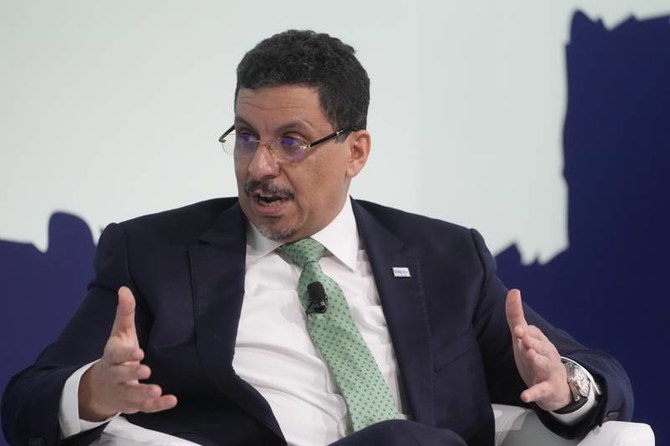
Yemeni Foreign Minister Ahmed Awadh bin Mubarak. (AP Photo)
Short Url
Updated 19 October 2022
Follow

Yemen’s government forms negotiating team for peace talks with Houthis

  • 11 members face uphill task to begin dialogue
  • Iran-backed group refuse to renew UN-brokered truce

AL-MUKALLA: Yemen’s Presidential Leadership Council has formed an 11-member committee to engage in talks with the Iran-backed Houthis to end the war, but there are no signs that the militia will accept any attempt to begin peace negotiations, including through the UN.

A government official told Arab News that the committee has veteran negotiators who had previously met with the Houthis in Kuwait, Geneva and other cities, including representatives of women groups and the pro-independence Southern Transitional Council.

The committee is led by incumbent Foreign Minister Ahmed Awadh bin Mubarak, and its members include Abdul Malik Al-Mekhlafi, a former foreign minister and the former head of the government’s team that held peace talks with the Houthis in Kuwait in 2016.

The team also has Nasser Al-Khoubaji, an STC senior member; Ali Al-Ashal, a parliamentarian and leading figure in the Islah Party; and Rasha Jarhum, a member of the Consultations and Reconciliation Commission.

International peace efforts, led by UN Yemen envoy Hans Grundberg, suffered a major blow earlier this month when the Houthis refused to renew the truce brokered by the world body that went into effect on April 2 and was extended twice.

The Houthis have demanded that the Yemeni government pay all public employees in areas under their control. They have also rejected the UN envoy’s proposal that they pay civilian public employees in their areas with revenue from fuel ships passing through Hodeidah port during the truce, with the government covering any shortfall.

The Houthis have further refused to partly break the siege of Taiz by opening at least one major route and several smaller roads heading in and out of the city.

Despite the parties’ failure to renew the truce, the Yemeni government has let commercial planes depart from Houthi-held Sanaa and lately permitted more fuel shipments to arrive at Hodeidah port.

To put pressure on the Yemeni government to comply with their demands, the Houthis asked maritime businesses that move oil from government-controlled ports to obtain authorization from them or face being targeted.

Meanwhile, Rosie Dyas, spokesperson of the British government in the MENA region, has demanded the Houthis cooperate with the UN envoy’s efforts to renew the truce and bring peace to Yemen.

“The moment has come for Houthi leaders to engage constructively with the UN. We encourage all parties to avoid further escalation because this is the biggest possibility for peace since the beginning of the conflict, and it is what the Yemeni people deserve,” she tweeted.

Yemen’s war began in September 2014, when the Houthis took power and imprisoned former President Abed Rabbo Mansour Hadi in Sanaa.

The Houthis’ move sparked brutal conflicts with government forces and resistance fighters, killing thousands and displacing millions.


UN nuclear watchdog says it’s unable to verify whether Iran has suspended all uranium enrichment

Updated 3 sec ago
Follow

UN nuclear watchdog says it’s unable to verify whether Iran has suspended all uranium enrichment

VIENNA: Iran has not allowed the United Nations nuclear watchdog to access nuclear facilities affected by the 12-day war in June, according to a confidential report by the watchdog circulated to member states and seen Friday by The Associated Press.
The report from the International Atomic Energy Agency stressed that therefore it “cannot verify whether Iran has suspended all enrichment-related activities,” or the “size of Iran’s uranium stockpile at the affected nuclear facilities.”
The IAEA report on Friday warned that due to the continued lack of access to any of Iran’s four declared enrichment facilities, the agency “cannot provide any information on the current size, composition or whereabouts of the stockpile of enriched uranium in Iran.”
The report stressed that the “loss of continuity of knowledge over all previously declared nuclear material at affected facilities in Iran needs to be addressed with the utmost urgency.”
Iran long has insisted its program is peaceful, but the IAEA and Western nations say Tehran had an organized nuclear weapons program up until 2003.
Highly enriched material should be verified regularly
According to the IAEA, Iran maintains a stockpile of 440.9 kilograms (972 pounds) of uranium enriched up to 60 percent purity — a short, technical step away from weapons-grade levels of 90 percent.
That stockpile could allow Iran to build as many as 10 nuclear bombs, should it decide to weaponize its program, IAEA director general Rafael Grossi warned in a recent interview with the AP. He added that it doesn’t mean that Iran has such a weapon.
Such highly enriched nuclear material should normally be verified every month, according to the IAEA’s guidelines.
The IAEA also reported that it had observed, through the analysis of commercially available satellite imagery, “regular vehicular activity around the entrance to the tunnel complex at Isfahan.”
The facility in Isfahan, some 350 kilometers (215 miles) southeast of Tehran, was mainly known for producing the uranium gas that is fed into centrifuges to be spun and purified.
Israel has struck buildings at the Isfahan nuclear site, among them a uranium conversion facility. The US also struck Isfahan with missiles during the war last June.
The IAEA also reported that through the analysis of commercially available satellite imagery, it has observed “activities being conducted at some of the affected nuclear facilities, including the enrichment facilities at Natanz and Fordow,” but it added that “without access to these facilities it is not possible for the Agency to confirm the nature and the purpose of the activities.”
The confidential IAEA report also said Friday that Iran did provide access to IAEA inspectors “to each of the unaffected nuclear facilities at least once since the military attacks of June 2025, with the exception of Karun Nuclear Power Plan, which is in the early stages of construction and does not contain nuclear material.”
IAEA joined Geneva talks between Iran and US
The IAEA reported on Friday that Grossi attended negotiations between the US and Iran on Feb. 17 and Feb. 26 in Geneva at which he “provided advice on issues relevant to the verification of Iran’s nuclear program.” The report said that those negotiations are “ongoing.”
The Trump administration has held three rounds of nuclear talks this year with Iran under Omani mediation. Thursday’s round of talks in Geneva ended without a deal, leaving the danger of another Mideast war on the table as the US has gathered a massive fleet of aircraft and warships in the region.
Oman’s Foreign Minister Badr Al-Busaidi said technical talks involving lower-level representatives would continue next week in Vienna, the home of the IAEA. The agency is likely to be critical in any deal.
The US is seeking a deal to limit Iran’s nuclear program and ensure it does not develop nuclear weapons.
Iran says it is not pursuing weapons and has so far resisted demands that it halt uranium enrichment on its soil or hand over its stockpile of highly enriched uranium.
Similar talks last year between the US and Iran about Iran’s nuclear program broke down after Israel launched what became a 12-day war on Iran, that included the US bombing Iranian nuclear sites.
Before the June war, Iran had been enriching uranium up to 60 percent purity.