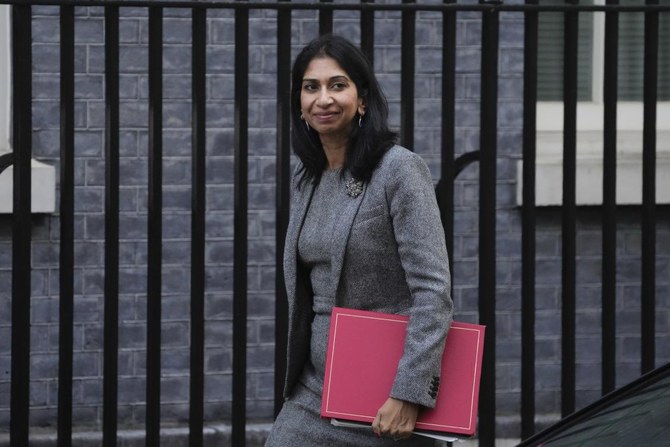
LONDON: Britain's interior minister quit on Wednesday with a thinly-veiled criticism of Prime Minister Liz Truss who is fighting to reassert her authority over restive lawmakers who are openly calling for her to quit.
The departure of Braverman, over a "technical" breach of government rules, means Truss has now lost two of her most senior ministers in less than a week, both replaced by politicians who had not backed her for the leadership.
Grant Shapps, who on Oct. 4 said Truss only had 10 days to save her premiership, will replace Braverman in a bid by the prime minister to bring critics into the fold to try to quell a rebellion which is growing in size.
Truss, in power for just over six weeks, has been fighting for her political survival ever since she launched a "mini-budget" - an economic programme of vast unfunded tax cuts on Sept. 23 that sent shockwaves through financial markets.
Hours after she told lawmakers that she was sorry for the mistakes she had made, but was not going to quit, reports swirled that her interior minister, or home secretary, had gone.
Confirming her departure, Braverman said she had broken rules by sending an official document from her personal email to a parliamentary colleague. But she added she was worried about the government and that just hoping problems would go away was not a viable approach.
"I have made a mistake, I accept responsibility, I resign," she said in a letter to the prime minister.
Media reports suggested Truss and Braverman may have clashed over immigration. Braverman, who said recently that she dreamt of seeing asylum seekers being deported to Rwanda, has advocated a hardline on immigration numbers.
Truss had suggested immigration restrictions could be lifted in some sections of the economy; as her new finance minister Jeremy Hunt works to find ways to boost the economy, easing immigration rules further could be one option.
LAUGHTER AND JEERS
The latest drama to hit a British government comes just hours after Truss faced a raucous prime minister's questions session in parliament for the first time since Hunt scrapped most of her tax-cutting plan. She came out fighting.
Asked by the leader of the main opposition Labour Party, Keir Starmer, why she should remain in power, she said: "I am a fighter and not a quitter."
"I have been very clear that I am sorry, and I have made mistakes," Truss told jeering opposition lawmakers in parliament. "I am somebody who's prepared to front up. I'm prepared to take the tough decisions."
The prime minister was met with laughter, boos and jeers, especially when she told the opposition Labour Party it needed to grasp economic reality.
She also tried to appease lawmakers over her future spending plans. After days of uncertainty, she said she was committed to increasing state pension payments in line with the level of inflation.
But some lawmakers were not convinced.
Conservative lawmaker William Wragg said he had submitted a letter of no confidence in the prime minister, joining a handful of others who have called for her to go. Wragg said he was "ashamed" of facing voters after the so-called mini-budget.
Former science minister, George Freeman, said; "Enough is enough. The Cabinet need to get a grip, fast, to restore collective responsibility and confidence."
Truss also faces a potential challenge later on Wednesday, when lawmakers vote on a motion brought by the main opposition party to overturn her pledge to reintroduce fracking - a vote being treated as test of confidence in the government.
Last month the government lifted a moratorium in place in England since 2019. It has sought to avert any Conservative opposition to the vote by promising to engage lawmakers to ensure local communities can give their consent to any projects.
At least three Conservatives have said they would not follow the government line on the fracking vote, which means they could be removed from the parliamentary party.
BALANCING THE BOOKS
Truss, who was elected on Sept. 6 by Conservative members on a promise of tax cuts and maintaining public spending, is under pressure despite apologising for going "too far and too fast" with an economic programme that prompted investors to dump the pound and government bonds.
Markets have somewhat stabilised since, but with mortgage rates increasing and official figures showing inflation back to a 40-year high, Truss faces a struggle to convince the public and her party that she can tackle a cost-of-living crisis.
Her Conservative Party is some 30 points behind Labour Party, according to opinion polls, and YouGov ranks her as the most unpopular leader the pollster has ever tracked.
Truss and Hunt are desperately trying to balance the books after investor confidence was shattered, and the government is now looking for ways to save money. After offering "reassurance" on pensions, Truss declined to give inflation-matching assurances for welfare payments, or say anything on foreign aid.


![]()

Braverman resigns as UK interior minister with veiled criticism of Truss
Short Url
https://arab.news/pgj59
Braverman resigns as UK interior minister with veiled criticism of Truss
- The departure of Braverman, over a "technical" breach of government rules, means Truss has now lost two of her most senior ministers in less than a week
- Truss, in power for just over six weeks, has been fighting for her political survival ever since she launched a "mini-budget"


Latest updates





© 2026 SAUDI RESEARCH & PUBLISHING COMPANY, All Rights Reserved And subject to Terms of Use Agreement.