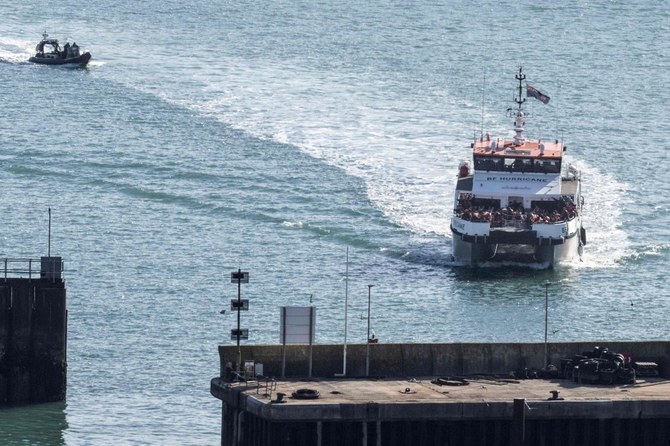
LONDON: UK police on Wednesday arrested an Albanian woman suspected of helping transport migrants across the English Channel in small boats, as authorities target the largest single national group now making the crossing.
The 31-year-old was arrested on suspicion of facilitating illegal immigration and has been taken into custody for questioning, according to the National Crime Agency (NCA).
Officers had acted on information that “Albanian organized crime groups were acting as brokers, seeking to facilitate the illegal migration of Albanian nationals,” said Jacque Beer, NCA Regional Head of Investigations.
“People smugglers only care about money, they don’t care about migrants’ safety or security.
“Channel crossings are utterly perilous, which is why disrupting and dismantling criminal networks is a priority,” he added.
The UK has vowed to speed up removals of Albanians illegally entering the country: official statistics show they are now the largest single group making small-boat crossings of the Channel.
Two weeks ago, Spanish police said they had broken up a gang suspected of smuggling Albanian migrants including children into Britain, hidden as stowaways in dangerous conditions aboard ferries and merchant ships.
The smuggling network provided migrants with accommodation and food until they made their journey to Britain.
A total of 2,165 Albanians made the dangerous crossing from northern France during the first six months of 2022, compared with 815 during the whole of 2021.
In previous years, asylum seekers from war zones made up the vast bulk of small-boat arrivals.
More than 500 migrants arrived in the UK on 12 boats after crossing the Channel on Tuesday, taking the provisional total for the year so far to 37,570.


![]()


UK arrests woman as Albanian traffickers targetted
Short Url
https://arab.news/chx7r
UK arrests woman as Albanian traffickers targetted
- The 31-year-old was arrested on suspicion of facilitating illegal immigration
- The UK has vowed to speed up removals of Albanians illegally entering the country


Poland withdraws from treaty banning antipersonnel mines and will use them to defend against Russia
- 1997 Anti-Personnel Mine Ban Treaty prohibits signatories from keeping or using antipersonnel mines
- Poland will begin domestic production of both antipersonnel and anti-tank land mines
WARSAW: Poland will use antipersonnel as well as anti-tank land mines to defend its eastern border against the growing threat from Russia, Poland’s deputy defense minister said on Friday as the country officially left an international convention banning the use of the controversial weapons.
The 1997 Anti-Personnel Mine Ban Treaty, also known as the Ottawa Convention, prohibits signatories from keeping or using antipersonnel mines, which can last for years and are known for having caused large-scale suffering among civilians in former conflict zones in countries including Cambodia, Angola and Bosnia and Herzegovina.
Poland, which ratified the document in 2012 and completed the destruction of its domestic anti-personnel mine stockpile in 2016, withdrew from the treaty on Friday and says it plans to renew manufacturing weapons.
“These mines are one of the most important elements of the defense structure we are constructing on the eastern flank of NATO, in Poland, on the border with Russia in the north and with Belarus in the east,” Paweł Zalewski, Poland’s deputy defense minister, said.
He said Poland needed to defend itself against Russia, a country which “has very aggressive intentions vis a vis its neighbors” and which itself never committed to the international land mine ban treaty.
Since Russia’s full-scale invasion of Ukraine, nearby countries have been reassessing their participation in the international treaty. Last year, Warsaw joined Finland, the three Baltic states of Estonia, Latvia and Lithuania, and Ukraine to announce it would leave the treaty.
Russia is one of nearly three dozen countries that have never acceded to the Ottawa treaty, alongside the United States.
Poland vows to make its own mines
Zalewski said that Poland will begin domestic production of both antipersonnel and anti-tank land mines, adding that the government would cooperate with Polish producers. He said Poland was aiming for self-sufficiency.
Land mines are an explosive weapon that’s placed on or just under the ground and blows up when a person or a vehicle crosses over them. Anti-tank mines, which are designed not to be triggered by a person’s weight, are not forbidden by the Ottawa Convention.
Speaking on Thursday after attending a demonstration of Bluszcz, an unmanned vehicle designed to distribute anti-tank mines produced by Polish company Belma SA and a military research institute, Polish Prime Minister Donald Tusk said Poland would “soon” have the ability to mine its eastern borders within 48 hours in case of a threat.
Given the length of the country’s eastern borders, he said, “a lot” of land mines will be needed.
Poland says it will only use mines in case of ‘realistic threat of Russian aggression’
Poland plans to prepare mine stockpiles as part of the so-called Eastern Shield, a system of enhanced fortifications Poland has been building on its borders with Belarus and Russia since 2024, Zalewski said.
But he said that Poland would only deploy the mines along its borders “when there is a realistic threat of Russian aggression.”
“We very much respect our territory and we don’t want to exclude it from day to day use for the Polish citizens,” Zalewski said.
Human rights groups have condemned moves to withdraw from the Ottawa Convention, arguing that anti-personnel mines are too dangerous to civilians.
But Zalewski responded that the country is striking a balance by keeping the mines in reserve unless the country faces attack.
“We are not an aggressive country,” he said, “but we have to use all means to deter Russia.”
The 1997 Anti-Personnel Mine Ban Treaty, also known as the Ottawa Convention, prohibits signatories from keeping or using antipersonnel mines, which can last for years and are known for having caused large-scale suffering among civilians in former conflict zones in countries including Cambodia, Angola and Bosnia and Herzegovina.
Poland, which ratified the document in 2012 and completed the destruction of its domestic anti-personnel mine stockpile in 2016, withdrew from the treaty on Friday and says it plans to renew manufacturing weapons.
“These mines are one of the most important elements of the defense structure we are constructing on the eastern flank of NATO, in Poland, on the border with Russia in the north and with Belarus in the east,” Paweł Zalewski, Poland’s deputy defense minister, said.
He said Poland needed to defend itself against Russia, a country which “has very aggressive intentions vis a vis its neighbors” and which itself never committed to the international land mine ban treaty.
Since Russia’s full-scale invasion of Ukraine, nearby countries have been reassessing their participation in the international treaty. Last year, Warsaw joined Finland, the three Baltic states of Estonia, Latvia and Lithuania, and Ukraine to announce it would leave the treaty.
Russia is one of nearly three dozen countries that have never acceded to the Ottawa treaty, alongside the United States.
Poland vows to make its own mines
Zalewski said that Poland will begin domestic production of both antipersonnel and anti-tank land mines, adding that the government would cooperate with Polish producers. He said Poland was aiming for self-sufficiency.
Land mines are an explosive weapon that’s placed on or just under the ground and blows up when a person or a vehicle crosses over them. Anti-tank mines, which are designed not to be triggered by a person’s weight, are not forbidden by the Ottawa Convention.
Speaking on Thursday after attending a demonstration of Bluszcz, an unmanned vehicle designed to distribute anti-tank mines produced by Polish company Belma SA and a military research institute, Polish Prime Minister Donald Tusk said Poland would “soon” have the ability to mine its eastern borders within 48 hours in case of a threat.
Given the length of the country’s eastern borders, he said, “a lot” of land mines will be needed.
Poland says it will only use mines in case of ‘realistic threat of Russian aggression’
Poland plans to prepare mine stockpiles as part of the so-called Eastern Shield, a system of enhanced fortifications Poland has been building on its borders with Belarus and Russia since 2024, Zalewski said.
But he said that Poland would only deploy the mines along its borders “when there is a realistic threat of Russian aggression.”
“We very much respect our territory and we don’t want to exclude it from day to day use for the Polish citizens,” Zalewski said.
Human rights groups have condemned moves to withdraw from the Ottawa Convention, arguing that anti-personnel mines are too dangerous to civilians.
But Zalewski responded that the country is striking a balance by keeping the mines in reserve unless the country faces attack.
“We are not an aggressive country,” he said, “but we have to use all means to deter Russia.”
Latest updates


© 2026 SAUDI RESEARCH & PUBLISHING COMPANY, All Rights Reserved And subject to Terms of Use Agreement.