

RIYADH: Augmented Reality has proven to be the backbone of multimedia instant messaging service Snapchat — and, increasingly, other social media apps — providing users with a range of options, from the use of amusing lenses and filters to virtual product trials.
Despite its popularity, Snapchat developer Snap Inc. feels the potential of AR has been “underestimated by many decision-makers in the various industries,” the company said. So it conducted a study titled Augmentality Shift, in partnership with Ipsos, to better understand the value of AR to brands and consumers.
It found that by 2025, 75 percent of the global population, and nearly all Gen Zs and millennials in the Kingdom, are expected to have adopted AR, according to Snap.
The growing adoption of AR alone isn’t enough, however, perception also matters.
“Playfulness will always be part of the AR experience but there is a growing demand for AR in our day-to-day lives,” Snap said in its report on the study.
It found that 94 percent of brands think AR is primarily for fun, even though only 53 percent of consumers think this.
Consumers are increasingly using AR for more than just using playful and funny lenses, with 67 percent of participants identifying shopping as their main reason for using AR. Moreover, 84 percent of consumers said they were interested in using AR to interact with a product before buying.
“AR has an unmatched power to transform brand experiences and drive consumer loyalty,” said Abdulla Alhammadi, regional business lead for Saudi Arabia at Snap Inc.
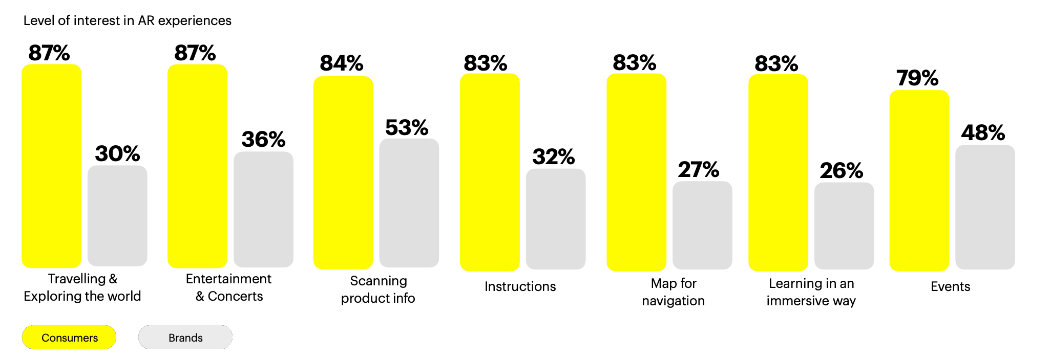
Beyond shopping and learning, 83 percent of consumers questioned for the study were interested in accessing AR maps for navigation; 87 percent were interested in exploring the world using AR, and 83 percent said they’d be interested in using AR instructions.
Consumers also view AR as a means of connection — even at physical gatherings — with 79 percent interested in experiencing AR at events and conferences, and 87 percent interested in the use of AR in entertainment experiences such as concerts and sporting events.
While many brands have started to recognize the potential of AR for their businesses, others have yet to see it, creating a gap between consumer expectations and brand offerings. For example, 83 percent of consumers expressed an interest in AR for learning, but only 26 percent of brands are interested in serving such a need.
In fact, across all categories, consumer interest in AR experiences was much higher than brands’ interest in delivering them.
Yet for brands that have already embraced AR, the rewards have been high, with 84 percent saying it has helped them to drive sales and performance metrics and acquire new customers; and 74 percent saying it boosts loyalty and improves the consumer experience.
This sentiment was echoed by consumers, with 74 percent saying they feel closer to brands or products that offer AR experiences.
Saudi Arabia is one of the Snapchat’s biggest markets, with the service reaching 90 percent of 13 to 34-year-olds in the Kingdom, with a monthly addressable reach of 20 million.
“Saudi Snapchatters are among the most engaged globally and we are excited to see how brands will leverage Snap’s AR capabilities to create extraordinary journeys and increase their brand awareness, while also building purpose for their consumers,” Alhammadi said.
FAST FACTS
• 60 percent e-commerce brands agree AR is an essential part of digital marketing
• 76 percent of brands that use AR lenses improved their brand awareness
• 84 percent of brands that use AR said it helps to drive sales, acquire new customers and drive performance metrics
• 80 percent of brands that use AR said it provides opportunities for deep and meaningful engagement
• 73 percent of brands agree that AR powers inclusivity