

Alibaba logistics unit Cainiao sets up South Asia’s first smart distribution center in Pakistan

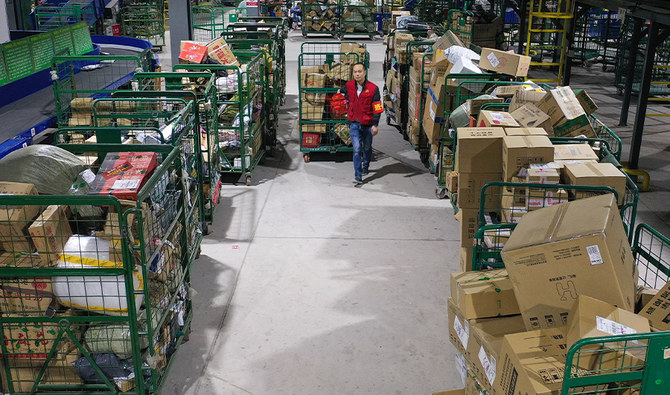
A worker transfers packages at a delivery company in Hengyang in China's central Hunan province early on November 12, 2019. (AFP/FILE)
Short Url
Updated 16 October 2022
Follow

Alibaba logistics unit Cainiao sets up South Asia’s first smart distribution center in Pakistan

  • E-commerce platform Daraz launches first automated smart distribution centers in Karachi and Lahore
  • Cainiao selected Pakistan as first location in South Asia for new centers because of digital sector potential 

KARACHI: Pakistani e-commerce platform Daraz this week launched the country’s first automated smart distribution centers in Karachi and Lahore in collaboration with Cainiao Network, the logistics arm of China’s Alibaba Group, the first such set up in South Asia. 

Equipped with innovative smart technologies such as an automatic assembly line and a smart distribution set-up, the centers are the most technologically advanced logistics facilities in South Asia, and mark Cainiao’s first deeply integrated distribution center network in the region.

The two facilities span over 50,000 square meters each, and have capacity to process 428,400 orders daily. 

Cainiao has so far built hundreds of automated distribution centers of varying scales in China, and 10 smart distribution hubs across Europe, Asia, and America.

Dr. Ding Hongwei, General Manager of Cainiao Technology, said Pakistan had been selected as the first location in South Asia to set up smart distribution centers because of the potential of its digital sector. 

“Our great confidence in the investment in Pakistan comes from its significant growth and high potential of the digital sector, and strong support from local government in infrastructure and policy as well,” Hongwei said. 

“We constantly innovate our operations and technology in Pakistan to continue scaling and enhancing our customer experience. Daraz is introducing smart technology in the country to bring more efficiency in our logistics,” Bjarke Mikkelsen, CEO and Founder of Daraz Group, said at the launch ceremony earlier this week.

“Launching our centers in Karachi and Lahore is a key step of this partnership, and we look forward to growing it in future.” 

Daraz officials said with the launch of the smart distribution centers, sorting capacity would increase manifold and manual errors would go down by over 90 percent.

“This will benefit the entire business chain and improve the customer experience.” Ahmed Tanveer, COO of Daraz Pakistan, said. 

Pakistan’s e-commerce market is projected to generate $7.6 billion revenue in 2022. The market volume is projected to grow by $9.1 billion by 2025, according to Statista, a Germany-based provider of market and consumer data.


Pakistan urges pilgrims to complete Saudi biometrics as Hajj preparations gain pace

Updated 30 January 2026
Follow

Pakistan urges pilgrims to complete Saudi biometrics as Hajj preparations gain pace

  • Government warns pilgrims biometric verification is required for Hajj visas
  • Step follows tighter oversight after last year’s Hajj travel disruptions

ISLAMABAD: Pakistan’s government on Friday urged aspiring pilgrims to complete mandatory Saudi biometric verification for Hajj visas, as preparations for the 2026 pilgrimage gather pace following stricter oversight of the Hajj process.

The announcement comes only a day after Pakistan’s Religious Affairs Minister Sardar Muhammad Yousuf said regulations for private Hajj operators had been tightened, reducing their quota following widespread complaints last year, when tens of thousands of pilgrims were unable to travel under the private Hajj scheme.

“Saudi biometric verification is mandatory for the issuance of Hajj visas,” the Ministry of Religious Affairs said in a statement, urging pilgrims to complete the process promptly to avoid delays.

“Hajj pilgrims should complete their biometric verification at home using the ‘Saudi Visa Bio’ app as soon as possible,” it added.

The statement said the pilgrims who were unable to complete biometric verification through the mobile application should visit designated Saudi Tasheer centers before Feb. 8, adding that details of the centers were available on Pakistan’s official Hajj mobile application.

Pakistan has been steadily implementing digital and procedural requirements for pilgrims ahead of Hajj 2026, including mandatory training sessions, biometric checks and greater use of mobile applications, as part of efforts to reduce mismanagement.

Saudi Arabia has allocated Pakistan a quota of 179,210 pilgrims for Hajj 2026, with the majority of seats reserved under the government scheme and the remainder allocated to private tour operators.