

UK announces additional £10 million in flood aid for Pakistan

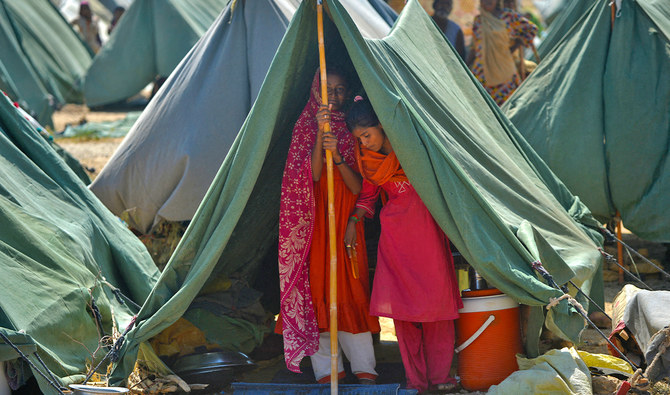
Internally displaced flood-affected people take refuge in a camp at Kotri in Jamshoro district of Sindh province, Pakistan, on September 28, 2022. (AFP)
Short Url
Updated 14 October 2022
Follow

UK announces additional £10 million in flood aid for Pakistan

  • UK minister of State Lord Tariq Ahmad arrives in Pakistan to discuss flood response
  • Last week, UN revised humanitarian appeal for Pakistan five-fold to $816 million

ISLAMABAD: The UK announced another £10 million in humanitarian aid for Pakistan on Friday for life-saving humanitarian support and to help in the country in its flood relief efforts, the British High Commission announced. 

Triggered by heavy monsoon rains, floods have devastated Pakistan and left over 1,700 people dead and 33 million out of a population of 220 million adversely affected. Officials say flood waters could take up to six months to recede. 

In the meantime, water and vector-borne diseases like dengue, malaria and skin, eye and gastronomical infections have rapidly spread. 

Last week, the United Nations revised its humanitarian appeal for Pakistan five-fold to $816 million while the UN has received only $90 million in assistance from the $180 million pledged so far. 

The revised appeal came amid a surge in water-borne diseases following the country’s worst floods in decades. 

“As part of a visit to the country, FCDO Minister Lord (Tariq) Ahmad of Wimbledon has today [Friday] announced a further £10 million of humanitarian aid, bringing the UK Government’s total contribution to £26.5 million,” the British High Commission said in a statement. 

The high commission added that extra support will be spent on urgent life-saving needs such as providing shelter, water and sanitation to prevent water-borne diseases. 

“It will focus on supporting people who are still displaced and those that are returning to their land, by helping re-establish communal water supplies,” the statement said. 

 During his visit to Pakistan, Lord Ahmad is scheduled to meet Prime Minister Shehbaz Sharif, Foreign Minister Bilawal Bhutto-Zardari and other government officials. In meetings with them, the minister is expected to discuss the impact of the floods, visit areas most affected by the catastrophe and speak with key UK-funded aid agencies in Pakistan’s southern Sindh province. 

 “Health remained our major concern as according to World Health Organization, 2.7 million children would be affected by malaria by January 2023, which is a significant increase as compared to previous years,” UN Resident and Humanitarian Coordinator in Pakistan, Julien Harneis, had said this week at a media briefing in Islamabad. 

Around 50,000 children died due to Malaria each year in Pakistan but this year the number could be higher due to a significant increase in cases, the UN representative said. 


Rating firm S&P says it won’t rush Iran war downgrades, sees risks for countries like Pakistan

Updated 12 March 2026
Follow

Rating firm S&P says it won’t rush Iran war downgrades, sees risks for countries like Pakistan

  • Agency says it is monitoring indebted energy importers as higher oil prices strain finances
  • Gulf economies seen better placed to weather shock, though Bahrain flagged as vulnerable

LONDON: S&P Global ‌said it would not make any knee-jerk sovereign rating cuts following the outbreak of war in the ​Middle East, but warned on Thursday that soaring oil and gas prices were putting a number of already cash-strapped countries at risk.

The firm’s top analysts said in a webinar that the conflict, which has involved US and Israeli strikes ‌against Iran and Iranian ‌strikes against Israel, ​US ‌bases ⁠and Gulf ​states, ⁠was now moving from a low- to moderate-risk scenario.

Most Gulf countries had enough fiscal buffers, however, to weather the crisis for a while, with more lowly rated Bahrain the only clear exception.

Qatar’s banking sector could ⁠also struggle if there were significant ‌deposit outflows in ‌reaction to the conflict, although there ​was no evidence ‌of such strains at the moment, they ‌said.

“We don’t want to jump the gun and just say things are bad,” S&P’s head global sovereign analyst, Roberto Sifon-Arevalo, said.

The longer the crisis ‌was prolonged, though, “the more difficult it is going to be,” he ⁠added.

Sifon-Arevalo ⁠said Asia was the second-most exposed region, due to many of its countries being significant Gulf oil and gas importers.

India, Thailand and Indonesia have relatively lower reserves of oil, while the region also had already heavily indebted countries such as Pakistan, Bangladesh and Sri Lanka whose finances would be further hurt by rising energy prices.

“We ​are closely monitoring ​these (countries) to see how the credit stories evolve,” Sifon-Arevalo said.