DUBAI: Iranian security forces stepped up their crackdown on Kurdish regions of the country overnight, deploying shock troops, as authorities pursued their deadly suppression of nationwide protests sparked by Mahsa Amini’s death in police custody.
Nearly four weeks after Amini, a 22-year-old Iranian Kurd, was detained in Tehran for “inappropriate attire,” the protests show no sign of abating in a bold challenge to Iran’s clerical rulers, even if the unrest does not seem close to toppling them.
The unrest has underlined pent-up frustrations over freedoms and rights in Iran, with many women joining in. The deaths of several teenaged girls reportedly killed while demonstrating have becoming a rally cry for more protests.
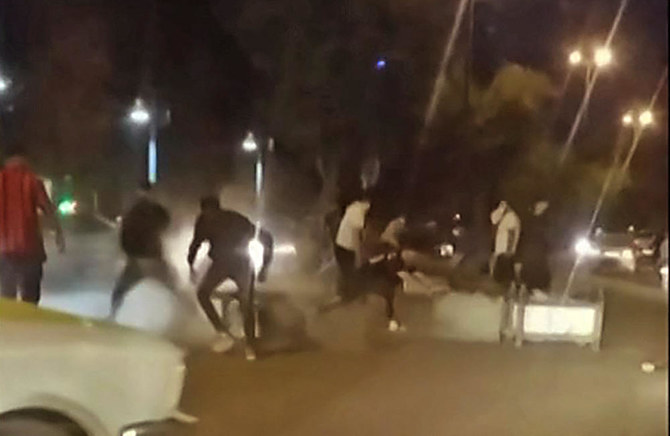
Iran deployed members of the Basij militia, troops which have been at the forefront of repressing popular unrest, in Kurdish areas where seven people were killed in protests overnight.
Videos on social media which Reuters could not verify showed what appeared to be Basij beating protesters in Kurdish areas.
Two sources in Sanandaj, capital of Kurdistan province, told Reuters that Basij members, along with riot police, were attacking demonstrators.
A witness told Reuters hundreds of riot police and Basij forces have been transferred from other provinces to Kurdistan to confront protesters.
“A few days ago some Basij members from Sanandaj and Baneh refused to follow orders and shoot the people,” said the witness.
“In Saqez the situation is the worst. Those Basiji forces just shoot at people, houses, even if there are no protesters.”
Basij volunteers, affiliated to the elite Revolutionary Guards, may number in the millions, with 1 million active members, analysts say.
Although the latest protests have persisted for weeks, the Iranian authorities have experience of quelling much longer bouts of unrest. In 2009, nationwide demonstrations that erupted over a disputed election lasted for about six months before finally being brought under control.
While many officials have struck an uncompromising tone, a top adviser to Supreme Leader Ayatollah Ali Khamenei has been cited as questioning whether police should be enforcing headscarf-wearing — rare criticism of state efforts to impose the hijab.
Human rights groups have reported more than 200 killed in the crackdown on the protests, which have been particularly intense in Kurdish regions where security forces have put down unrest by the Kurdish minority in the past.
A source in Sanandaj told Reuters riot police were searching houses and arresting dozens of young people, describing the situation as very tense with hundreds of police officers on the city’s streets.
“We have information from Baneh and Saqez as well. They have arrested dozens of young people since yesterday, including teenagers,” added the source, who declined to be identified because of fears for their safety.
Rights group Hengaw, which reports on Iran’s Kurdish regions, said protesters in 10 cities had confronted “security forces’ intense violence” on Wednesday night.
In the city of Kermanshah, direct fire from security forces killed two people, Hengaw said. It posted a picture of the body of an 18-year-old man it said was one of the dead.
A video posted on social media from Kermanshah late on Wednesday showed a fire burning in the road. “Kermanshah is hell, it’s war, it’s war,” a voice can be heard saying.
Three members of the security forces were also killed in Kermanshah and around 40 more injured, Hengaw said.
It said a fourth member of the security forces was killed in Mahabad, and firing by security forces killed another person in Sanandaj.
Officials have denied that security forces have fired on protesters and have previously reported around 20 members of the security forces killed during the nationwide unrest.
Reuters could not independently verify the videos and reports.
Iran’s Kurds are part of an ethnic minority spread between several regional states whose autonomy aspirations have also led to conflicts with authorities in Iraq, Syria and Turkey.
TOUGH SENTENCES
While officials have blamed violence on ethnic separatists — the Revolutionary Guards have attacked Kurdish Iranian dissident bases in neighboring Iraq — protesters’ chants have stressed unity against Islamist rule and called for Khamenei’s downfall.
During the protests, many women have been publicly removing, waving and burning the headscarves they are required to wear under Iran’s conservative dress codes that led to Amini’s arrest.
Khamenei adviser Ali Larijani, a former parliament speaker, said “if 50 percent of our country’s women do not practice wearing a full hijab, then the police should not be involved.”
“The question here is this: Should the government interfere in all matters such as this one?” he told the Ettela’at daily.
Security forces arrested three human rights lawyers who were protesting in front of the Bar Association in Tehran on Wednesday, lawyer Saeid Dehghan said.
While Iran has used force to crack down on the unrest, there has been no sign yet of the Revolutionary Guards — an elite force — being deployed.
Iran’s top judge said he had ordered tough sentences for the “main elements of riots,” a semi-official news agency reported.
“I have instructed our judges to avoid showing unnecessary sympathy ... and issue tough sentences for them while separating the less guilty people,” Gholamhossein Mohseni Ejei was quoted as saying.
Iranian state media has reported indictments have been filed against some people detained during the protests, but has not said how many. Rights groups estimated thousands have been arrested.

Iran intensifies crackdown on Kurdish areas as protests rage
Short Url
https://arab.news/25nr7
Iran intensifies crackdown on Kurdish areas as protests rage
- Nearly four weeks after Amini, a 22-year-old Iranian Kurd, was detained in Tehran for “inappropriate attire”
- The unrest has underlined pent-up frustrations over freedoms and rights in Iran, with many women joining in
In Gaza hospital, patients cling to MSF as Israel orders it out
KHAN YUNIS: At a hospital in Gaza, wards are filled with patients fearing they will be left without care if Doctors Without Borders (MSF) is forced out under an Israeli ban due to take effect in March.
Last month, Israel announced it would prevent 37 aid organizations, including MSF, from operating in Gaza from March 1 for failing to provide detailed information on their Palestinian staff.
“They stood by us throughout the war,” said 10-year-old Adam Asfour, his left arm pinned with metal rods after he was wounded by shrapnel in a bombing in September.
“When I heard it was possible they would stop providing services, it made me very sad,” he added from his bed at Gaza’s Nasser Hospital.
Israel’s Ministry of Diaspora Affairs and Combating Antisemitism, which oversees NGO registrations, has accused two MSF employees of links to Palestinian militant groups Hamas and Islamic Jihad, allegations MSF vehemently denies.
The ministry’s decision triggered international condemnation, with aid groups warning it would severely disrupt food and medical supplies to Gaza, where relief items are already scarce after more than two years of war.
Inside the packed Nasser Hospital in southern Gaza, one of the few medical facilities still functioning in the territory, MSF staff were still tending to children with burns, shrapnel wounds and chronic illnesses, an AFP journalist reported.
But their presence may end soon.
The prospect was unthinkable for Fayrouz Barhoum, whose grandson is being treated at the facility.
“Say bye to the lady, blow her a kiss,” she told her 18-month-old grandson, Joud, as MSF official Claire Nicolet left the room.
Joud’s head was wrapped in bandages covering burns on his cheek after boiling water spilled on him when strong winds battered the family’s makeshift shelter.
“At first his condition was very serious, but then it improved considerably,” Barhoum said.
“The scarring on his face has largely diminished. We need continuity of care,” she said.
- ‘We will continue working’ -
AFP spoke with patients and relatives at Nasser Hospital, all of whom expressed the same fear: that without MSF, there would be nowhere left to turn.
MSF says it currently provides at least 20 percent of hospital beds in Gaza and operates around 20 health centers.
In 2025 alone, it carried out more than 800,000 medical consultations and over 10,000 deliveries.
“It’s almost impossible to find an organization that will come here and be able to replace all what we are doing currently in Gaza,” Nicolet told AFP, noting that MSF not only provides medical care but also distributes drinking water to a population worn down by a prolonged war.
“So this is not really realistic.”
Since the start of the war in October 2023, triggered by Hamas’s deadly attack on southern Israel, Israeli officials and the military have repeatedly accused Hamas of using Gaza’s medical facilities as command centers.
Many have been damaged by two years of bombardments or overcrowded by casualties, while electricity, water and fuel supplies remain unreliable.
Aid groups warn that without international support, critical services such as emergency care, maternal health, and paediatric treatment could collapse entirely, leaving hundreds of thousands of residents without basic medical care.
Humanitarian sources say at least three international NGO employees whose files were rejected by Israeli authorities have already been prevented from entering Gaza through the Kerem Shalom crossing.
“For now, we will continue working as long as we can,” said Kelsie Meaden, an MSF logistics manager at Nasser Hospital, adding that constraints were already mounting.
“We can’t have any more international staff enter into Gaza, as well as supplies... we will run into shortages.”
Last month, Israel announced it would prevent 37 aid organizations, including MSF, from operating in Gaza from March 1 for failing to provide detailed information on their Palestinian staff.
“They stood by us throughout the war,” said 10-year-old Adam Asfour, his left arm pinned with metal rods after he was wounded by shrapnel in a bombing in September.
“When I heard it was possible they would stop providing services, it made me very sad,” he added from his bed at Gaza’s Nasser Hospital.
Israel’s Ministry of Diaspora Affairs and Combating Antisemitism, which oversees NGO registrations, has accused two MSF employees of links to Palestinian militant groups Hamas and Islamic Jihad, allegations MSF vehemently denies.
The ministry’s decision triggered international condemnation, with aid groups warning it would severely disrupt food and medical supplies to Gaza, where relief items are already scarce after more than two years of war.
Inside the packed Nasser Hospital in southern Gaza, one of the few medical facilities still functioning in the territory, MSF staff were still tending to children with burns, shrapnel wounds and chronic illnesses, an AFP journalist reported.
But their presence may end soon.
The prospect was unthinkable for Fayrouz Barhoum, whose grandson is being treated at the facility.
“Say bye to the lady, blow her a kiss,” she told her 18-month-old grandson, Joud, as MSF official Claire Nicolet left the room.
Joud’s head was wrapped in bandages covering burns on his cheek after boiling water spilled on him when strong winds battered the family’s makeshift shelter.
“At first his condition was very serious, but then it improved considerably,” Barhoum said.
“The scarring on his face has largely diminished. We need continuity of care,” she said.
- ‘We will continue working’ -
AFP spoke with patients and relatives at Nasser Hospital, all of whom expressed the same fear: that without MSF, there would be nowhere left to turn.
MSF says it currently provides at least 20 percent of hospital beds in Gaza and operates around 20 health centers.
In 2025 alone, it carried out more than 800,000 medical consultations and over 10,000 deliveries.
“It’s almost impossible to find an organization that will come here and be able to replace all what we are doing currently in Gaza,” Nicolet told AFP, noting that MSF not only provides medical care but also distributes drinking water to a population worn down by a prolonged war.
“So this is not really realistic.”
Since the start of the war in October 2023, triggered by Hamas’s deadly attack on southern Israel, Israeli officials and the military have repeatedly accused Hamas of using Gaza’s medical facilities as command centers.
Many have been damaged by two years of bombardments or overcrowded by casualties, while electricity, water and fuel supplies remain unreliable.
Aid groups warn that without international support, critical services such as emergency care, maternal health, and paediatric treatment could collapse entirely, leaving hundreds of thousands of residents without basic medical care.
Humanitarian sources say at least three international NGO employees whose files were rejected by Israeli authorities have already been prevented from entering Gaza through the Kerem Shalom crossing.
“For now, we will continue working as long as we can,” said Kelsie Meaden, an MSF logistics manager at Nasser Hospital, adding that constraints were already mounting.
“We can’t have any more international staff enter into Gaza, as well as supplies... we will run into shortages.”
© 2026 SAUDI RESEARCH & PUBLISHING COMPANY, All Rights Reserved And subject to Terms of Use Agreement.


