

Filipino expats join forces to keep Saudi Arabia green

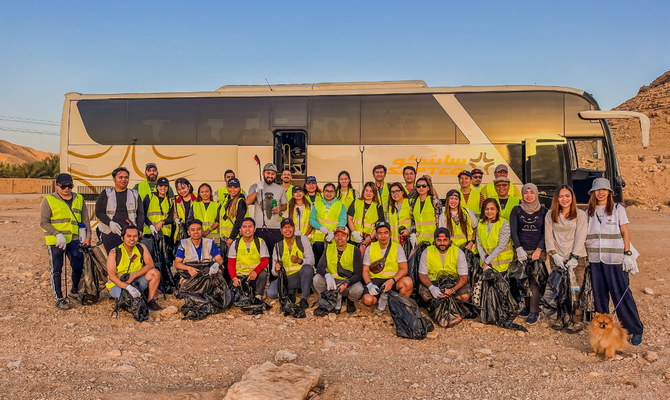
As of October, the group has 200 volunteers, collected 356 bags of trash, and planted 100 trees. They have held more than 10 cleanup drives in Heet Caves Park, Sha’ib Luha, and in other southern parts of Riyadh. (Supplied)
Short Url
Updated 13 October 2022
Follow

Filipino expats join forces to keep Saudi Arabia green

  • Volunteer group sees clearing trash and planting trees as ‘way to give back to society’

JEDDAH: Every Friday before the break of dawn, Jimrey Buntas Dapin boards a bus with his group and travels to the deserts in Riyadh to pick up trash and plant trees in support of the Saudi Green Initiative.

Dapin, 29, is one of five co-founders of the Filipinos for the Saudi Green Initiative, a group set up in 2020 after being inspired by the work of other volunteer bodies, the Environmental Green Horizons Society and Green Daqla.

While the Saudi Green Initiative seeks to combat climate change and improve the quality of life for future generations, Dapin and his group found that their volunteer work also allows them to give back to Saudi Arabia. 

“Working in Saudi Arabia has given me a good life here, and it has made my family’s lifestyle better back home in the Philippines. Thus, I feel the responsibility to give back to society,” said Dapin. 

“My simple way of giving back to the society was tree planting and desert cleanup. We live here in the same space and ecosystem, so it’s everyone’s responsibility.” 
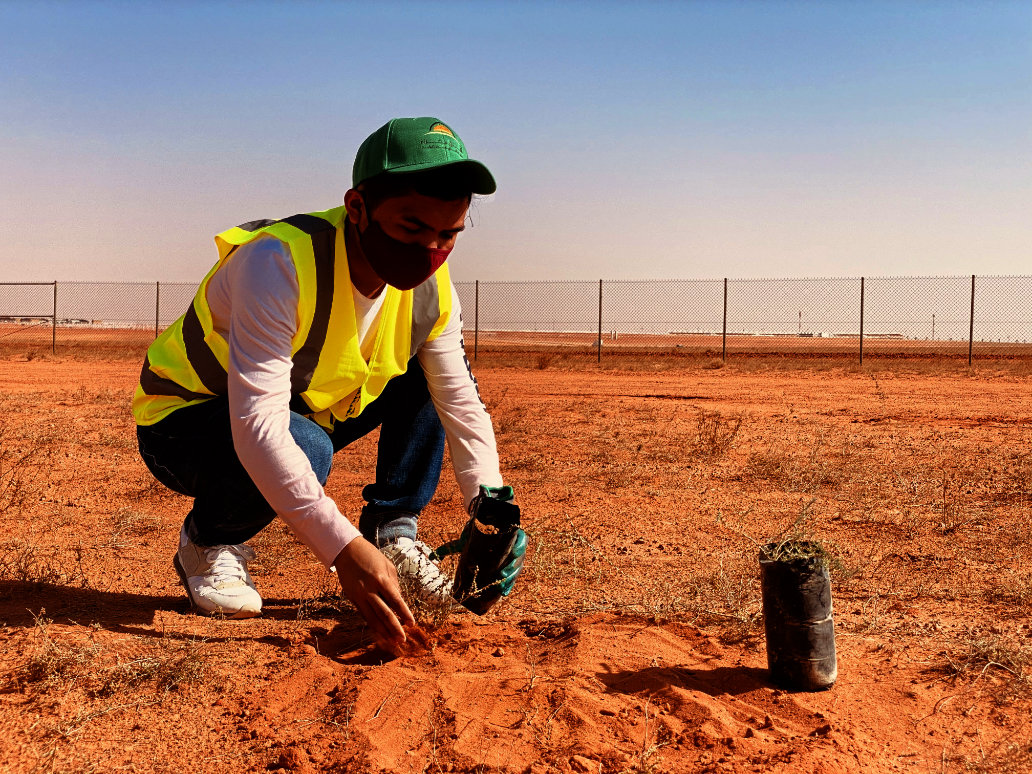
Dapin, who works at a Riyadh-based company, is also a licensed social studies teacher. He encourages his students and peers to “participate in social and civic responsibilities.”

With all major objectives of the Kingdom aligned with Vision 2030, the Filipinos are using the year as a number to reach by each member — in terms of bags of trash collected and trees planted.

As of October, the group has 200 volunteers, collected 356 bags of trash, and planted 100 trees. They have held more than 10 cleanup drives in Heet Caves Park, Sha’ib Luha, and in other southern parts of Riyadh. During one of their recent trips, the group collected 3,000 plastic bottles in just five hours from the Red Sand area. All the trash collected is delivered to a local recycling facility.

“For cleanup drives, we enquire from our friends about the public places and research the location before embarking on the trip,” said Dapin. 
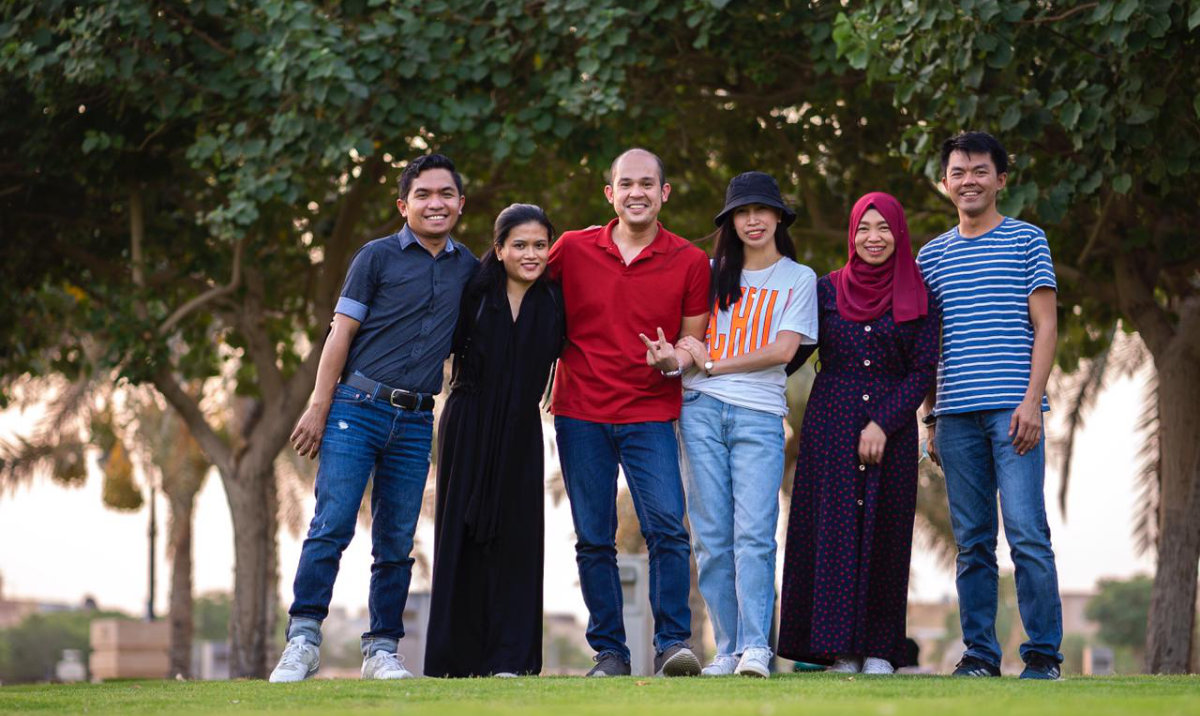
Dapin said they started with just a handful of community members passionate about the environment, but pictures of their work on Twitter attracted attention and traction.

One of people who saw the social media posts was Mary Abigail Pajarillo, who works as a public diplomacy assistant at the Philippine Embassy in the Kingdom. “I have been residing in the Kingdom since I was three years old. For me, (the) Kingdom is my first home. I saw one of the posts of Jimrey on Twitter, and it piqued my interest since I was not aware that a group of Filipinos was volunteering for such an activity. Whenever I’m free, I’m always ready to join.”

For Reine Baquiano, a Filipino engineer, joining the group was also an introduction to social work. “Volunteering is a first for me and I have grown to enjoy it and learn as I go with the process.” 
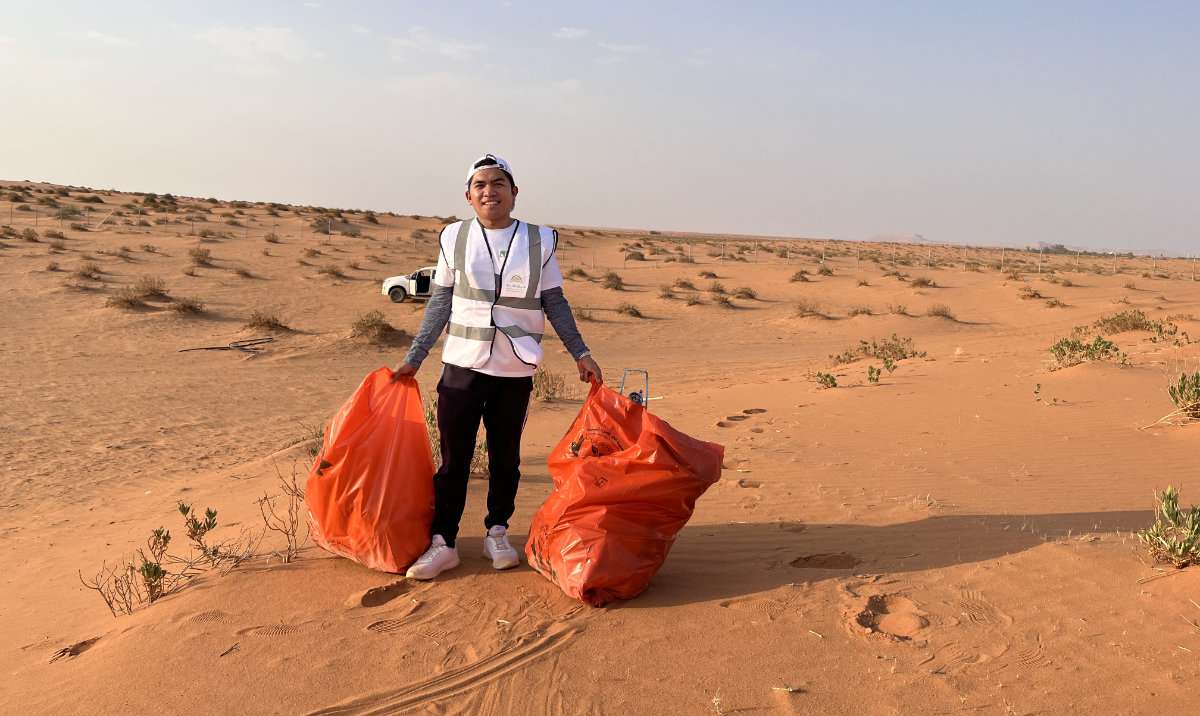
Dapin said it takes him and his team a week to plan a trip that comprises conducting meetings with authorities, making travel arrangements, shopping for trash bags, gloves, food and water for the attendees, and creating social media posts pre- and post-trip while juggling full-time jobs. 

“It’s all commitment and love for the environment here in the Kingdom.” 

Once everything is set, volunteers “wake up 3 a.m. every weekend to do their part for their home, Saudi Arabia.”

SAPTCO, a transport company, provides free transport for the group as part of its social responsibility program.

Several good Samaritans and organizations including Tadweer, Dunkin Donuts and Romansiah offer support to the group.

Their work has garnered significant praise on Twitter from Saudis. While overwhelmed with all the support and encouragement, Dapin believes “that caring and protecting the environment is everyone’s responsibility not just the citizens and government.”


Threat to Kingdom’s security is ‘red line’ that will be ‘addressed and neutralized,’ Saudi envoy says

Updated 56 min 29 sec ago
Follow

Threat to Kingdom’s security is ‘red line’ that will be ‘addressed and neutralized,’ Saudi envoy says

  • Abdulaziz Alwasil tells UN Security Council the situation in southern Yemen is ‘a just cause with social and historic dimensions’ that can only be resolved through dialogue
  • Recent military activity in the south was unilateral, resulting in an escalation that harms the interests of Yemeni people and undermines efforts to address issues in the south, he said

NEW YORK CITY: Any attempt to threaten Saudi Arabia’s national security is a “red line” and will be met with decisive action, the Kingdom’s ambassador to the UN told the Security Council on Wednesday.

Speaking during a meeting of the council to discuss Yemen, Abdulaziz Alwasil said the situation in the south of the country is “a just cause with social and historic dimensions” that can only be resolved through dialogue.

“We stress that any attempt to threaten our national security is a red line, and we will not hesitate to take the necessary actions and steps to address it and neutralize it,” he added.

Alwasil reaffirmed Saudi Arabia’s support for Yemeni President Rashad Al-Alimi, the Presidential Leadership Council, and the Yemeni government in their efforts to achieve security, stability, development and peace while preserving national unity.

He said military activity by Southern Transitional Council forces in Hadramout and Al-Mahra on Dec. 2, 2025, was unilateral, did not have the approval of the Presidential Leadership Council, and was not carried out in coordination with the Coalition to Restore Legitimacy in Yemen.

It had resulted in an unjustified escalation that harmed the interests of the Yemeni people, undermined efforts to address the issues in the south, and ran counter to the coalition’s objectives, Alwasil added.

The Kingdom, working with its coalition partners, the Presidential Leadership Council and the Yemeni government, had moved to contain the situation by dispatching a military force to coordinate arrangements with the Southern Transitional Council in Aden, he said.

The aim was to ensure the return of the southern council’s forces to their previous positions outside of Hadramout and Al-Mahra, and the handover of camps to legitimate government forces and local authorities in line with agreed procedures, Alwasil added.

He expressed regret over the military operations that took place in Hadramout and Al-Mahra, close to Saudi Arabia’s southern border, which he said posed a direct threat to the Kingdom’s national security, as well as the security of Yemen and regional stability. Such steps were extremely dangerous, he added, and contradicted the principles on which the Coalition to Restore Legitimacy in Yemen had been founded.

Alwasil welcomed a prisoner and detainee exchange agreement signed in Muscat on Dec. 23, which he described as an important humanitarian measure to alleviate suffering and build confidence.

He praised Oman for hosting and sponsoring the consultations and supporting negotiations, and commended the efforts of UN’s special envoy for Yemen, Hans Grundberg, the International Committee of the Red Cross and all others that has played a part.

Regarding the political efforts to resolve the crisis, Alwasil said Saudi Arabia welcomed President Al-Alimi’s call for an inclusive conference in Riyadh to bring together all stakeholders to discuss just solutions to the situation in southern Yemen.

Preparations for the conference have begun, he added, in cooperation with the Yemeni government and southern representatives, reflecting the close ties between the two countries and their shared interests in stabilizing Yemen.

He urged all southern stakeholders to participate actively and constructively in the talks, to help find comprehensive and just solutions that meet the legitimate aspirations of the people of southern Yemen.

Alwasil called on all Yemeni forces and stakeholders to cooperate and intensify their efforts to reach a lasting political settlement that would ensure security and stability.

He described the southern issue as “a just cause with social and historic dimensions,” adding that “the only way to address it is through dialogue that leads to a comprehensive political solution” based on nationally and internationally agreed terms of reference.