

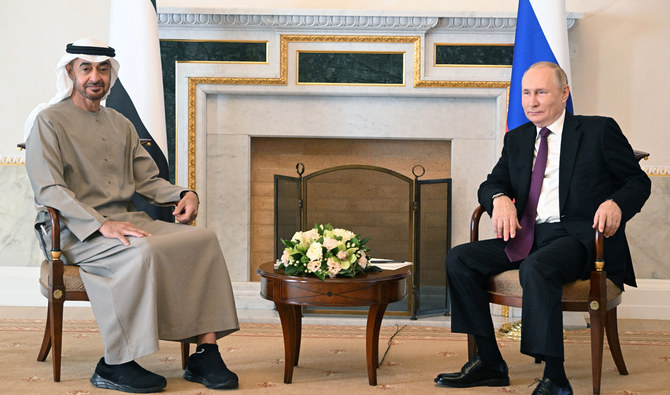
UAE president calls for ‘negotiation and diplomacy’ to end Ukraine war

Russian President Vladimir Putin meets with United Arab Emirates President Sheikh Mohamed bin Zayed Al-Nahyan in Saint Petersburg on October 11, 2022. (AFP)
Short Url
Updated 12 October 2022
Follow

UAE president calls for ‘negotiation and diplomacy’ to end Ukraine war

  • Sheikh Mohamed says his country is working to reduce tensions and find diplomatic solutions to crises
  • He called for the continuation of serious consultations to resolve the Ukraine crisis through dialogue

JEDDAH: The president of the UAE called on Tuesday for dialogue, negotiation and diplomacy among all parties to end the war in Ukraine.

On a visit to Russia for talks in St. Petersburg with President Vladimir Putin, Sheikh Mohammed bin Zayed Al-Nahyan said his country sought to contribute to strengthening the foundations of peace and stability in the world.

“We discussed several issues of mutual concern, including the Ukraine crisis, and the importance of engaging in dialogue to reduce tensions and arrive at a diplomatic solution,” Sheikh Mohammed said.

Anwar Gargash, diplomatic adviser to the president, said Sheikh Mohammed’s visit had been scheduled within the general framework of bilateral relations, but that the war in Ukraine required an urgent solution.

The two leaders also reviewed regional and international issues, including last week’s decision by OPEC+ — the oil producers’ alliance led by Saudi Arabia and Russia — to cut output by 2 million barrels a day from November.

The decision had been criticized by US President Joe Biden and other American politicians, but Putin denied on Tuesday that the alliance was acting against anyone else’s interests.

“Our actions are aimed at creating stability in the global energy markets, so that both consumers of energy resources and those involved in production, suppliers to the global markets, feel calm, stable and confident … so that supply and demand would be balanced.”

Elsewhere, Turkey on Tuesday called for a ceasefire in Ukraine just days ahead of a meeting between Putin and Turkish President Recep Tayyip Erdogan in Astana, Kazakhstan. Erdogan has a good working relationship with the Russian leader, despite disagreements on issues such as Syria, and also has good ties with Kyiv.

Turkey has stayed neutral throughout the conflict in Ukraine despite being a NATO member, but increasing Russian attacks on Ukrainian cities are further diminishing the chances for a diplomatic solution.

“Unfortunately both sides have quickly moved away from diplomacy,” Turkish Foreign Minister Mevlut Cavusoglu said on Tuesday. “The situation gets worse and more complicated. A ceasefire must be established as soon as possible, and the sooner the better.

“There must be a just peace for Ukraine. Where is the war going on? It’s going on on Ukrainian soil. A process that will ensure Ukraine’s border and territorial integrity should start. Without a ceasefire, it is not possible to talk about those issues in a healthy way: a viable ceasefire and a just peace.”

On the ground in Ukraine on Tuesday there was a second day of Russian missile strikes, although with less intensity than on Monday, when dozens of air raids killed 19 people, injured more than 100 and knocked out power supplies across the country.


Israel sees spike in PTSD and suicide among troops as war persists

Updated 3 sec ago
Follow

Israel sees spike in PTSD and suicide among troops as war persists

JERUSALEM: Israel is grappling with a dramatic increase in post-traumatic stress disorder and suicide among its troops after its two-year assault on Gaza, precipitated by the October 7, 2023, Hamas attack on southern Israel.
Recent reports by the Defense Ministry and by health providers have detailed the military’s mental health ​crisis, which comes as fighting persists in Gaza and Lebanon and as tensions flare with Iran.
The Gaza war quickly expanded with cross-border fire between Israel and Lebanon’s Hezbollah, and saw hundreds of thousands of soldiers and reservists deployed across both fronts in some of the heaviest fighting in the country’s history.
Israeli forces have killed more than 71,000 Palestinians in Gaza and 4,400 in southern Lebanon, according to Gazan and Lebanese officials, and Israel says more than 1,100 service members have been killed since October 7.
The war has left much of Gaza destroyed and its 2 million people overwhelmingly lack proper shelter, food or access to medical and health services.
Palestinian mental health specialists have said Gazans are suffering “a volcano” of psychological trauma, with large numbers now seeking treatment, and children suffering symptoms such as night terrors and an inability to focus.

PTSD CASES AMONG ISRAELI SOLDIERS UP 40 percent SINCE 2023
Israeli studies show the war has taken its toll on the mental health of soldiers carrying out Israel’s stated ‌war aims of eliminating ‌Hamas in Gaza, retrieving hostages there and disarming Hezbollah.
Some soldiers who came under attack when their military bases ‌were ⁠invaded by ​Hamas on ‌October 7 are also struggling.
Israel’s Defense Ministry says it has recorded a nearly 40 percent increase in PTSD cases among its soldiers since September 2023, and predicts the figure will increase by 180 percent by 2028. Of the 22,300 troops or personnel being treated for war wounds, 60 percent suffer from post-trauma, the ministry says.
It has expanded the health care provided to those dealing with mental health issues, expanded the budget, and said there was an increase of about 50 percent in the use of alternative treatments.
The country’s second-largest health care provider, Maccabi, said in its 2025 annual report that 39 percent of Israeli military personnel under its treatment had sought mental health support while 26 percent had voiced concerns about depression.
Several Israeli organizations like NGO HaGal Sheli, which uses surfing as a therapy technique, have taken on hundreds of soldiers and reservists suffering from PTSD. Some former soldiers have therapy dogs.

MORAL INJURY OVER DEATHS ⁠OF INNOCENTS
Ronen Sidi, a clinical psychologist who directs combat veteran research at Emek Medical Center in northern Israel, said soldiers were generally grappling with two different sources of trauma.
One source was related to “deep experiences of fear” and “being ‌afraid to die” while deployed in Gaza and Lebanon and even while at home in Israel. ‍Many witnessed the Hamas assault on southern Israel — in which the militants also ‍took around 250 hostages back into Gaza — and its aftermath firsthand.
Sidi said the second source is from moral injury, or the damage done to a person’s ‍conscience or moral compass from something they did.
“A lot of (soldiers’) split-second decisions are good decisions,” which they take under fire, “but some of them are not, and then women and children are injured and killed by accident, and living with the feeling that you have killed innocent people... is a very difficult feeling and you can’t correct what you have done,” he said.
One reservist, Paul, a 28-year-old father of three, said he had to leave his job as a project manager with a global firm because “the whistles of the bullets” above his head ​lingered with him even after returning home.
Paul, who declined to give his last name over privacy concerns, said he deployed in combat roles in Gaza, Lebanon and Syria. Although fighting has abated in recent months, he says he lives in a constant state of alert.
“I ⁠live that way every day,” Paul said.

UNTREATED TRAUMA
A soldier seeking state support for their mental health must appear before a defense ministry assessment committee which determines the severity of their case and grants them official recognition. That process can take months and can deter soldiers from seeking help, some trauma professionals say.
Israel’s Defense Ministry says it provides some immediate help to soldiers once they start the evaluation process and has increased this effort since the war began.
An Israeli parliamentary committee found in October that 279 soldiers had attempted suicide in the period from January 2024 to July 2025, a sharp increase from previous years. The report found that combat soldiers comprised 78 percent of all suicide cases in Israel in 2024.
The risk of suicide or self-harm increases if trauma is untreated, said Sidi, the clinical psychologist.
“After October 7 and the war, the mental health institutions in Israel are overwhelmed completely, and a lot of people either can’t get therapy or don’t even understand the distress that they are feeling has to do with what they have experienced.”
For soldiers, the chance of seeing combat remains high. Israel’s military remains deployed in over half of Gaza and fighting has persisted there despite a US-backed truce in October, with more than 440 Palestinians and three Israeli soldiers killed.
Its troops still occupy parts of southern Lebanon, as the Lebanese army presses on with disarming Hezbollah under a separate US-brokered ‌deal. In Syria, Israeli troops have occupied an expanded section of the country’s south since the ouster of former leader Bashar Assad.
As tensions flare with Iran and the US threatens to intervene, Israel could also find itself in another violent confrontation with Tehran, after last June’s 12-day war.