Celebrity-loved designer Jean-Louis Sabaji collaborates with Barbie at Arab Fashion Week

Model Ameni Esseibi walked the runway, fresh off a Paris Fashion Week appearance.. (Supplied)
Short Url
Updated 11 October 2022
Follow

Celebrity-loved designer Jean-Louis Sabaji collaborates with Barbie at Arab Fashion Week

DUBAI: Pink seems to be the fashion world’s color of choice this year. As Aerosmith’s lead singer Stephen Tyler once crooned, “Pink, it’s not even a question” — and it certainly was not at Lebanese designer Jean-Louis Sabaji’s Arab Fashion Week show on Monday night.

His much-anticipated collection in collaboration with Barbie was all anyone could talk about in the run-up to the event. After all, he is the first Middle Eastern designer to partner with Mattel, and that is quite an achievement.


“My first-ever fashion experience was with a Barbie doll, and as a child, I used to dress them. I still have the dresses I made for them. There were around five,” Sabaji told Arab News.

“I can’t believe that on the 10-year anniversary of my brand, I’m doing a collaboration with them. It’s like going back to my childhood dream,” added the designer, who has dressed celebrities such as Beyonce, Cardi B and Kelly Rowland.
The vibe was buzzing as prominent magazine editors from the region took their seats. Also in attendance was model Chanel Ayan and star of Bravo TV's "Real Housewives of Dubai" – a strong supporter of Sabaji's creations. 

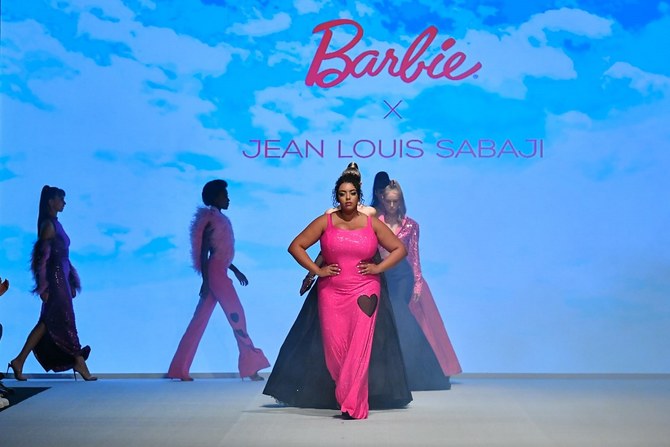
The runway presentation started with a bang, with curvy model Ameni Esseibi opening the show. In a tiered, black-feathered skirt with a shimmery bright pink top, she championed size inclusivity and did away with the notion that Barbie-inspired ensembles are only for traditional model body types. Sabaji’s lineup was inclusive, and it showed that his clothes are meant for every body.
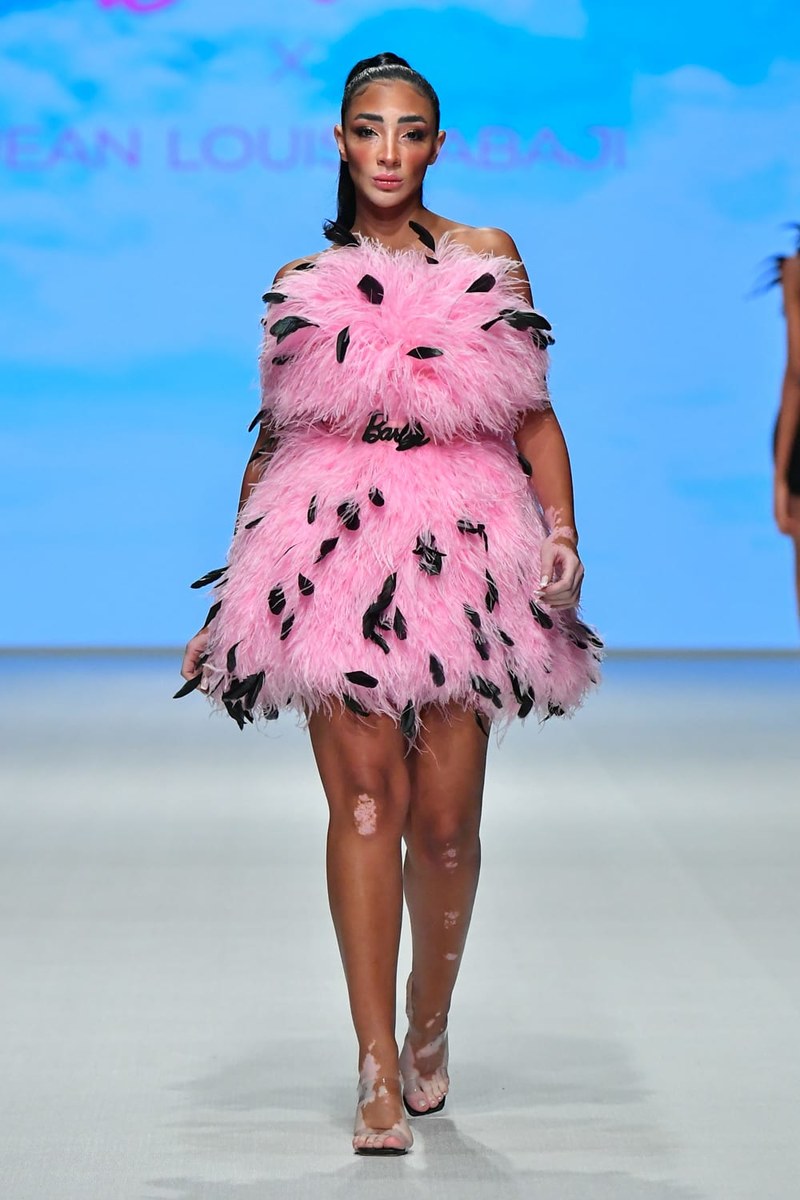
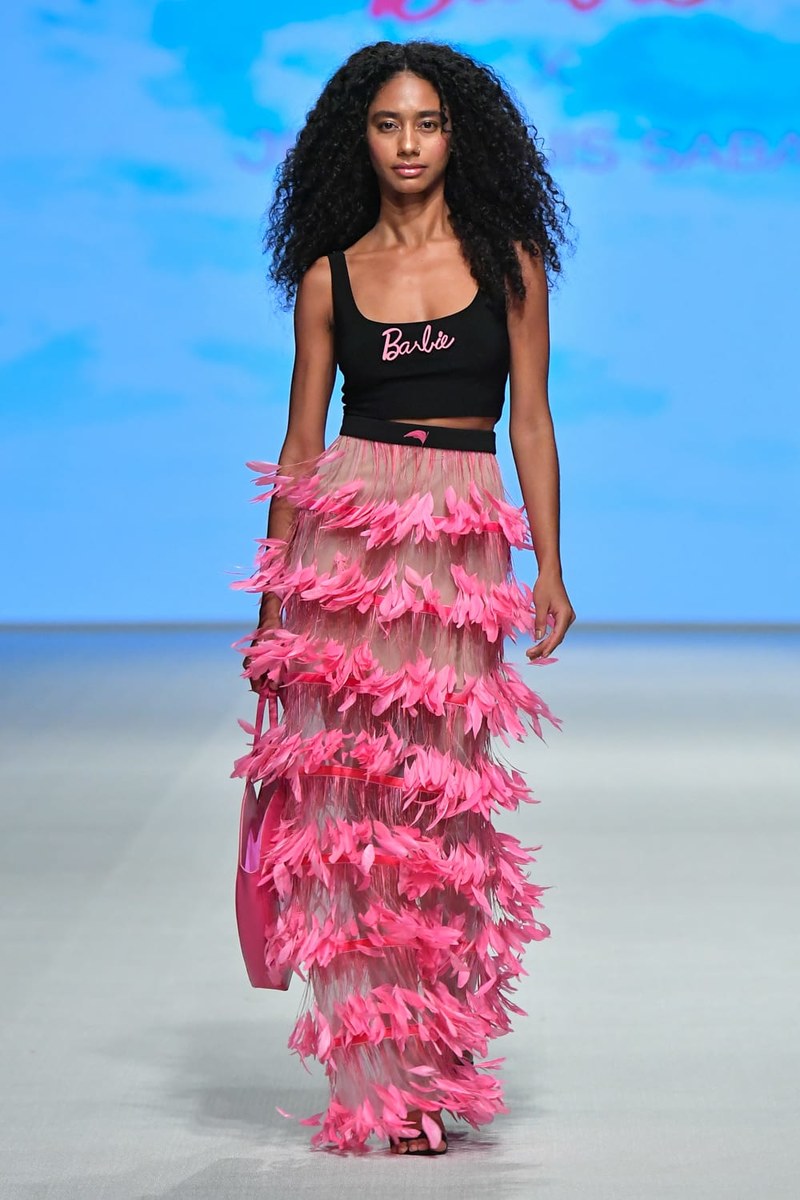
More feathers followed: some of the large and stiff variety, functioning as a conceptual sleeve; on others, the plumes were wispy. Case in point: a pink, oversized heart-shaped top exploding with ostrich feathers. Overall, the silhouettes were light and playful. Whimsical, heart-shaped cutouts were recurrent throughout the show. On a floor-length pink dress with power shoulders, they served as pocket detailing, while on a pair of tailored trousers, they ran down each side. There was definitely a sporty vibe here. How else does one explain the sheer varsity jacket or the stretchy bodysuit paired with a ballgown skirt complete with stretchy gloves?

Eveningwear came in full throttle, but none of it was restrictive. Sabaji wants his women to have fun, and so they did. One standout option was a buttery soft leather strapless gown with a slit on the back for movement and an embellished sculptural sleeve that stretched around the model’s neck.

No doubt this was a celebratory show for Sabaji. In just a decade in the business, the couturier has conquered not only the red carpet but also the world’s most iconic doll.


The difference between European and Gulf weddings — from a photographer’s point of view

Updated 4 sec ago
Follow

The difference between European and Gulf weddings — from a photographer’s point of view

DUBAI: From her early career in northeast France to working across the Gulf and Europe, wedding photographer Maddy Christina has observed many contrasts between such events in different parts of the world.

Her early years as a photographer were defined by variety; she worked across fashion, family portraits and weddings simultaneously before recognizing how wedding photography brings multiple genres together in a single day. 

Christina said weddings in the region required a shift in both perspective and technique. (Supplied)

“I actually fell into weddings by accident,” Christina told Arab News. “It blends every discipline at once — fashion for the couple session, sports for the reception, documentary work throughout the day, still life with details and jewelry.”

Christina’s connection to the Middle East began through Parisian clients who invited her to Dubai for a post-wedding session: “I instantly connected with the energy of the city,” she said.

Christina’s connection to the Middle East began through Parisian clients who invited her to Dubai for a post-wedding session. (Supplied)

A few years later, a wedding in Kuwait marked the start of her long-term relationship with the region.

Now working extensively across the Gulf Cooperation Council, Christina said weddings in the region required a shift in both perspective and technique.

For Christina, the most meaningful aspect extends beyond the wedding day itself. (Supplied)

“Working across the GCC has opened my mind in ways I didn’t expect,” she said, adding it felt like “resetting everything I thought I knew about weddings” — particularly compared to her experience in Europe.

She said there were clear distinctions between the two regions. “European weddings tend to be more demonstrative and expressive, while brides in the Gulf often place a deeper emphasis on tradition, family bonds and a sense of ceremony,” she said. “The emotional language is different, yet equally beautiful.”

From a technical standpoint, the contrast is just as pronounced: “In the south of France, I was used to shooting outdoors at sunset with couples already comfortable in front of the camera. Here, I often find myself in much smaller spaces, with no windows, artificial light and couples who may be more reserved.”

Christina is drawn to candid moments. (Supplied)

She added that adapting to these conditions pushed her to explore new ways of shaping light and expanded her creative approach.

While Christina is drawn to candid moments, like “guests laughing together, old friends reconnecting, a fleeting emotion passing across someone’s face,” posed pictures remain central to her work.

For Christina, the most meaningful aspect extends beyond the wedding day itself.

“It’s not the decor that makes a wedding unforgettable for me,” she said. “It’s the connection I build with the bride. That long-term bond is what feels truly magical.”